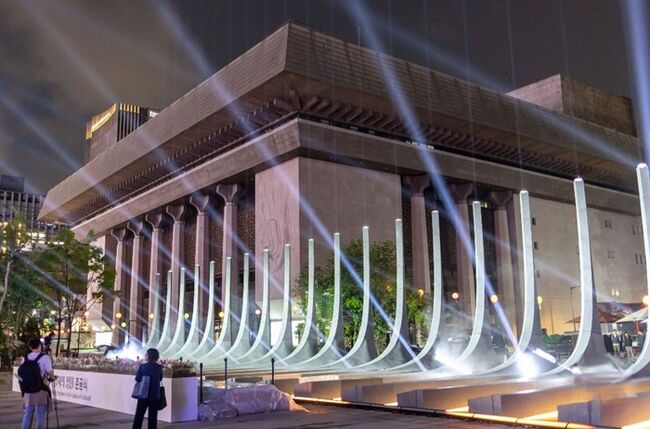
 Night view of the Garden of Gratitude [Photo: Yonhap News]
Gratitude, beyond mere politeness, bestows positive energy and freedom upon life.
On the 12th, a meaningful space was established in Gwanghwamun Square, a landmark of Seoul. It is the 'Garden of Gratitude,' dedicated to honoring those who sacrificed for the freedom and peace of Korea.
Thanking them for their dedication, which has brought Korea to its current state, regardless of political spectrum, is a human duty and an act that elevates ourselves.
23 Stone Pillars Erected at the Heart of Korea
Gwanghwamun Square, historically known as 'Yukjo Street' where key government offices of the Joseon Dynasty were concentrated and a main road for the public, remains a symbolic national space today. Establishing a space for gratitude in Gwanghwamun holds significance in conveying the values of freedom and peace not only to the citizens of Korea but also to tourists worldwide.
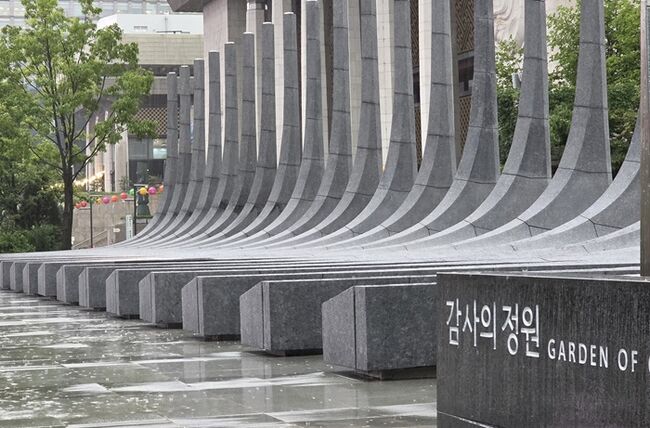
 Above ground section of the Garden of Gratitude. [Photo: Reporter Lim Yo-hee]The Garden of Gratitude is largely divided into two parts. The above-ground 'Light of Gratitude 23' is a symbolic sculptural space representing the 23 countries that participated in the Korean War, including South Korea. The underground 'Freedom Hall' is a media experience space.
'Light of Gratitude 23' consists of 23 sculptures, each 6.25 meters high, honoring the contributions of the 23 countries that fought in the Korean War. They are arranged in a north-south line, from the United States in the south to South Korea in the north, in chronological order of their participation, visually representing the history of solidarity.
Currently, stones donated by seven countries (Netherlands, India, Greece, Belgium, Luxembourg, Norway, and Germany) have been utilized in 'Light of Gratitude 23,' and stones from five countries (Sweden, Australia, the United States, Thailand, and Turkey) will also be incorporated by the end of this year.
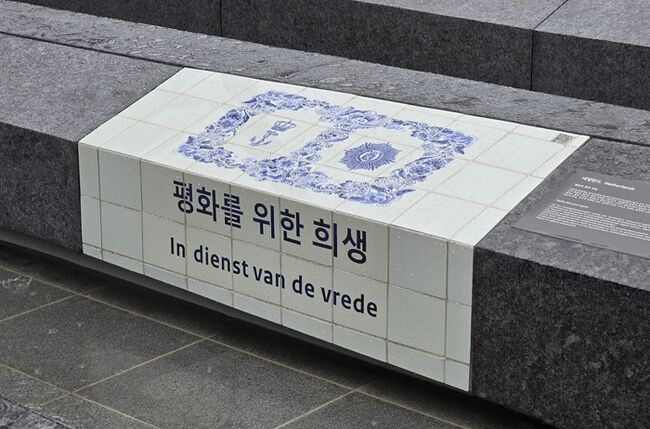
The Dutch sculpture features Delft Blue Tiles, a traditional Dutch ceramic art. The tiles are inscribed with the emblems of the Dutch Navy and Army who participated in the Korean War, adding to their significance. This can be seen as an endeavor that encompasses both culture and gratitude.
For the Indian sculpture, 'Rajasthan Red Sandstone,' which was used for the floor slabs of the Taj Mahal, has been employed. This sandstone is also widely used as exterior material for commemorative buildings in India.
The Norwegian sculpture uses Larvikite, a granite with white and silver particles mixed on a blue background, and the German sculpture incorporates concrete blocks from the Berlin Wall, carrying memories of division and the Cold War. All were donated to honor the friendship between the respective countries.
The Greek sculpture features Volakas marble, with a white background and gray patterns, and the Belgian sculpture includes Belgian Bluestone, with a black background and white spot patterns. The Luxembourg sculpture reflects Gilsdorf Sandstone, a mix of light yellow and beige. All of them serve to introduce their respective countries' nature and to honor the participating soldiers.
Every evening from 8 PM to 11 PM, a light show illuminates the night sky around Gwanghwamun, projected from the 23 sculptures. The light show runs for 10 minutes at 30-minute intervals, with six showings per day.
War Veterans Blooming Like Flowers
At the entrance to the underground Freedom Hall, the inscription "Freedom is not free" is displayed. This well-known phrase from the Korean War Veterans Memorial in Washington D.C. serves as a reminder of the high price paid for the freedom we take for granted.
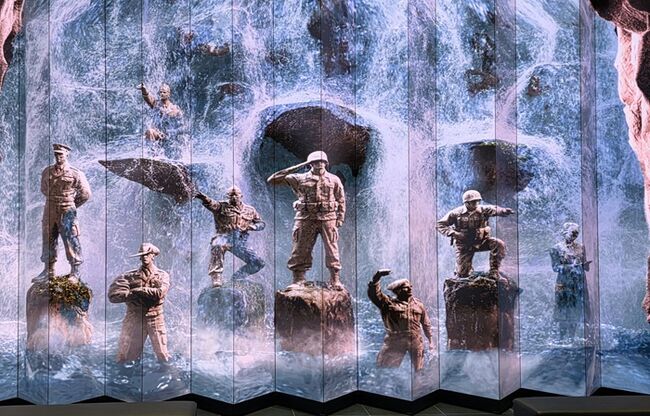
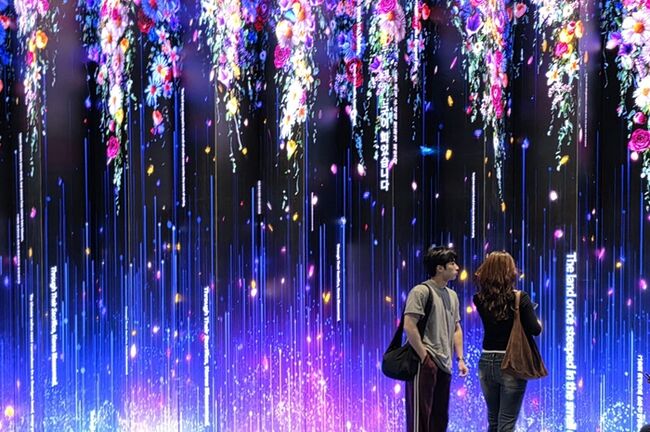 'Memorial Wall' decorating one side of Freedom Hall. [Photo: Reporter Lim Yo-hee]
Freedom Hall, built upon the dedication of war veterans, showcases Korea's transformation from a recipient of aid to a provider of aid through four media installations: the Memorial Wall, the Window of Connection, the Gratitude Archiving Wall, and the Stories We Won't Forget.
First, the 'Memorial Wall,' which covers an entire side of the hall, conveys the message that "Today's Korea has bloomed thanks to the sacrifices of war veterans," using the national flowers of the participating countries as its motif.
Twenty-three triangular LEDs, linked to the 23 above-ground sculptures, display petals of flowers symbolizing gratitude, sacrifice, hope, and prosperity from each country in a wave-like motion. The video concludes with a majestic scene of war veterans emerging from a waterfall and blooming into flowers.
The spherical 'Window of Connection' features interactive content that connects the past and present, Korea and the world. It includes the 'World Portal,' where real-time videos from New York's Times Square can be viewed, and 'Reviving Past,' where AI-restored photos from the Korean War can be seen.
'The Garden of Gratitude' is directly accessible from Exit 7 of Gwanghwamun Station on Subway Line 5. Visiting it alongside nearby historical sites like the National Museum of Korea, the Seoul Museum of History, Gyeongbokgung Palace, and the Sejong Center for the Performing Arts offers a deeper understanding of Seoul's history and culture.
Using the Seoul Public Service Reservation system, visitors can book guided tours of the Freedom Hall exhibition. Exhibition tours are available daily (closed on Mondays) from 10 AM to 7:20 PM (excluding the lunch break from 12:00 PM to 2:00 PM).
Reporter Lim Yo-hee

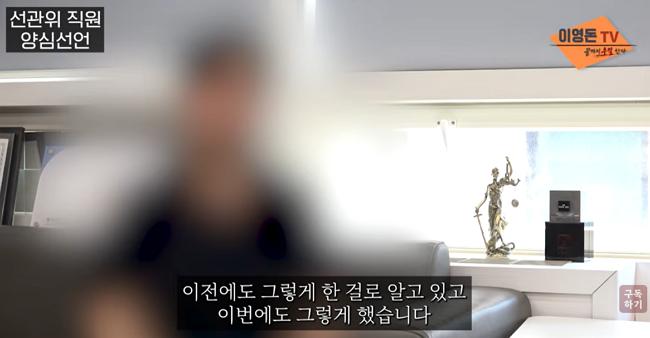 [Focus] Why did the dedicated communication network, checked three times, stop?... Three questions about the "Wi-Fi connection" for early voting
In the broadcast of Lee Young-don TV on the 16th, a current National Election Commission official exposes the reality of the 6.3 local elections based on direct experience. [Photo=Screenshot fr
[Focus] Why did the dedicated communication network, checked three times, stop?... Three questions about the "Wi-Fi connection" for early voting
In the broadcast of Lee Young-don TV on the 16th, a current National Election Commission official exposes the reality of the 6.3 local elections based on direct experience. [Photo=Screenshot fr
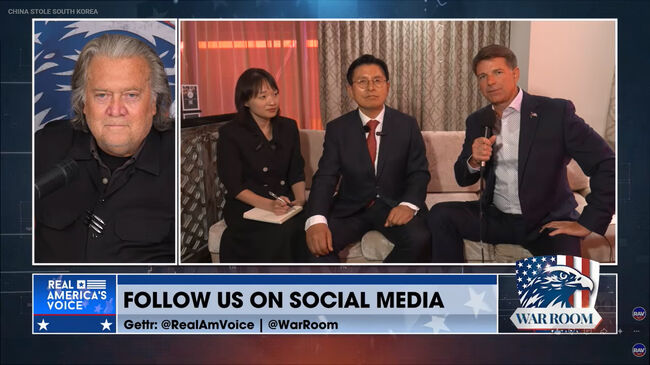 Hwang Kyo-ahn Urges President Trump's "Direct and Decisive Intervention"
Hwang Kyo-ahn, leader of the Liberty and Innovation Party, who is visiting the United States, appeared on Steve Bannon's podcast "War Room," known for its significant influence among the American cons
Hwang Kyo-ahn Urges President Trump's "Direct and Decisive Intervention"
Hwang Kyo-ahn, leader of the Liberty and Innovation Party, who is visiting the United States, appeared on Steve Bannon's podcast "War Room," known for its significant influence among the American cons
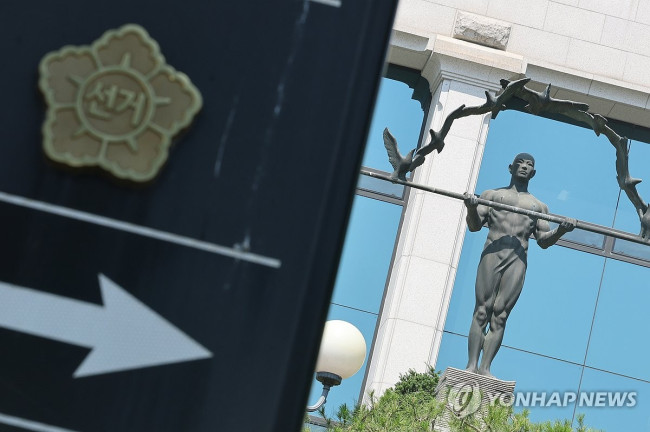 National Election Commission Special Committee for State Audit Officially Launched... State Audit Plan Adopted
  "Let's go to the special prosecutor!"... A mysterious 'three-year-old ballot' found in the ballot box
Past ballots were discovered belatedly during the vote counting and tabulation process of the 21st presidential election last year. [Photo=Yonhap News]Past ballots used in previous elections were conf
"Let's go to the special prosecutor!"... A mysterious 'three-year-old ballot' found in the ballot box
Past ballots were discovered belatedly during the vote counting and tabulation process of the 21st presidential election last year. [Photo=Yonhap News]Past ballots used in previous elections were conf
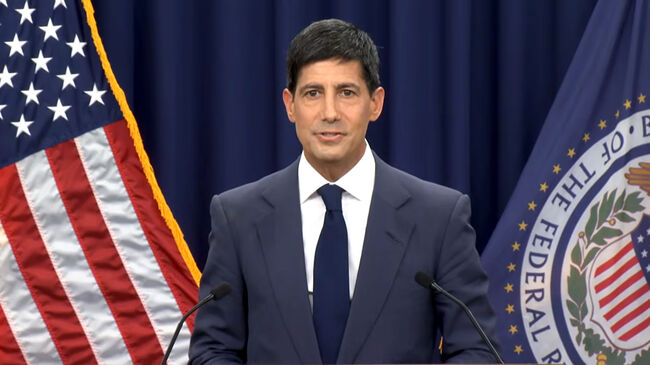 Wash: Fed committed to maintaining 2% inflation target
Federal Reserve (Fed) Chair Jerome Powell stated on Wednesday that the central bank is unanimously committed to bringing inflation down to its 2% target.In his first press conference since taking offi
Wash: Fed committed to maintaining 2% inflation target
Federal Reserve (Fed) Chair Jerome Powell stated on Wednesday that the central bank is unanimously committed to bringing inflation down to its 2% target.In his first press conference since taking offi
 [Photo] Current status of Chairman Hwang Kyo-ahn and lawyer Park Joo-hyun attending the US election fraud fighter summit
Lawyer Park Joo-hyun with lawyer Peter Ticktin, who was pardoned by U.S. President Donald Trump. [Facebook]Hwang Kyo-ahn, leader of the Liberty and Innovation Party (second from left), informing about
[Photo] Current status of Chairman Hwang Kyo-ahn and lawyer Park Joo-hyun attending the US election fraud fighter summit
Lawyer Park Joo-hyun with lawyer Peter Ticktin, who was pardoned by U.S. President Donald Trump. [Facebook]Hwang Kyo-ahn, leader of the Liberty and Innovation Party (second from left), informing about
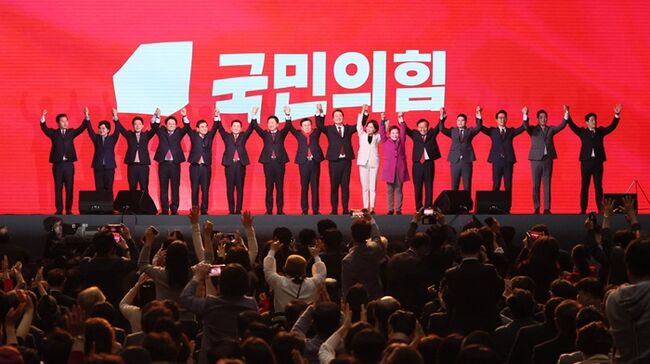 [Kim Taesan Column] I See People Power Politicians Worse Than X
[Photo = Yonhap News]There is a Korean proverb: "Even a dog remembers the kindness of those who raise it." It means to be wary of those who are ungrateful. If a human betrays the person who raised the
[Kim Taesan Column] I See People Power Politicians Worse Than X
[Photo = Yonhap News]There is a Korean proverb: "Even a dog remembers the kindness of those who raise it." It means to be wary of those who are ungrateful. If a human betrays the person who raised the
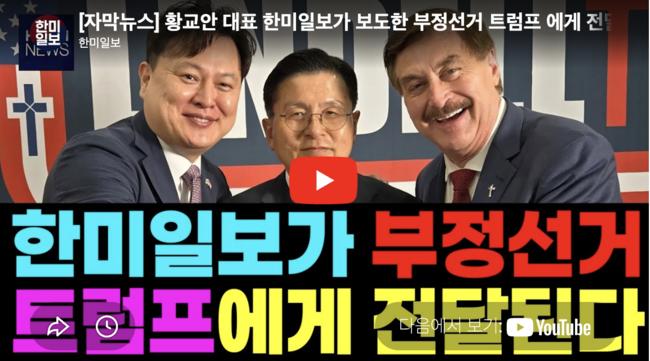 [Video] 'Trump's close friend' Lindell "I will inform Trump about South Korea's fraudulent election"
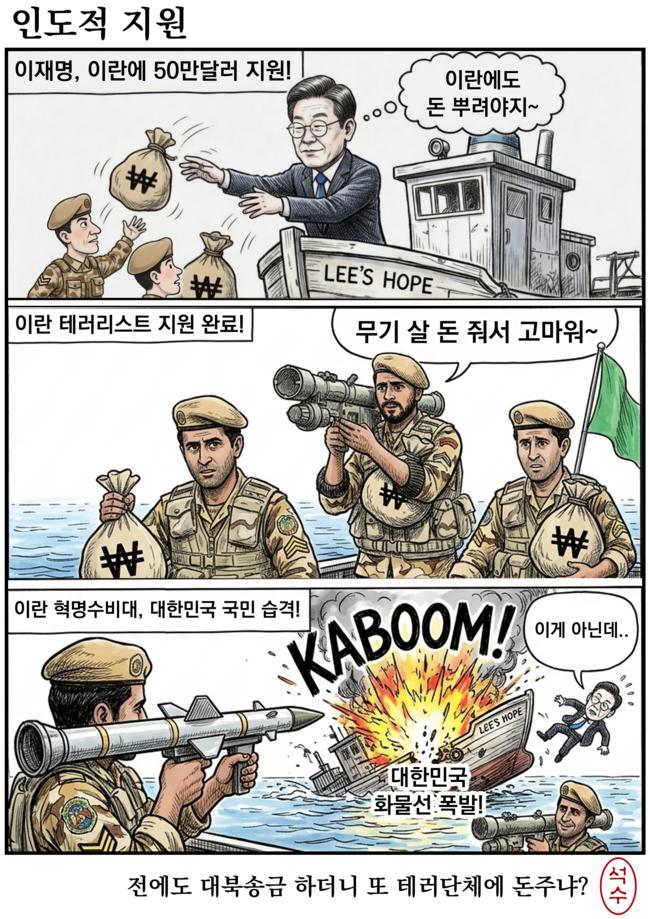 [Editorial Cartoon] Humanitarian Aid

 List
List