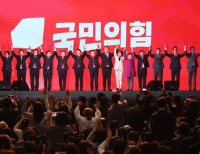
Cadets salute during the graduation and commissioning ceremony of the Korea Military Academy. [Photo=Yonhap News]
Recent controversies surrounding the potential merger of military academies and the relocation of the Korea Military Academy have drawn significant attention from the political sphere, raising deep concerns within the security community.
From the alumni association of the Korea Military Academy, retired generals, former chiefs of staff and academy superintendents, to numerous civilians concerned about national security, they are all speaking with one voice, warning of the "annihilation of the identity of military academy education" and continuing a heartfelt struggle.
Since the current administration took office, the politicization of national defense policy has been shaking the very foundations of our military's professionalism. The confusion in the military's counterintelligence functions following the restructuring of the Defense Security Command, the unreasonable reorganization of military branches, suspicions of political favoritism in general appointments handled by civil servants, the use of the Chinese term 'Resist America, Aid Korea' in the Korean War exhibition at the War Memorial, and the sophistry of the Ministry of National Defense spokesperson's replies all serve as evidence of the military's crisis-ridden reality.
This behavior, driven by political objectives rather than military feasibility, has reduced security assets such as the relocation of the Korea Military Academy and the merger of military academies into mere political spoils of war. As cases that deny the military's identity and impose external logic accumulate, our military's command structure and professionalism will suffer irreparable internal damage.
National security is not an experimental ground for any administration. The series of attempts to re-sculpt military professionalism through political logic is a tyrannical act that destroys the military's inherent functions and a dangerously risky political maneuver that uses security as a bargaining chip for the administration's achievements and to secure regional votes.
1. The Fiction of 'Efficiency' and 'Jointness': Astronomical Costs and Destruction of Professionalism
Proponents of merging military academies advocate for 'budget savings' and 'enhanced jointness' as their justifications. However, this is a shortsighted idea that pursues minor administrative convenience at the cost of national disaster and a treasonous act disguised by political intent.
∆ The Fiction of 'Budget Savings'
The complete dismantling of the unique educational facilities, training grounds, faculty, and research infrastructure of each military academy, established over 80 years, and the construction of a new integrated campus will incur unimaginable construction costs and administrative sunk costs. This is an act of pouring water into a leaky pot, disguised as 'efficiency,' which drains national finances, and a political rampage that shakes the very foundation of the military.
∆ A Fatal Misunderstanding of 'Jointness'
Jointness, the core of future warfare, is like an orchestra where harmony is achieved when each branch's specialized expertise is highly developed. The idea of abolishing all violins, cellos, and flutes and unifying them into one all-purpose instrument will only produce an unrecognizable noise, not a beautiful harmony.
The attempt to forcibly tie the unique roots of the Army, Navy, and Air Force into one tree will only result in the training of 'soldiers of indeterminate identity' who cannot perform to their full potential in any theater of war, whether on land, at sea, or in the air.
2. History Proves the Value of Military Branch Uniqueness and the Cost of Security Destruction
The three military academies are not merely degree-granting institutions but cradles for nurturing officers who inherit the spirit and disposition suited to the specificities of the battlefield. Let us examine the dire consequences of politically driven military branch integration.
∆ The Tragic History of the Canadian Forces (1968)
In the late 1960s, Canadian Minister of National Defence Paul Hellyer, driven by budget savings and administrative efficiency, forcibly integrated the Army, Navy, and Air Force into a single organization called the 'Canadian Forces.' The unique uniforms of each branch were abolished and unified into a single green uniform, and even the military education system was bundled together.
The results were disastrous. The unique professionalism and pride of each branch evaporated, and the morale of junior officers plummeted. Numerous veteran commanders left the organization. Ultimately, Canada had to bear astronomical social costs, only returning to a separate Army, Navy, and Air Force system in 2011, 43 years later.
∆ Lessons from the Imjin War
The consequences of shaking the military with political interests, disregarding the essence of the battlefield, have always been tragic. During the Imjin War, King Seonjo and his court's rash actions, attempting to control Admiral Yi Sun-sin's navy, which had undergone specialized training and perfectly understood the specifics of naval warfare, with political jealousy and central government logic, ultimately led to the national catastrophe of the great defeat at the Battle of Chilcheollyang.
Military academies cannot be subjected to a rush for political achievements within a presidential term. The education of cadets, who will be responsible for national security a generation from now, requires utmost prudence.
3. The Military's Reality Sacrificed for Regional Balanced Development Theory
The moment the military is treated as an object for physical merger and balanced development, and such efforts are pursued, the essence of defense reform disappears, leaving only a grand political power struggle and crude vote-grabbing.
We have already witnessed numerous instances where left-leaning administrations have used national defense strongholds and large-scale military facilities as political bargaining chips. In the past, when the relocation of major military bases or defense educational facilities was pushed forward not based on military feasibility but on political rhetoric like 'regional balanced development' or 'appeasing local electorates,' the military experienced extreme confusion.
Mud-slinging battles ensued for years during the site selection process, and the energy that the military should have devoted to operations and education was consumed in resolving conflicts with local residents and authorities.
It is evident that the merger of military academies will inevitably lead to political parties and local governments holding the security hostage in a struggle for vested interests, disregarding the historical foundation and infrastructure built by the Korea Military Academy over 80 years and the preservation of its world-class architecture, simply to decide "which region will host the new integrated school."
The moment the core objective of nurturing elite officers is ignored and it devolves into a 'regional vote-trading card' for the next general election and presidential election, South Korea's national security will be shaken to its core. This is the most dangerous gamble, undertaken at the expense of national security.
4. What is Needed Now is 'Reform,' Not 'Destruction'
True reform lies not in demolishing and rebuilding the systematically operating three military academies, but in the 'innovation of software' that intricately connects them while preserving their professionalism.
Flexible integration methods, such as inter-cadet exchange programs or joint research in advanced science and technology fields, are readily available. Military diversity is not inefficiency; it is the most powerful weapon for responding to an unpredictable future battlefield.
Political leaders must remember that when politicians ignorant of national security intervene in matters of security, the price is always paid by the sacrifice of the people. The reckless discussion of mergers that shake the hundred-year plan for national security and repeat historical failures must come to an end. The three military academies are bastions protecting the nation's future, not political experimental grounds.
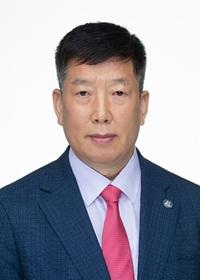
◆ Park Pil-gyu
Editorial Board Member, Hanmi Ilbo
40th Graduating Class, Korea Military Academy

 [Focus] Why did the dedicated communication network, checked three times, stop?... Three questions about the "Wi-Fi connection" for early voting
In the broadcast of Lee Young-don TV on the 16th, a current National Election Commission official exposes the reality of the 6.3 local elections based on direct experience. [Photo=Screenshot fr
[Focus] Why did the dedicated communication network, checked three times, stop?... Three questions about the "Wi-Fi connection" for early voting
In the broadcast of Lee Young-don TV on the 16th, a current National Election Commission official exposes the reality of the 6.3 local elections based on direct experience. [Photo=Screenshot fr
 Hwang Kyo-ahn Urges President Trump's "Direct and Decisive Intervention"
Hwang Kyo-ahn, leader of the Liberty and Innovation Party, who is visiting the United States, appeared on Steve Bannon's podcast "War Room," known for its significant influence among the American cons
Hwang Kyo-ahn Urges President Trump's "Direct and Decisive Intervention"
Hwang Kyo-ahn, leader of the Liberty and Innovation Party, who is visiting the United States, appeared on Steve Bannon's podcast "War Room," known for its significant influence among the American cons
 National Election Commission Special Committee for State Audit Officially Launched... State Audit Plan Adopted
  "Let's go to the special prosecutor!"... A mysterious 'three-year-old ballot' found in the ballot box
Past ballots were discovered belatedly during the vote counting and tabulation process of the 21st presidential election last year. [Photo=Yonhap News]Past ballots used in previous elections were conf
"Let's go to the special prosecutor!"... A mysterious 'three-year-old ballot' found in the ballot box
Past ballots were discovered belatedly during the vote counting and tabulation process of the 21st presidential election last year. [Photo=Yonhap News]Past ballots used in previous elections were conf
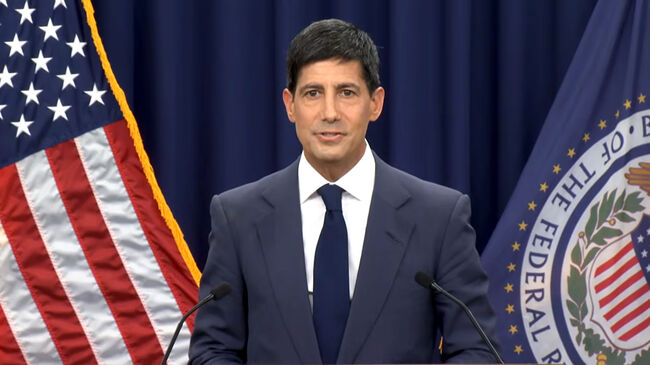 Wash: Fed committed to maintaining 2% inflation target
Federal Reserve (Fed) Chair Jerome Powell stated on Wednesday that the central bank is unanimously committed to bringing inflation down to its 2% target.In his first press conference since taking offi
Wash: Fed committed to maintaining 2% inflation target
Federal Reserve (Fed) Chair Jerome Powell stated on Wednesday that the central bank is unanimously committed to bringing inflation down to its 2% target.In his first press conference since taking offi
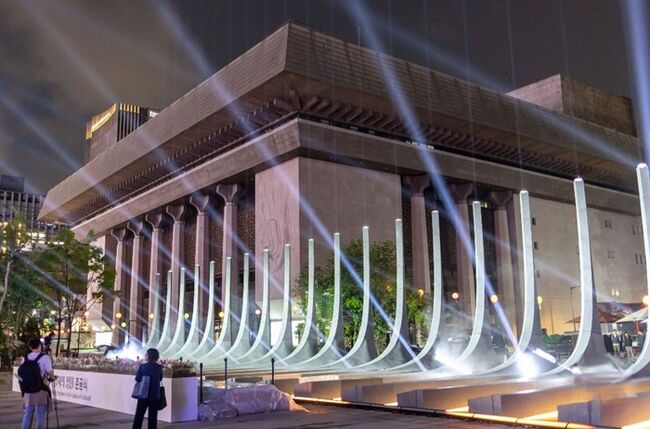 [Patriotism Month Travel Destinations] ② "Freedom is not free"... Gwanghwamun Square 'Garden of Gratitude'
Night view of the Garden of Gratitude [Photo: Yonhap News]Gratitude, beyond mere politeness, bestows positive energy and freedom upon life. On the 12th, a meaningful space was established in Gwan
[Patriotism Month Travel Destinations] ② "Freedom is not free"... Gwanghwamun Square 'Garden of Gratitude'
Night view of the Garden of Gratitude [Photo: Yonhap News]Gratitude, beyond mere politeness, bestows positive energy and freedom upon life. On the 12th, a meaningful space was established in Gwan
 [Photo] Current status of Chairman Hwang Kyo-ahn and lawyer Park Joo-hyun attending the US election fraud fighter summit
Lawyer Park Joo-hyun with lawyer Peter Ticktin, who was pardoned by U.S. President Donald Trump. [Facebook]Hwang Kyo-ahn, leader of the Liberty and Innovation Party (second from left), informing about
[Photo] Current status of Chairman Hwang Kyo-ahn and lawyer Park Joo-hyun attending the US election fraud fighter summit
Lawyer Park Joo-hyun with lawyer Peter Ticktin, who was pardoned by U.S. President Donald Trump. [Facebook]Hwang Kyo-ahn, leader of the Liberty and Innovation Party (second from left), informing about
 [Kim Taesan Column] I See People Power Politicians Worse Than X
[Photo = Yonhap News]There is a Korean proverb: "Even a dog remembers the kindness of those who raise it." It means to be wary of those who are ungrateful. If a human betrays the person who raised the
[Kim Taesan Column] I See People Power Politicians Worse Than X
[Photo = Yonhap News]There is a Korean proverb: "Even a dog remembers the kindness of those who raise it." It means to be wary of those who are ungrateful. If a human betrays the person who raised the
 [Video] 'Trump's close friend' Lindell "I will inform Trump about South Korea's fraudulent election"
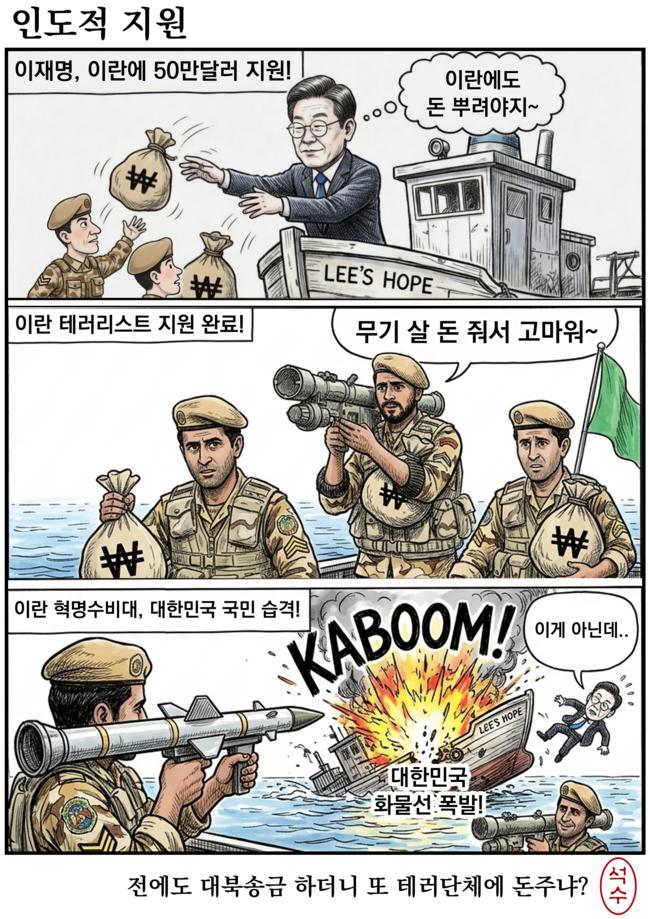 [Editorial Cartoon] Humanitarian Aid

 List
List