'Infringement of National Political Participation Rights' National Election Commission Ahead of National Assembly's Institutional Report [Gwacheon=Yonhap News]
A court has overturned disciplinary action taken against an employee of the National Election Commission (NEC), who had received a reprimand due to hiring irregularities revealed by an audit by the Board of Audit and Inspection (BAI).
The court's decision was based on the fact that the NEC, despite being an independent constitutional body and having its claim for a dispute over the BAI's audit authority accepted by the Constitutional Court, proceeded to impose disciplinary action relying solely on the BAI's findings without conducting its own investigation.
According to legal sources on the 22nd, the Seoul Administrative Court's Division 3 for Administrative Affairs (Presiding Judge Ho Sung-ho) ruled in favor of the plaintiff on the 22nd of last month in a lawsuit filed by NEC employee A against the Secretary-General of the NEC to nullify the reprimand.
The BAI launched an audit of the NEC in September 2023 after media reports raised suspicions of preferential hiring of children of high-ranking NEC officials.
Subsequently, on February 25th of last year, the final audit results revealed that in the 2021 competitive recruitment process, employee A had unlawfully hired two candidates who did not meet the eligibility criteria, applying regulations different from those stated in the job announcement.
The BAI requested that the NEC take disciplinary action of at least a minor disciplinary offense against employee A.
In response, the NEC deliberated on A's disciplinary action in March of the same year and issued a reprimand in April.
However, A filed an administrative lawsuit, arguing that the disciplinary action was decided in March 2025, which exceeded the three-year statute of limitations for a matter that occurred in October 2021.
Under the State Public Officials Act, the statute of limitations for disciplinary action against public officials is three years for offenses other than sexual offenses. However, the statute of limitations is suspended if the BAI issues a notice of commencement of investigation.
The court ruled that in this case, the BAI's audit itself was unlawful, and therefore the notice of commencement of investigation could not be considered a cause for suspension of the statute of limitations.
The court cited the fact that the NEC had filed a dispute over authority with the Constitutional Court questioning the BAI's audit, and the Constitutional Court accepted it on February 27th of last year, two days after the BAI's final announcement.
At that time, the Constitutional Court ruled that "the NEC has the authority to independently perform various duties, including personnel matters related to election affairs, without undue interference from external bodies such as the executive branch," and "the BAI cannot be considered to have been granted the authority for supervisory audits of the NEC."
Based on this, the court pointed out, "The Constitutional Court clearly stated that the authority for supervisory audits of the NEC is not recognized."
It further stated, "This audit cannot be considered an audit based on legitimate authority granted by the Constitution and laws, and therefore the notice of commencement of investigation cannot be considered to have the effect of prohibiting the continuation of disciplinary proceedings."
Based on this, the court determined that the three-year statute of limitations for disciplinary action against A had already expired.
The court explained, "The NEC had originally planned to conduct its own special audit regarding allegations of corruption, such as preferential hiring, but by agreeing to accept the audit, it did not proceed with separate audit or disciplinary procedures. Regarding employee A, no disciplinary proceedings were initiated until the BAI's final audit results were announced and disciplinary action was requested on February 25, 2025."
The court did not accept the NEC's argument of a "legal impediment," suggesting that it was uncertain whether the audit constituted the BAI's supervisory audit until the Constitutional Court's decision.
The court pointed out, "The BAI's notice of commencement of investigation does not have the effect of prohibiting the NEC's own disciplinary action and therefore cannot be considered a legal impediment."
It added, "Given that the NEC stated its intention to accept the BAI's audit in 2023, it would have been practically difficult to proceed with its own disciplinary procedures for employee A despite the notice of commencement of investigation. However, there is no justifiable reason that warrants the exclusion of the disciplinary statute of limitations (3 years), which is stipulated to ensure the stability of public officials' duties and status."
The NEC has appealed the ruling, and the case is currently pending before the Seoul High Court.

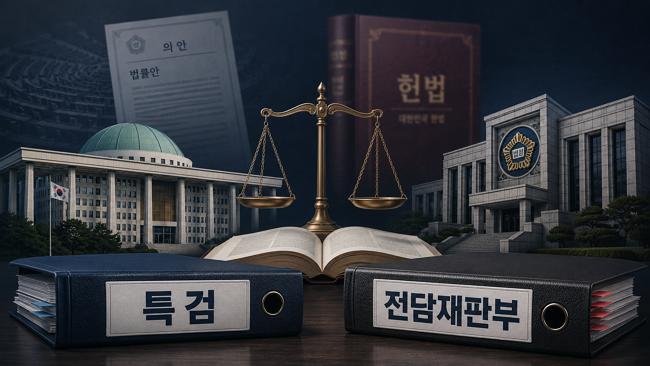 [Special Feature - Disenfranchisement National Assembly Investigation ③] Constitutional Amendment is a Long-term Task, the Law on the Special Court for Insurrection Should Be Applied
Image symbolizing the need for a special prosecutor and dedicated court panels within the existing judicial system to investigate the criminal responsibility for the June 3rd disenfranchisement incide
[Special Feature - Disenfranchisement National Assembly Investigation ③] Constitutional Amendment is a Long-term Task, the Law on the Special Court for Insurrection Should Be Applied
Image symbolizing the need for a special prosecutor and dedicated court panels within the existing judicial system to investigate the criminal responsibility for the June 3rd disenfranchisement incide
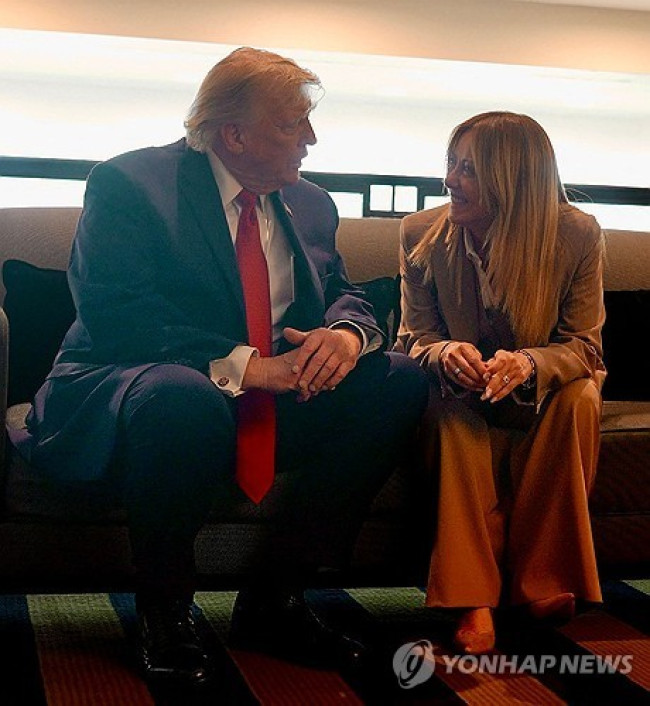 Trump to Italian Prime Minister amid conflict, "We protected you, but you turned away"
U.S. President Donald Trump and Italian Prime Minister Giorgia Meloni converse at the G7 Summit. [AFP=Yonhap News]U.S. President Donald Trump continued his criticism of Italian Prime Minister Gi
Trump to Italian Prime Minister amid conflict, "We protected you, but you turned away"
U.S. President Donald Trump and Italian Prime Minister Giorgia Meloni converse at the G7 Summit. [AFP=Yonhap News]U.S. President Donald Trump continued his criticism of Italian Prime Minister Gi
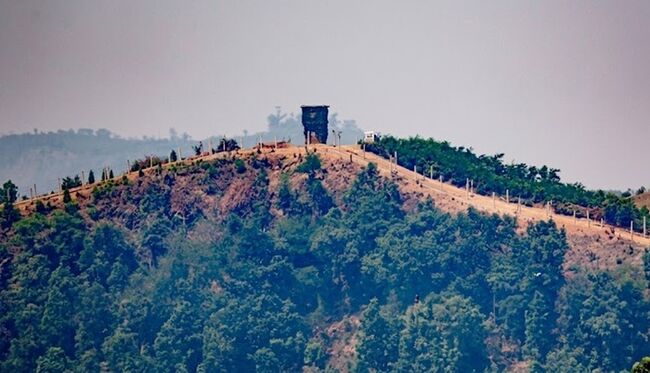 North Korea lays barbed wire and landmines right up to the MDL... JCS "Clear violation of the Armistice Agreement"
A structure believed to be a fence is installed at a North Korean guard post in Kaepung County, viewed from the border area in Paju, Gyeonggi Province. Photographed on the 19th. [Photo=Yonhap News]Nor
North Korea lays barbed wire and landmines right up to the MDL... JCS "Clear violation of the Armistice Agreement"
A structure believed to be a fence is installed at a North Korean guard post in Kaepung County, viewed from the border area in Paju, Gyeonggi Province. Photographed on the 19th. [Photo=Yonhap News]Nor
 [Analysis] "Identity Verification Devices" as seen in the Daegu Case... Concerns of Voting Rights Infringement "Become Reality"
Identity verification device installed at a prior voting station. [Photo=Yonhap News] The First Gateway to Guaranteeing Voting Rights Has Been Breached The core issue of the prior voting ide
[Analysis] "Identity Verification Devices" as seen in the Daegu Case... Concerns of Voting Rights Infringement "Become Reality"
Identity verification device installed at a prior voting station. [Photo=Yonhap News] The First Gateway to Guaranteeing Voting Rights Has Been Breached The core issue of the prior voting ide
 [HANMI DATA LAB] June Week 3 (15-19) Money Insight
The left side of the screen contrasts growth assets such as AI, semiconductors, automobiles, and industrial equipment, while the right side displays defensive assets like the Federal Reserve, banks, a
[HANMI DATA LAB] June Week 3 (15-19) Money Insight
The left side of the screen contrasts growth assets such as AI, semiconductors, automobiles, and industrial equipment, while the right side displays defensive assets like the Federal Reserve, banks, a
 Democracy Threatens Ruin and Despair... Writer Kim Gyu-na's 'A World Like a Novel' Episode 308
José Saramago's novel "The City of the Blinding"Recently, author Kim Kyu-na introduced a novel perfectly suited to the current political climate on the 308th episode of "A World Like a Novel." K
Democracy Threatens Ruin and Despair... Writer Kim Gyu-na's 'A World Like a Novel' Episode 308
José Saramago's novel "The City of the Blinding"Recently, author Kim Kyu-na introduced a novel perfectly suited to the current political climate on the 308th episode of "A World Like a Novel." K
 [Photo] Freedom High School Alliance installs banner in Gangdong-gu, Seoul: "June 3rd Fraudulent Election Rerun, In-person Voting, On-site Counting"
The Korea High School Union installed a banner in the Gangdong-gu district of Seoul on the 21st with the slogan "June 3rd Fraudulent Election Re-election, Same-Day Vote Count." The banner also states,
[Photo] Freedom High School Alliance installs banner in Gangdong-gu, Seoul: "June 3rd Fraudulent Election Rerun, In-person Voting, On-site Counting"
The Korea High School Union installed a banner in the Gangdong-gu district of Seoul on the 21st with the slogan "June 3rd Fraudulent Election Re-election, Same-Day Vote Count." The banner also states,
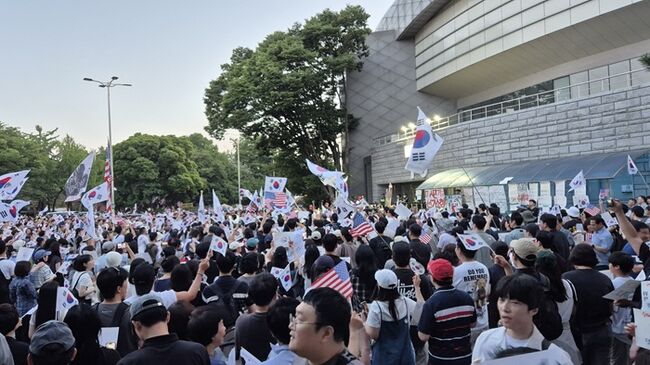 [Dume Poet Column] The Second Han River Miracle That Opened the Floodgates
20s and 30s youth defending the site of alleged election fraud for 20 days, shouting for a rerun and same-day ballot counting! ⒸHanmi IlboIn 1960, the March 15th fraudulent election occurred, leadin
[Dume Poet Column] The Second Han River Miracle That Opened the Floodgates
20s and 30s youth defending the site of alleged election fraud for 20 days, shouting for a rerun and same-day ballot counting! ⒸHanmi IlboIn 1960, the March 15th fraudulent election occurred, leadin
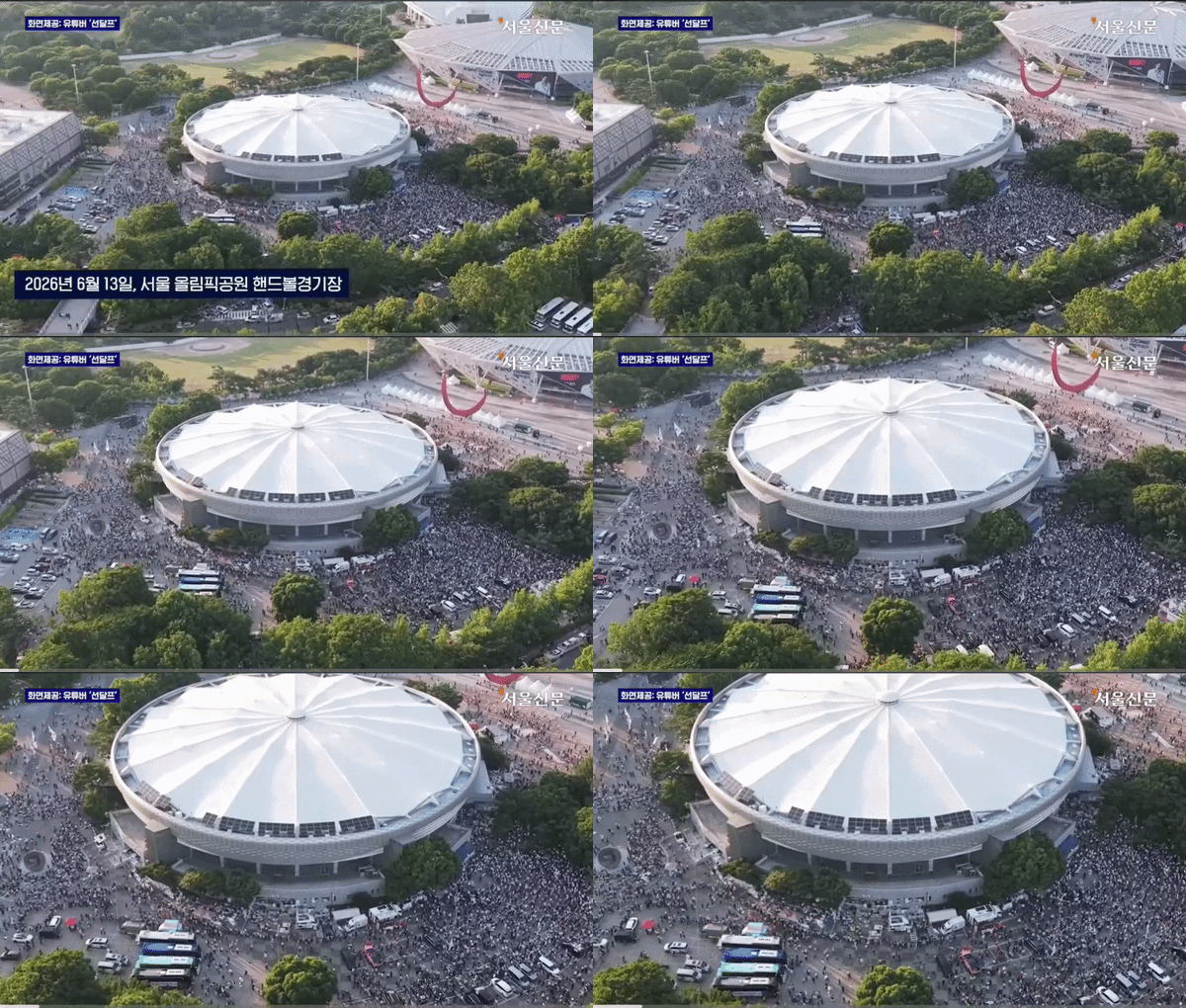 [Video] The Scene of the 'Jamsil Democratization Movement' as Seen from the Sky
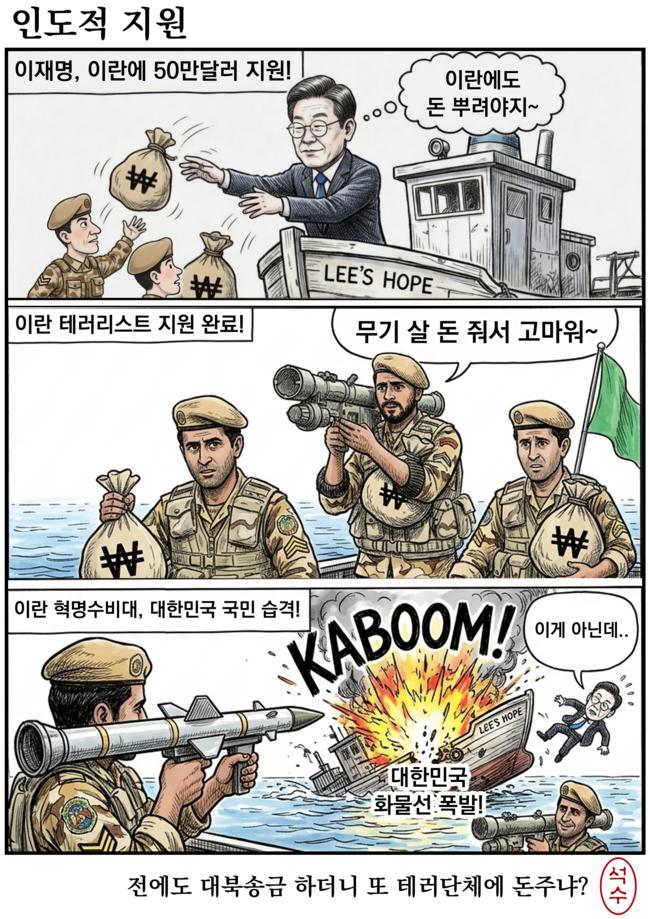 [Editorial Cartoon] Humanitarian Aid

 List
List