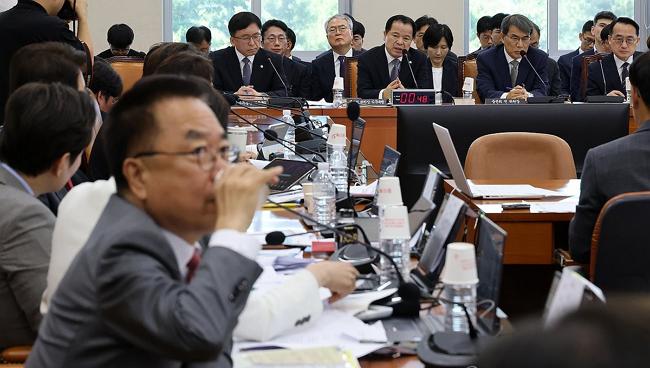
 Acting Chairman of the National Election Commission, Wi Cheol-hwan, answers questions from lawmakers during a plenary session of the special committee for a parliamentary inquiry into the truth behind the infringement of the people's right to participate in politics, including the ballot paper shortage incident, and the reform of election management, held at the National Assembly on the 23rd. From left: Acting Secretary-General Kang Dong-wan, Acting NEC Chairman Wi Cheol-hwan, former NEC Chairman Noh Tae-ak, and former Secretary-General Heo Cheol-hoon. [Photo=Yonhap News]
The reason why the first meeting of the special committee for a parliamentary inquiry into the infringement of the right to participate in politics received a failing grade is clear. While the parliamentary inquiry has begun, it has been pointed out that the investigation into the truth behind the infringement of the right to participate in politics has not progressed even one step.
There are five main reasons why the first meeting received a failing grade: limitations in the naming, controversy over the chairman's credibility, the NEC's defensive stance, controversies over witnesses and document submission, and the structural limitations revealed by the differing views of the ruling and opposition parties and the limited schedule.
A Parliamentary Inquiry That Lost Trust from the Start Due to Its Name
The first problem is the name. While the official name of this parliamentary inquiry includes "investigation into the truth behind the infringement of the people's right to participate in politics," the core issue of "election fraud" is omitted. If people went to the polling stations and there were no ballot papers, if voting was suspended at some polling stations, and if there were even suggestions within the NEC to halt the vote count, this is not a simple ballot paper shortage incident but a matter that requires investigating whether election fraud occurred.
Of course, there might have been opposition from the ruling party. However, the name of a parliamentary inquiry is not just a label. It is the first sentence that determines what will be investigated, what kind of incident it will be considered, and to what extent responsibility will be assigned.
The moment the "election fraud" issue, which is the essence of the problem, was omitted from the official name, the parliamentary inquiry is unavoidable from criticism for putting the first button of trust in the wrong place from the start.
Political Distrust Surrounding the Chairman's Appointment
The second issue is the chairman. While the appointment of Representative Yoon Sang-hyun as the special committee chairman may be a procedural decision, the position, which requires thoroughly investigating the suspicions of disenfranchisement, demands not only procedural neutrality but also political trust.
The appointment of Chairman Yoon has not resolved the political distrust that has been raised within conservative supporters. If voters who perceive this situation as an election fraud issue doubt the chairman's will and the possibility of a thorough investigation, the parliamentary inquiry will inevitably bear the cost of distrust from the outset.
For the special committee for a parliamentary inquiry into the infringement of the right to participate in politics to become a forum for resolving public suspicion, rather than just a procedural body within the National Assembly, it should have secured strong trust from the chairman's system.
NEC's Answers Prioritized Defense Over Responsibility
The third issue is the NEC's attitude. Acting NEC Chairman Wi Cheol-hwan called the demand for a re-election at the parliamentary inquiry a "irresponsible assertion" before retracting his statement and apologizing. Acting Chairman Wi has a background as a contemporary of President Lee Jae-myung from law school and the Judicial Research and Training Institute, and has also faced controversy over being a "밥친구" (a close acquaintance, literally "rice friend").
The scene where such a person confidently made remarks denying the possibility of a re-election at a parliamentary inquiry dealing with the disenfranchisement situation inflicted further distrust on the public who had expected reflection and accountability.
The attitude of former NEC Chairman Noh Tae-ak's answers was also insufficient to restore trust. Although former Chairman Noh stated that he felt responsible, he responded by saying he did not recall the decision-making process to lower the ballot paper printing standard from 60% to 50% and whether he had been pre-informed.
If the person with the highest responsibility cannot answer with clear memory and records regarding decisions that affected the voting rights of the people, the parliamentary inquiry is bound to be seen as a forum for evading responsibility rather than investigating the truth.
The meeting minutes of the NEC from the early morning after the election also reveal such gaps. According to reports, at a meeting on the morning of June 4th, the secretariat reported that they thought "50% was enough" for the number of ballot papers to be printed for the main election day. The proportion of ballot papers printed is not a matter of administrative convenience but a matter of guaranteeing the right to participate in politics.
However, if the explanation given at a subsequent meeting is "we thought it was enough," then the entire election management judgment system itself becomes subject to investigation.
The fact that an opinion was raised at the same meeting to temporarily suspend the vote counting at polling district No. 2 in Jamsil 7-dong until the Central Election Commission's discussion is also important. This means that even within the NEC, the seriousness of the situation was recognized.
Despite this, the vote count proceeded, and subsequently, the NEC concluded that it was not grounds for a re-election. The parliamentary inquiry needs to confirm the legal basis for this decision and the decision-making line, but there are limitations with public questioning alone.
Doubts About Effectiveness Fueled by Controversies Over Non-Attendance and Document Submission
The fourth issue is the controversy over witness non-attendance and document submission. From the first meeting, many members of the NEC did not attend, and only after being reprimanded by both the ruling and opposition parties did some belatedly appear. The very fact that election management officials did not appear on time for an investigation into allegations of infringement of the right to participate in politics undermined public trust.
Furthermore, suspicions of pre-meeting arrangements surrounding witness attendance have been raised, increasing doubts about whether there was pre-coordination rather than mere non-attendance. For a parliamentary inquiry to function properly, witnesses must attend, documents must be submitted, and those responsible must answer with records. However, what the public saw in the first meeting was the opposite.
The attitude towards document submission is also problematic. If the NEC claims to have no documents or effectively evades submission regarding key documents requested by the parliamentary inquiry members, the parliamentary inquiry faces limitations from the start.
If the original meeting minutes, situation logs, on-site reports, and documents related to the decision to proceed with the vote count are missing or not submitted, questions arise as to what the National Assembly will use to investigate the truth.
The correction of figures and timelines also makes it difficult to accept the NEC's explanations at face value. The NEC revised the initial timing of the ballot paper shortage and the number of polling stations that received additional ballot papers during its parliamentary inquiry briefing, differing from its previous announcements.
If basic figures and times are changed, the NEC's subsequent announcements become subjects of investigation rather than conclusions.
Limitations of Differing Views Between Ruling and Opposition Parties and a Limited Schedule
The fifth issue is the differing views among the ruling and opposition party members of the parliamentary inquiry and the limitations of the tight schedule. In the first meeting, both the ruling and opposition parties criticized the NEC's poor election management and insincere attitude. However, they differed in their definition of the problem and its solution.
While the ruling party focused on structural reform of the NEC and institutional improvements, the opposition party pressed for the resignation of Acting Chairman Wi Cheol-hwan and the necessity of a special prosecutor.
This difference is not merely a political stance. The more the ruling party emphasizes institutional reform, the more the clarification of responsibility can be delayed. And even if the opposition party calls for a special prosecutor, it is difficult to lead to forced investigation without consensus within the parliamentary inquiry.
This matter cannot be resolved by simply reforming the NEC system. What must be clarified first is who lowered the ballot paper printing standard, who reviewed the risks, and at what stage on-site reports were delayed or omitted.
The schedule itself also shows limitations. The special committee for a parliamentary inquiry into the infringement of the right to participate in politics is scheduled to operate for 45 days until August 1st. The second institutional briefing is scheduled for July 1st, on-site investigations for July 8th, the first hearing for July 14th, and the second hearing for July 22nd.
While parliamentary inquiries have meaning as public verification procedures, it is assessed that this schedule alone has clear limitations in swiftly preserving key evidence and forcibly tracing lines of responsibility.
The first special committee for a parliamentary inquiry into the infringement of the right to participate in politics received an evaluation that it did not serve as a starting point for investigating the truth.
It has been pointed out that no progress has been made in investigating the truth behind the infringement of the right to participate in politics due to the non-attendance of NEC members, controversies over document submission, gaps in key records, evasive answers regarding responsibility, and differing views between the ruling and opposition parties.
Growing Demand for Simultaneous Parliamentary Inquiry and Special Prosecutor Proceedings
Because of this, the demand for conducting a parliamentary inquiry and a special prosecutor investigation simultaneously is gaining momentum. A parliamentary inquiry is a procedure to reveal issues through public questioning and requests for document submission. On the other hand, a special prosecutor can trace lines of responsibility through forced investigations such as searches, forensic analysis, obtaining testimony from related parties, and preserving evidence. The two procedures are closer to parallel procedures with different roles rather than being substitutes for each other.
The core of the argument for the necessity of a special prosecutor lies in the nature of the subjects of investigation.
This matter goes beyond a mere administrative error of insufficient ballot papers. The process of changing the ballot paper printing standard, whether risks were reviewed, the on-site reporting system, the process of distributing additional ballot papers, the procedures for storing, transporting, and counting ballot boxes, and the legal basis for the decision to proceed with the vote count are all subject to verification.
If differences between post-hoc explanations and actual records are revealed during this process, the investigation can extend to whether there was false reporting, dereliction of duty, or concealment of evidence.
Therefore, the argument for a parallel structure where the parliamentary inquiry handles public verification and the special prosecutor handles forced investigations is gaining traction.
The call for a swift special prosecutor is not merely a partisan demand but is evolving into a procedural requirement to ascertain the truth behind the allegations of infringement of the right to participate in politics.
Without records, there is no responsibility. Without responsibility, it is difficult to prevent recurrence. The limitations of the first parliamentary inquiry committee were precisely that.
#InfringementOfRightToParticipateInPolitics #ParliamentaryInquirySpecialCommittee #ElectionFraud #SpecialProsecutor #NationalElectionCommission #BallotPaperShortage #HaniDaily

 [Fact Check] The National Election Commission's 'Deprivation of Civil Rights Case' from a Legal Perspective
The shortage of ballots that occurred during the main vote of the June 3rd local elections cannot be simply dismissed as a mere on-site confusion. In a briefing on the 5th, the Central Election
[Fact Check] The National Election Commission's 'Deprivation of Civil Rights Case' from a Legal Perspective
The shortage of ballots that occurred during the main vote of the June 3rd local elections cannot be simply dismissed as a mere on-site confusion. In a briefing on the 5th, the Central Election
 Moss: "Korean people should regain their right to vote and call for Lee Jae-myung's resignation"
Former International Criminal Court Ambassador Moss Tantum stressed on the 23rd (Korean time) during an appearance on PEN&MIKE that the Korean people must fight to regain their right to vote.In an
Moss: "Korean people should regain their right to vote and call for Lee Jae-myung's resignation"
Former International Criminal Court Ambassador Moss Tantum stressed on the 23rd (Korean time) during an appearance on PEN&MIKE that the Korean people must fight to regain their right to vote.In an
 Lawyer Park Ju-hyun visits the 'dissolution' site, raising suspicion of "intent to completely destroy evidence"
Lawyer Park Ju-hyun visited a company that dissolved election print materials at a polling station in Jamsil on the 23rd. [YouTube GIF]Lawyer Park Ju-hyun visited a dissolution company in Guri,
Lawyer Park Ju-hyun visits the 'dissolution' site, raising suspicion of "intent to completely destroy evidence"
Lawyer Park Ju-hyun visited a company that dissolved election print materials at a polling station in Jamsil on the 23rd. [YouTube GIF]Lawyer Park Ju-hyun visited a dissolution company in Guri,
 Meta Launches First In-House Branded AI Smart Glasses... $299 Low-Cost Model
Meta Launches First Proprietary AI Smart Glasses... Low-Cost $299 ModelSmart glasses 'Starfire' created in collaboration with Kylie Jenner [Provided by Meta]Meta, the top company in the global smart g
Meta Launches First In-House Branded AI Smart Glasses... $299 Low-Cost Model
Meta Launches First Proprietary AI Smart Glasses... Low-Cost $299 ModelSmart glasses 'Starfire' created in collaboration with Kylie Jenner [Provided by Meta]Meta, the top company in the global smart g
 [On-Site] Universities Revitalize Regions, Embrace the World... Far East University to Hold 'Gammok Festival: Freshly Baked Peaches' in September
Students from the Department of Theater and Acting at Kookje University perform a dynamic 'Samul Fantasy' based on traditional Korean percussion instruments. [Photo by Lim Yo-hee]In an era where regio
[On-Site] Universities Revitalize Regions, Embrace the World... Far East University to Hold 'Gammok Festival: Freshly Baked Peaches' in September
Students from the Department of Theater and Acting at Kookje University perform a dynamic 'Samul Fantasy' based on traditional Korean percussion instruments. [Photo by Lim Yo-hee]In an era where regio
 [Photo] Freedom High School Alliance installs banner in Gangdong-gu, Seoul: "June 3rd Fraudulent Election Rerun, In-person Voting, On-site Counting"
The Korea High School Union installed a banner in the Gangdong-gu district of Seoul on the 21st with the slogan "June 3rd Fraudulent Election Re-election, Same-Day Vote Count." The banner also states,
[Photo] Freedom High School Alliance installs banner in Gangdong-gu, Seoul: "June 3rd Fraudulent Election Rerun, In-person Voting, On-site Counting"
The Korea High School Union installed a banner in the Gangdong-gu district of Seoul on the 21st with the slogan "June 3rd Fraudulent Election Re-election, Same-Day Vote Count." The banner also states,
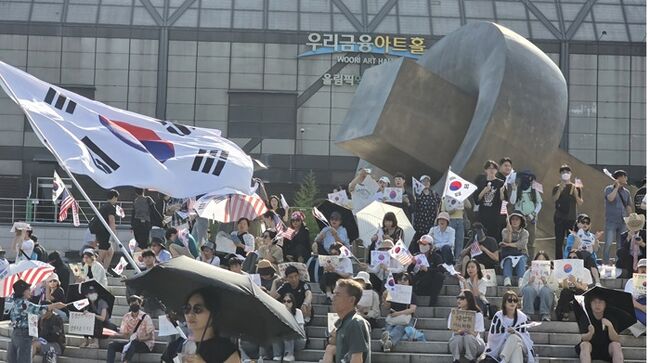 [Cho Yang-geon Column] Selection and Concentration Should Also Apply to Patriotic Activities
A scene in and around Olympic Park, Jamsil. When middle and high school students, and even elementary school students, are aware of and participating in the struggle, if the older generation is unawar
[Cho Yang-geon Column] Selection and Concentration Should Also Apply to Patriotic Activities
A scene in and around Olympic Park, Jamsil. When middle and high school students, and even elementary school students, are aware of and participating in the struggle, if the older generation is unawar
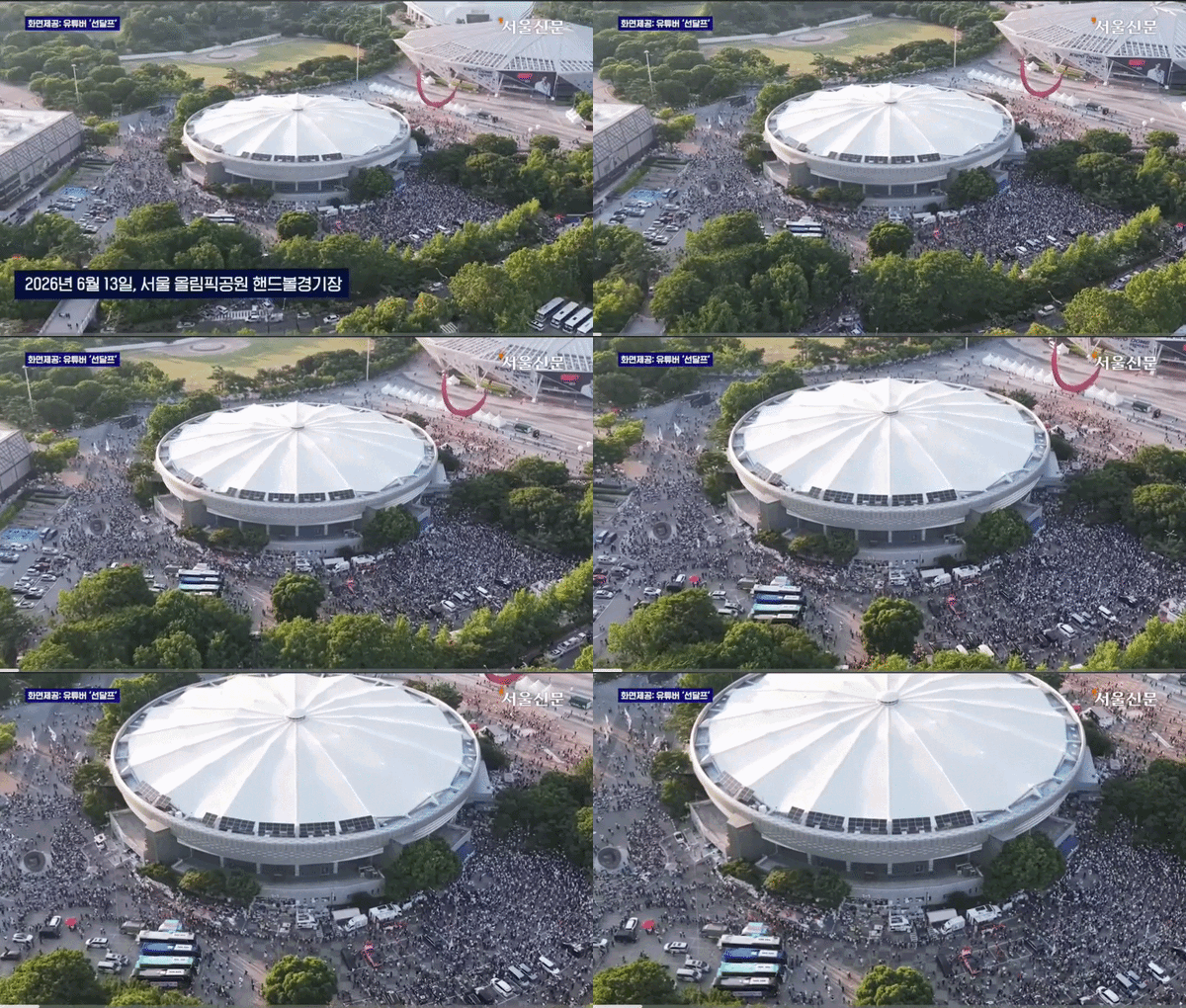 [Video] The Scene of the 'Jamsil Democratization Movement' as Seen from the Sky
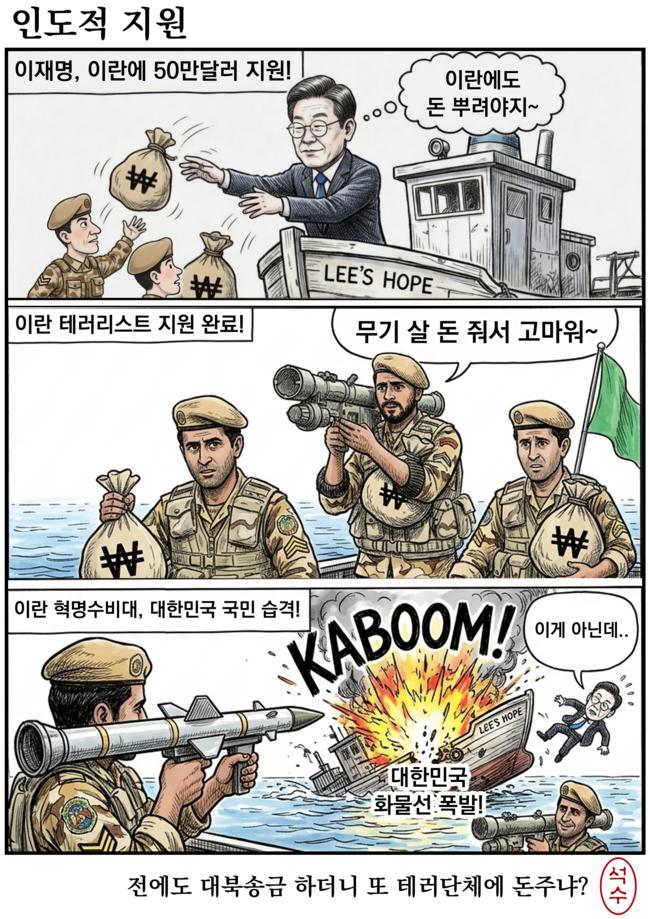 [Editorial Cartoon] Humanitarian Aid

 List
List