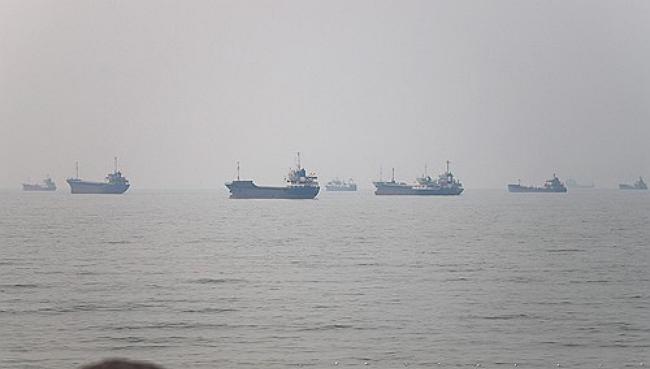
 Vessels are passing through the Strait of Hormuz, a critical passageway for global crude oil transport. Amid concerns over supply disruptions from the Middle East, Brent crude prices surged past $100 per barrel during the week, simultaneously putting pressure on corporate earnings and stock valuation multiples. [Photo=Reuters & Yonhap News Data]
The market has not abandoned AI
The market has not discarded the growth potential of AI. However, as rising international oil prices pressure corporate earnings forecasts and climbing U.S. long-term interest rates lower appropriate price-to-earnings ratios (PER), the market has begun to recalculate the price it is willing to pay for the same level of growth.
Last week, Money Insight noted that the risks in the Strait of Hormuz could propagate from oil prices to exchange rates and interest rates. This week, those risks began to translate into the fair value of stocks.
Brent crude rose as high as $102 per barrel during the week, while the yield on the U.S. 10-year Treasury note hit 4.71% during intraday trading. The Nasdaq fell 2.1% over the week, and the KOSPI plunged 5.72% on the 24th, the final trading day.
The fair value of a stock is determined by two main factors.
The first is the future earnings a company is expected to generate. The second is the discount rate applied when converting those future earnings into present value.
Rising oil prices put pressure on the first factor: corporate earnings.
While this may be positive for energy producers, it leads to increased fuel, raw material, and logistics costs for aviation, shipping, chemical, steel, retail, and power generation companies. If a company cannot pass these increased costs entirely onto sales prices, operating profit will decline even if revenue remains stable.
A rise in U.S. long-term interest rates increases the second factor: the discount rate.
When the required rate of return for investors rises, a lower PER is applied even to companies generating the same level of profit. Growth stocks, where future earnings carry more weight than current earnings, are affected more significantly by changes in the discount rate.
If oil prices and long-term interest rates rise simultaneously, both corporate earnings forecasts and appropriate PERs can decrease.
For example, if a company's expected profit drops by 10% and the market-applied PER falls from 20x to 17x, the fair stock price would decline by approximately 23.5%. When a decline in earnings coincides with a contraction in valuation multiples, the magnitude of the stock price drop far exceeds the rate of the earnings decline.
The South Korean stock market is particularly sensitive to this dynamic.
Large-cap semiconductor stocks, such as Samsung Electronics and SK Hynix, account for a significant portion of the KOSPI. Even if the earnings outlook for semiconductor companies remains intact, any decline in the fair PER applied to U.S. tech stocks can exert downward pressure on Korean semiconductor stocks.
Rising international oil prices increase production and transportation costs for Korean companies while also impacting inflation and interest rates. If the USD/KRW exchange rate also rises, it creates a "double burden" as the won-denominated cost of energy imports, settled in dollars, increases.
However, the USD/KRW exchange rate closed at 1,466.6 on the 24th, 0.2 won lower than the previous day. Despite massive net selling by foreign investors, dollar selling by exporters and the stability efforts of foreign exchange authorities limited the rise in the exchange rate. This is why it cannot be concluded that the oil price shock has unilaterally transferred to the exchange rate.
In terms of interest rates, signs of transmission have appeared. According to AsianBondsOnline data from the Asian Development Bank, the yield on South Korea's 10-year government bond rose to 4.397% on the 23rd. However, the exchange rate and domestic interest rates did not react to oil prices at the same speed.
The net selling of over 5 trillion won by foreigners and institutions in the KOSPI on the 24th can be interpreted as a reflection of concerns that rising oil prices and long-term interest rates could simultaneously pressure the earnings and valuations of Korean companies, in addition to the correction seen in U.S. tech stocks.
However, it is not yet the stage to conclude that this correction is the beginning of a long-term bear market.
If Brent crude stabilizes back below $100 and the Federal Reserve remains cautious about further tightening, the burden of the discount rate could ease. If Big Tech demonstrates that increased AI investment costs are successfully converting into revenue and cash flow, tech stocks could justify their high valuations once again.
Conversely, if oil prices stay above $100 for an extended period and the U.S. 10-year Treasury yield climbs further past 4.75%, the market will be forced to lower both corporate earnings expectations and appropriate PERs.
In this scenario, the South Korean stock market could face shocks that are difficult to mitigate through strong semiconductor performance alone. This is because even if semiconductor profits increase, stock prices can still fall if the valuation multiples accepted by the market contract more rapidly.
Results of last week's checkpoints
• Has oil transit through the Strait of Hormuz recovered: Full recovery not confirmed
Rather than resolving maritime transport risks, concerns over supply disruptions have resurfaced due to attacks on oil tankers in the Red Sea and conflict in the Middle East.
• Did Brent crude break through $90: Yes, it broke through
It surpassed $90 and rose as high as $102 during the week.
• Was the rise in oil prices reflected in both exchange rates and domestic interest rates: Partially confirmed
Upward pressure was seen in domestic long-term interest rates, but the USD/KRW exchange rate fell slightly on the 24th. A simultaneous rise in interest rates and the exchange rate was not confirmed.
Next week's checkpoints
• Will Brent crude remain above $100 and further lower corporate earnings forecasts?
• Will the U.S. 10-year Treasury yield exceed 4.75% and further pressure the appropriate PER for stocks?
• Will the FOMC strengthen signals of additional tightening due to rising oil prices?
• Will U.S. GDP and PCE inflation data show a combination of strong economic activity and rising prices?
• Will strong earnings from Samsung Electronics and SK Hynix overcome the rise in discount rates?
• Will foreign investors return to buying Korean semiconductor stocks, or will they continue selling?
Points to avoid jumping to conclusions about
This correction is not evidence that the AI growth story has ended. The market has not abandoned AI; rather, it is lowering the price it is willing to pay for the same growth as oil prices and interest rates have risen.
The core risk to the Korean stock market should also not be simplified to just a decline in semiconductor profits. It is necessary to track whether a "double downgrade"—where international oil prices lower earnings forecasts and U.S. long-term interest rates lower appropriate PERs—is occurring simultaneously.
※ This article analyzes financial markets and industrial trends based on publicly available market data and does not recommend the purchase or sale of any specific financial investment products or stocks. Investment decisions and the consequences thereof are the responsibility of the investor.

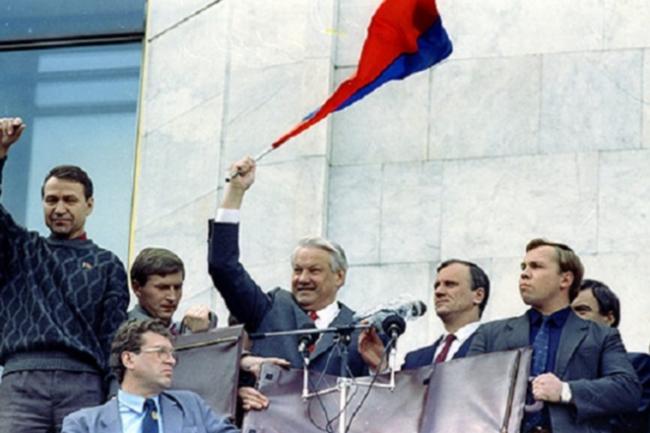 [Songsan Column | 80-Year History of the Pro-North Korean Left] ㉛ 1991: The Dissolution of the Soviet Union
On August 22, 1991, Russian President Boris Yeltsin waves the Russian tricolor flag, calling for resistance against the coup forces. On December 26, 1991, the Soviet Union (USSR), once the world’s m
[Songsan Column | 80-Year History of the Pro-North Korean Left] ㉛ 1991: The Dissolution of the Soviet Union
On August 22, 1991, Russian President Boris Yeltsin waves the Russian tricolor flag, calling for resistance against the coup forces. On December 26, 1991, the Soviet Union (USSR), once the world’s m
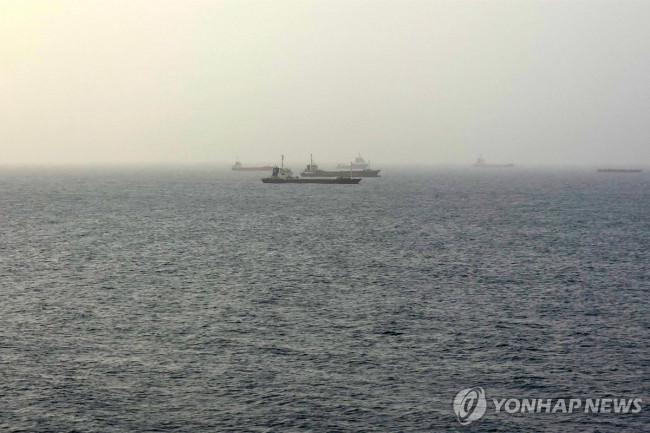 U.S. Military: "Iran maritime blockade remains in effect… 2 vessels neutralized, 12 forced to change course"
Gulf of Oman [AFP=Yonhap News]The U.S. military announced on the 25th (local time) that it is maintaining a full maritime blockade against Iran.U.S. Central Command (CENTCOM), which oversees the Middl
U.S. Military: "Iran maritime blockade remains in effect… 2 vessels neutralized, 12 forced to change course"
Gulf of Oman [AFP=Yonhap News]The U.S. military announced on the 25th (local time) that it is maintaining a full maritime blockade against Iran.U.S. Central Command (CENTCOM), which oversees the Middl
 Jang Dong-hyeok suggests unifying slogans, asking, "Is there anyone left who still denies these were rigged or flawed elections?"
People Power Party Representative Jang Dong-hyeok speaks in Daegu on the 25th. [Maeil Shinmun YouTube Video GIF]As the sweat and tears shed by patriotic citizens on the asphalt over the past decade ha
Jang Dong-hyeok suggests unifying slogans, asking, "Is there anyone left who still denies these were rigged or flawed elections?"
People Power Party Representative Jang Dong-hyeok speaks in Daegu on the 25th. [Maeil Shinmun YouTube Video GIF]As the sweat and tears shed by patriotic citizens on the asphalt over the past decade ha
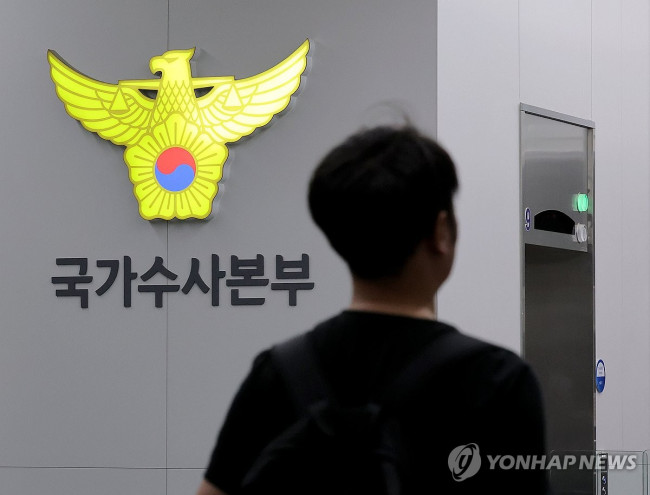 "Cannot Trust Police Investigations": Objections Double in 4 Years… 34,000 Cases in First Half of This Year
Police officials walk past the lobby of the National Office of Investigation (NOI) as the special investigation team looking into the Jang Yoon-gi case conducts a raid at the National Police Agency he
"Cannot Trust Police Investigations": Objections Double in 4 Years… 34,000 Cases in First Half of This Year
Police officials walk past the lobby of the National Office of Investigation (NOI) as the special investigation team looking into the Jang Yoon-gi case conducts a raid at the National Police Agency he
 [New Book] Approaching the Truth of Gwangju… ‘The Memory of Two Gunshots, The Tears of Two Gwangjus’
For a long time, the memory of the May 18 Gwangju Democratization Movement has remained fragmented, never converging into a singular meaning. The new book, Memories of Two Gunshots, Tears of Two Gwang
[New Book] Approaching the Truth of Gwangju… ‘The Memory of Two Gunshots, The Tears of Two Gwangjus’
For a long time, the memory of the May 18 Gwangju Democratization Movement has remained fragmented, never converging into a singular meaning. The new book, Memories of Two Gunshots, Tears of Two Gwang
 [Writer Park Joo-hyun’s Column] The ‘Controversy Over Recommended Summer Reading Lists’ Caused by Blind Idolatry
The cover of the full audio recording file of the so-called "sister-in-law profanity" call, released in 2021 by the pro-Moon Jae-in group "Awakened Citizens' Solidarity Party." [Source: Awakened Citiz
[Writer Park Joo-hyun’s Column] The ‘Controversy Over Recommended Summer Reading Lists’ Caused by Blind Idolatry
The cover of the full audio recording file of the so-called "sister-in-law profanity" call, released in 2021 by the pro-Moon Jae-in group "Awakened Citizens' Solidarity Party." [Source: Awakened Citiz
 [Photo] Evidence of Election Fraud Flooding U.S. Media… Trump Had 2.7 Million Votes Stolen
 [Video] U.S. Semiquincentennial Air Show... 'Art in the Sky' streaks across New York
 [Editorial Cartoon] A Draconian Law That Undermines Freedom of Expression

 List
List