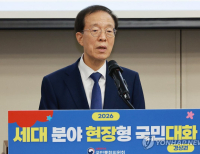
The government will begin the full-scale relocation of administrative and public institutions starting in the first half of next year.
It is also launching reforms to reduce the number of public institutions by 109, the largest scale in history.
Prime Minister Han Seong-sook announced at a press conference on the "Plan for Relocation of Administrative and Public Institutions and Reform of Public Institution Functions" held at the Government Complex Seoul on the 3rd, "We will proceed with the relocation of public institutions to local regions with speed," adding, "Targeting approximately 350 public institutions in the metropolitan area, we will announce the relocation plan in the fourth quarter of this year under the 'principle of minimizing residual presence' and begin the relocation from 2027."
She continued, "As the President has emphasized, we will move away from 'pork-barrel' distribution and gather regional growth energy like a bonfire, concentrating it around innovation cities to maximize the power of regional hubs."
She stated, "While there will inevitably be some disagreements and walls of conflicting interests," she promised, "I will listen sufficiently to various opinions from local governments, the labor sector, and others to create a rational relocation plan that can gain broad consensus. We will minimize social friction."
She also emphasized, "To ensure that employees of relocated institutions face no inconvenience, we will provide substantial support for relocation and housing costs, and drastically improve living conditions such as education and medical services."
She added, "For the metropolitan area, including Seoul, we will pursue a new vision and development direction aimed at strengthening functions in economy, culture, and international exchange."
Minister of Land, Infrastructure and Transport Kim Yun-duk emphasized regarding the principle of minimizing residual presence in the capital area, "We will conduct a comprehensive review of the residual criteria applied during the first round of relocations," adding, "In principle, we will include all institutions in the relocation target unless there is a mandatory reason for them to remain."
He further promised, "Unlike the first round of relocations, we will not wait for the construction of new government buildings but will immediately begin leading relocations starting next year by utilizing leased private buildings," and added, "We will significantly increase support levels, with more robust support for institutions that relocate further and faster."
The relocation of central administrative agencies concentrated in the capital region will also be pushed forward in earnest starting in the first half of next year.
Prime Minister Han stated, "Regarding central administrative agencies located in the capital region, we will prioritize moving agencies with large scales and significant ripple effects to Sejong Special Self-Governing City starting in the first half of 2027."
She continued, "Sejong City is the symbol and central axis of balanced development," and promised, "By building the Presidential Office in Sejong by August 2029 to center administration there and supporting the completion of the National Assembly Sejong Building by 2033 without setbacks, we will complete the Administrative Complex City as the true center of national administration."
Minister of the Interior and Safety Yoon Ho-jung explained, "Starting in the first half of 2027, we will sequentially promote the relocation of agencies with significant scale or impact, such as the Ministry of Justice and the Ministry of Gender Equality," adding, "Agencies requiring dedicated facilities, such as the Prosecution Service (Public Investigation Office, Major Crime Investigation Office) and the National Police Agency, will be relocated after the construction of new buildings."
In the Q&A, Minister Yoon explained, "(Agencies not mentioned, such as the Financial Services Commission) does not mean they are excluded. We will finalize and announce the list of agencies subject to relocation across the fourth quarter," and added, "For the Ministry of Foreign Affairs and the Ministry of Unification, their relocation will be reviewed in line with the timing of the Presidential Office relocation in 2030 and the opening of the legislative branch in 2033."
Along with this, Prime Minister Han stated, "In response to the rapidly changing policy environment, we will boldly reform the functions of public institutions," adding, "Through strategic structural reform, unification of similar and redundant functions, and consolidation of small-scale institutions, we will reduce the number of public institutions by 109, the largest scale ever."
This reduction scale amounts to approximately 20% of all public institutions.
Prime Minister Han added, "Each ministry will prepare implementation procedures such as functional reform roadmaps, and we will begin implementation immediately for agencies that do not require legal amendments," continuing, "We will also devise various support measures, including employment succession guarantees for affected public institution staff, as well as benefits including compensation and incentives."
Second Vice Minister of Economy and Finance Heo Jang explained, "We will proactively respond to rapid policy environment changes and future demands by strategically redeploying functions of public institutions related to national infrastructure such as energy and ports," and stated that they will push for the integration of similar/redundant agencies and the consolidation of overlapping duties between subsidiaries and small-scale agencies.
In this regard, the government's policy is to integrate the five power generation companies into one to achieve an energy transition centered on renewable energy, and to integrate the four port authorities to enhance port competitiveness.
Prime Minister Han noted, "At the starting point of many big and small problems Korea faces today is the capital-centric monocentric system and territorial imbalance," adding, "Balanced growth has become not a matter of choice, but a survival strategy for a sustainable Republic of Korea."
She continued, "These (announced) policies will serve as a symbolic and substantial turning point for easing congestion in the metropolitan area and securing regional growth engines, in connection with megaprojects and the promotion of the '5-pole, 3-specialty' growth engine," and promised, "We will promote the tasks reported today swiftly and effectively. We will concentrate the entire government's capabilities for the effective implementation of these policies."
The government plans to continuously monitor progress through a council of relevant ministries centered on the Prime Minister's Office.
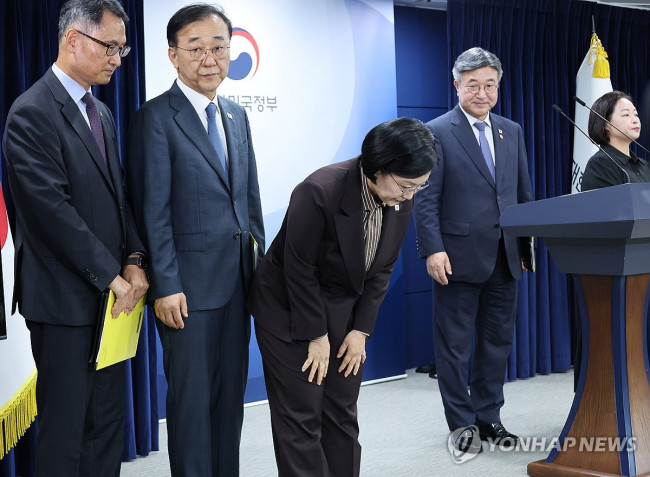 Announcement of the relocation of administrative and public institutions [Seoul=Yonhap News]

 [Analysis] Is a ‘Win-Win’ Possible for the U.S. and Venezuela?
U.S. President Donald Trump and Venezuelan Interim President Delcy Rodríguez. The U.S. government has secured a 35% stake in the parent company of the private oil firm NABEP and the rights to acquire
[Analysis] Is a ‘Win-Win’ Possible for the U.S. and Venezuela?
U.S. President Donald Trump and Venezuelan Interim President Delcy Rodríguez. The U.S. government has secured a 35% stake in the parent company of the private oil firm NABEP and the rights to acquire
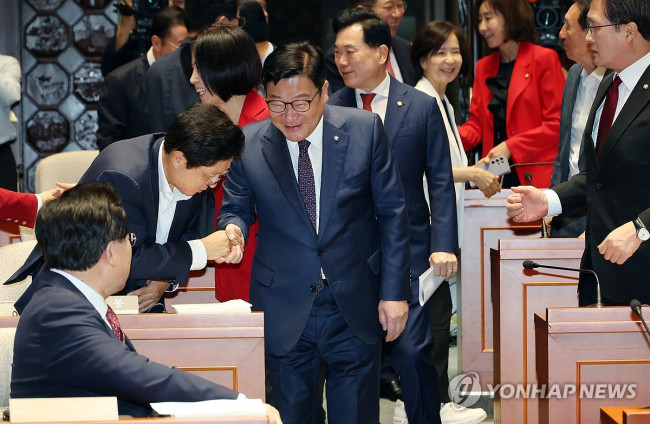 PPP's general meeting fails to adopt 'People's Voting Rights Protection Act' as party platform; agrees to further discussions
Floor Leader Jeong Jeom-sik attending the policy general meeting of lawmakers [Seoul=Yonhap News]On the 3rd, the People Power Party planned to adopt as a party platform a bill to reform the National E
PPP's general meeting fails to adopt 'People's Voting Rights Protection Act' as party platform; agrees to further discussions
Floor Leader Jeong Jeom-sik attending the policy general meeting of lawmakers [Seoul=Yonhap News]On the 3rd, the People Power Party planned to adopt as a party platform a bill to reform the National E
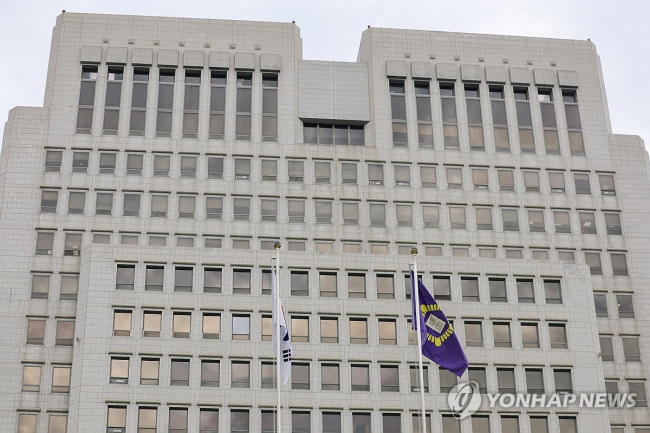 27 legal professionals from the Seoul National University Law School class of '76: "The Blue House’s demand for the reappointment of Supreme Court Justices is unjust."
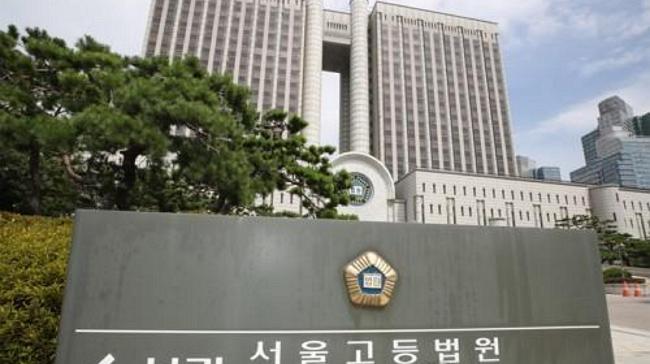
The Supreme Court of Korea [Seoul=Yonhap News] Twenty-seven legal professionals from the Seoul National University College of Law's class of '76 issued a joint statement on the 3rd, criticizing P
27 legal professionals from the Seoul National University Law School class of '76: "The Blue House’s demand for the reappointment of Supreme Court Justices is unjust."
The Supreme Court of Korea [Seoul=Yonhap News] Twenty-seven legal professionals from the Seoul National University College of Law's class of '76 issued a joint statement on the 3rd, criticizing P
 [New Book] The True Face of the Ivory Tower Hidden in the Shadow of Power… Park Sun-kyung’s ‘Misaki’
The university campus, often called a sanctuary of intellect. A new novel has been published that sharply dissects the hypocrisy and absurdity committed within those solid walls of power. &
[New Book] The True Face of the Ivory Tower Hidden in the Shadow of Power… Park Sun-kyung’s ‘Misaki’
The university campus, often called a sanctuary of intellect. A new novel has been published that sharply dissects the hypocrisy and absurdity committed within those solid walls of power. &
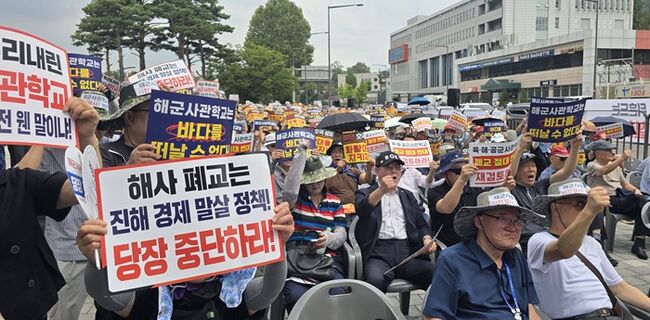 [Photo] “We Oppose the Closing of the Military Academy”… Large-Scale Protest Held in Front of the War Memorial on the 26th
The "National Solidarity for Preventing the Closure of Military Academies" held a rally to protest the closure of military academies at the plaza in front of the War Memorial of Korea in Samgakji, Seo
[Photo] “We Oppose the Closing of the Military Academy”… Large-Scale Protest Held in Front of the War Memorial on the 26th
The "National Solidarity for Preventing the Closure of Military Academies" held a rally to protest the closure of military academies at the plaza in front of the War Memorial of Korea in Samgakji, Seo
 [Trending Destinations] The Leisure of Seoul's Hangang Bus and the Romance of Hong Kong's Star Ferry
Hannam Bridge viewed from the Hangang Bus. [Video = Reporter Lim Yo-hee]With the introduction of the Hangang Bus, Seoul—which previously lacked sufficient water-based public transport—has gained a
[Trending Destinations] The Leisure of Seoul's Hangang Bus and the Romance of Hong Kong's Star Ferry
Hannam Bridge viewed from the Hangang Bus. [Video = Reporter Lim Yo-hee]With the introduction of the Hangang Bus, Seoul—which previously lacked sufficient water-based public transport—has gained a
 [Jung Jae-hak’s From Jeolla-do] Listening to Patti Kim’s ‘Song of September’
Today, as it has been all day long, the heat wave has been sculpting clouds, and the wind has been gathering them. Thus, from the early evening through the night, the sound of rain persists.&nbs
[Jung Jae-hak’s From Jeolla-do] Listening to Patti Kim’s ‘Song of September’
Today, as it has been all day long, the heat wave has been sculpting clouds, and the wind has been gathering them. Thus, from the early evening through the night, the sound of rain persists.&nbs
 [Issue Commentary] 3 Reasons Why the Lee Jae-myung Trial Must Proceed
 [Editorial Cartoon] A Draconian Law That Undermines Freedom of Expression

 List
List