The special prosecutor team led by Lee Tae-han, tasked with investigating allegations of election fraud in the June 3rd election, has finally assembled its staff and entered the full-scale investigation preparation phase. Some remain skeptical about the expertise and investigative capabilities of the appointed assistant special prosecutors, harboring deep anxieties that the team, appointed by the Lee Jae-myung administration, might downplay the election fraud allegations and grant a "get-out-of-jail-free card" to those involved. In response, is serializing [Classic Articles], a series that re-uploads selected coverage and reports from our archives during our time at other media outlets, to provide information regarding election fraud. hopes that the special prosecutor team will focus on the fact that the election statistics of the Republic of Korea are so mysterious that they would require rewriting mathematics textbooks worldwide. We urge the team not to stop at merely uncovering whether voter turnout was manipulated, but to commit their full efforts to identifying and judicially punishing the entities that artificially manipulated the "vote shares." [Editor's Note]
The following article was reported on September 23, 2024, three months before the December 3rd emergency martial law declaration.
|
“Lee Jae-myung’s Probability of Winning is ‘Incomprehensible’… Lower than Winning the Lottery First Prize Three Times in a Row”
Data Analyst Hong Seong-bin Raises Objections
Lee’s 51.8% Vote Share in Gyesan 2-dong during the 4.10 General Election
Probability of 59.6% in Early Voting Analyzed as 1 in 66 Hae (a massive numerical unit)
“Such Astronomical Statistical Records are a National Disgrace”
 Data analyst Hong Seong-bin presents at the seminar, 'Analysis of 4.10 General Election Results, Diagnosis of the Reality of Election Litigation, and Alternatives,' held at Inha University Law School in Michuhol-gu, Incheon, at 2 p.m. on the 19th. [Photo=Reporter Heo Gyeom]
Academic research findings indicate that the probability of candidate Lee Jae-myung being elected as a member of the National Assembly is lower than the probability of winning the first prize in the national lottery three times in a row.
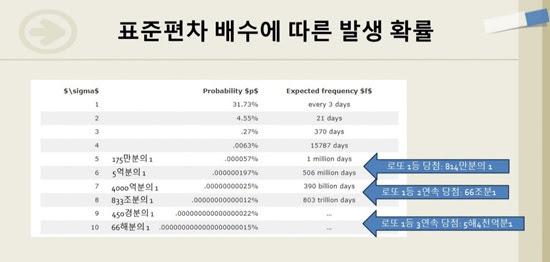
According to simulations conducted on the 23rd by data analyst Hong Seong-bin, a practicing dentist, based on National Election Commission (NEC) statistics, the probability of candidate Lee Jae-myung—who received 51.8% (4,349 votes) of the total 8,383 valid votes in Gyesan 2-dong, Gyeyang-eul constituency during the 4.10 general election—obtaining 59.6% (2,306 votes) in early voting was analyzed to be lower than "1 in 66 hae" (1/6,600,000,000,000,000,000,000).
One "hae" is 10 billion × 10 billion. One trillion has 12 zeros, while one "hae" has 20. The unit after 1,000 trillion, 1 quadrillion, 10 quadrillion, 100 quadrillion, and 1,000 quadrillion is "1 hae."
Conversely, the probability of winning the first prize in the lottery three times in a row was calculated as 1 in 5 hae 403.5 quadrillion. For reference, the probability of winning the lottery first prize once is 1 in 8.145 million, and the probability of winning twice in a row is 1 in 66 trillion.
Consequently, the conclusion was drawn that the "66 hae" figure in the Gyesan 2-dong general election statistics is an impossible number that could never occur in reality without artificial manipulation.
These research findings were presented for the first time at the seminar, 'Analysis of 4.10 General Election Results, Diagnosis of the Reality of Election Litigation, and Alternatives,' held at 2 p.m. on the 19th at Inha University Law School in Michuhol-gu, Incheon.
The seminar was hosted by the Lawyers and Professors for Rule of Law and Liberty (NPK; Chairman Maeng Joo-sung, Professor Emeritus at Hanyang University; Secretary General Kim Mi-young, CEO of VON News). Numerous academic figures and citizens packed the lecture hall, showing great interest in the presentation.
Data analyst Hong raised an objection, stating, “DNA testing has a margin of error of 1 in 10 trillion, yet we often see in the media that courts battle over the authenticity of such results. However, despite the probability of the NEC statistics being lower than 1 in 66 hae, most of the public accepts the results without suspicion.”
Specifically, he explained, “Candidate Lee Jae-myung’s early voting share in Gyesan 2-dong should have fallen within the 99% confidence interval of 50.30% to 53.39%.”
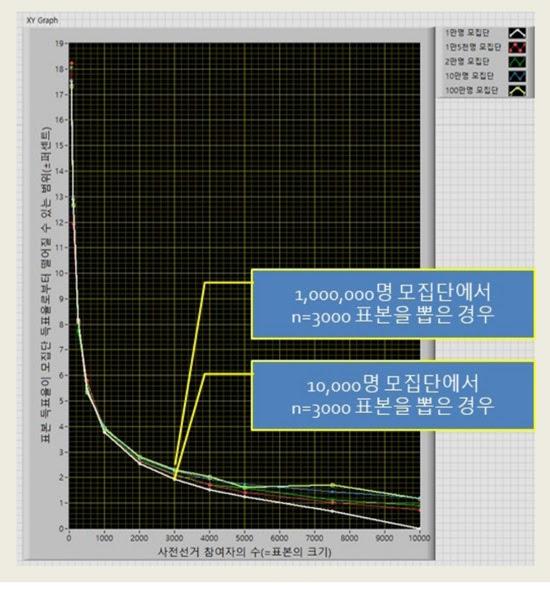
L-shaped Curve Graph is Normal… Results Stabilize with Samples over 3,000
According to statistical science, once the 99% confidence interval is exceeded, the probability of occurrence decreases exponentially for every 1% increase.
For example, if the vote share were 55.45%, it would be analyzed as similar to the probability of winning the lottery once.
However, to reach a vote share of 56.05%—just 0.6% higher—the probability plummets to a level similar to winning the lottery twice in a row.
Candidate Lee’s 59.6% early vote share in Gyesan 2-dong is a statistically impossible figure on Earth.
According to statistical science, if a sample exceeds a certain size, it converges to the population value and becomes increasingly consistent.
Specifically, if 500–1,000 people participate in early voting, the results narrow to within ±4% of the population value.
With 2,000 people, the margin narrows to ±3%; with 3,000, it comes within ±2%; and as it nears 5,000, it converges toward the population value.
Consequently, a curve is drawn that meets a convergence point while sloping downward to the right.
This is called an "L-shaped curve."
Therefore, there is almost no difference between taking a sample of 3,000 from 10,000 people or 3,000 from 1 million people. This is because the range of deviation from the population narrows to within ±2%.
Even though 3,000 people out of a population of 10 million is only 0.03%, this is the same principle that allows polling agencies to predict results based only on surveying 1,000 to 2,000 people without surveying the entire population. It is because the margin of error decreases once a certain size is reached.
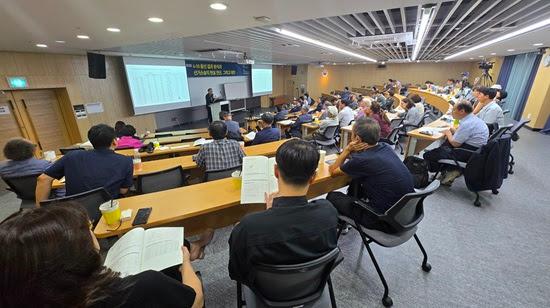 The seminar, ‘Analysis of 4.10 General Election Results, Diagnosis of the Reality of Election Litigation, and Alternatives,’ hosted by NPK and organized by the NPK Special Committee for Investigation (Committee Chairman Kwon Oh-yong, Attorney), is underway at Inha University Law School in Michuhol-gu, Incheon, at 2 p.m. on the 19th. Incheon=Reporter Heo Gyeom
“Gyesan 2-dong General Election Statistics: ‘66 Hae’ Impossible Without Artificial Manipulation”
Most of the Public Shows No Suspicion Despite Statistics Representing Probabilities That Cannot Exist
99% Confidence Interval for Gyesan 2-dong Early Voting Should be 50.30%–53.39%
When data analyst Hong conducted a simulation by extracting 3,869 samples—the actual number of early voters in Gyesan 2-dong—1,000 times, the average sample vote share was calculated as 51.89%, the standard deviation as 0.61, and the 99% confidence interval as ±1.55%.
According to the statistics published by the NEC, there were 3,869 in-district early votes in Gyesan 2-dong, with candidate Lee Jae-myung receiving 59.6% (2,306 votes) and candidate Won Hee-ryong receiving 39.9% (1,545 votes).
Impossible Statistics on Earth… Even a ±1% Increase Leads to Exponential Collapse
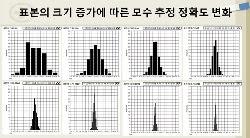 (From top left to right, bottom left to right) As the sample size increases, it gradually converges toward the population, and the width of the bar graph narrows within the confidence interval.
Regarding this, data analyst Hong stated, “If only 50 people had participated in early voting, a 59.6% result could potentially appear.”
He added that even with 100 people, 59% could be obtained, and it would remain possible even with 250.
However, once 500 people participated in early voting, a 59% result did not appear in random simulations, and it exceeded the 99% confidence interval.
The 99% confidence interval means that there is a 99% probability that the true value of the population is contained within this range.
However, because the probability decreases exponentially even when just slightly outside the confidence interval, a 59.6% result is an outcome that could never occur once 500 people participate.
Analyst Hong emphasized that even if the process were repeated 1,000 times based on the 3,869 people who actually participated in the in-district early voting, the 59.6% result remains impossible.
This value is also located at a point on the graph that significantly exceeds 10 times the standard deviation, creating another mystery.
The "Six Sigma (6σ)" concept developed by Motorola helps in understanding phenomena exceeding 10 times the standard deviation. It is one of the quality management techniques used by leading global companies like General Electric today.
"6σ" signifies a standard deviation aimed at achieving a zero-defect rate; in practice, ±6σ corresponds to 2 defective products per 1 billion.
Therefore, the general election result in candidate Lee Jae-myung’s constituency corresponds to the probability of an event occurring in a range exceeding 10 times the standard deviation (±10σ), and Analyst Hong calculated that value through simulation to be lower than 1 in 66 hae.
He explained, “As a result of the simulation, the moment the vote share exceeded 52.3%, it completely deviated from the confidence interval. Despite entering a range where the probability of occurrence becomes extremely low, an absolutely incomprehensible result of 59.6% appeared (in candidate Lee’s constituency).”
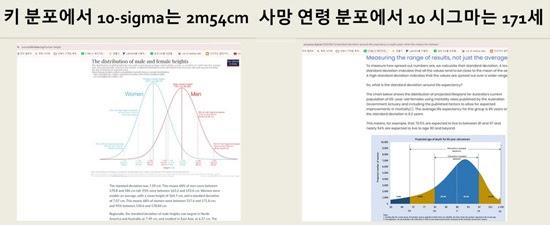
161 Democratic Winners Standing 2m 54cm Tall… The Result Equivalent to Dying at Age 171
The final vote tally for the Gyeyang-eul constituency, combining day-of voting and early voting, showed candidate Lee Jae-myung with 54.1% (48,365 votes) and candidate Won Hee-ryong with 45.4% (40,616 votes) out of a total of 89,354 votes.
Early voting decided the outcome. This is because candidate Lee overturned candidate Won, who had won the day-of vote, through overwhelming early voting results.
Regarding this result, there is a rebuttal that early voting turnout is higher among left-leaning (progressive) voters, explaining the Democratic Party's overwhelming vote share.
However, analyzing the general election statistics shows that the Progressive Party, which is classified as more left-leaning than the Democratic Party, had virtually no difference between day-of voting and early voting results.
In short, the Democratic Party was the only one that scored high, and across the country, there were numerous instances where the People Power Party’s share was lower by exactly the same high standard deviation that the Democratic Party’s was higher.
The 3,000-person sample is particularly noteworthy. In this general election, a significant number of electoral districts across the country had roughly 3,000 early voting participants.
Analyst Hong emphasized that if a sample is 3,000 people, the ability to predict the population remains within ±2.5%. In simple terms, there should not be many districts where a large discrepancy exists between day-of voting and early voting.
Nevertheless, a bizarre result emerged in most polling stations nationwide where the Democratic Party held an overwhelming lead in early voting.
Analyst Hong also unveiled an interesting analysis that day, applying the general election simulation results to national height and age data.
In the distribution of height using statistics relative to the population, ±10σ corresponds to 2 meters and 54 centimeters. Among the populace, one or two people might be this tall.
However, there were 161 Democratic Party winners in the 4.10 general election. It is impossible for 161 citizens to have a height of 2m 54cm, which would be tall enough to be listed in the Guinness World Records.
Similarly, applying ±10σ to the age of death allows for the interpretation that 161 Democratic Party winners lived to the age of 171 before passing away.
Analyst Hong added, “This statistical result is equivalent to saying that Democratic Party candidates take turns winning the lottery three times a year.”
At this point, one might raise a reasonable counter-argument: Don't first-prize lottery winners appear every week?
To this, Analyst Hong emphasized, “While the probability of winning the first prize in the lottery is extremely low, a much larger number of lottery tickets are sold every week.”
Specifically, for the 1106th draw on February 10th of this year, 126 million games were sold—15.5 times more than the 8.145 million probability figure. That is why 11 first-prize winners could emerge.
However, there is a decisive difference: National Assembly early elections are held only once every four years.
“An Era Where Justice Has Vanished… Mountains of Forged Ballots Have Poured Out”
Analyst Hong stated, “It is heartbreaking to have to discuss astronomical numbers when talking about election statistics. The fact that such numbers are plainly recorded in databases produced and managed by the state is a national disgrace that must be rectified.”
At the seminar that day, Heo Byung-ki, Professor Emeritus of Engineering at Inha University, gave a lecture on the "Academic Verification Results of the 22nd General Election," and attorney Kwon Oh-yong (Co-chairman of the NPK Special Committee for Investigation) presented on the "Reality of Election Litigation and Alternatives." This was followed by a discussion and Q&A session with NPK Chairman Maeng Joo-sung (Professor Emeritus at Hanyang University) and Secretary General Kim Mi-young. The session was moderated by Hong Seung-gi, Dean of the Inha University Law School and 10th Chairman of the Korea Legal Ethics Council.
The event was also attended by former Prime Minister Hwang Kyo-ahn, former National Assembly member Min Kyung-wook, executives of the Inha University Alumni Association (founded by President Syngman Rhee), law school faculty, and executives of civic groups that have been passionately committed to uncovering election fraud, such as the Election Fraud Prevention Squad (Bubangdae).
Earlier, NPK Chairman Maeng Joo-sung delivered opening remarks, saying, “This seminar carries great significance.”
Regarding the progress of the April 15th election litigation, Chairman Maeng urged, “The Supreme Court Justices were partners who acted as a single team with the NEC, which consistently used anti-intellectual and unscientific logic, stopping at nothing to suppress and even destroy evidence, acting as the ultimate lawbreakers who dismissed the entire litigation.” He added, “Even if not immediately, the content presented today will serve as a solid foundation of basic data on the day an investigation is conducted to realize justice, and everyone listening to this seminar will remain witnesses to history.”
Former Prime Minister Hwang Kyo-ahn emphasized in his congratulatory speech, “Election fraud is a fact in the 4.10 election, following the 4.15 election, and now people everywhere are worried about election fraud. The final piece of the puzzle lies in the investigation. Institutional reform takes a long time, but an investigation can be done quickly. In my 28-year career as a prosecutor, I worked mostly as a public security prosecutor. The Public Security Department catches spies and election fraud. The reason public security handles it is because if elections collapse, the nation collapses.” He added, “I am grateful that such a valuable seminar was held just as everyone was beginning to forget about election fraud. I thank those who have taken the lead in the field to establish election justice in the Republic of Korea.”
Former National Assembly member Min Kyung-wook said in his congratulatory speech, “I have been asserting election fraud for four years, but some call us conspiracy theorists, and Han Dong-hoon, the leader of the People Power Party, is one of them.” He encouraged further interest in the issue, saying, “Despite such perspectives and cynicism from society, there are those who discover injustices ahead of others and try to make them known. There are righteous people of this era who can deeply mock the election fraud cartel of this society in their hearts.”
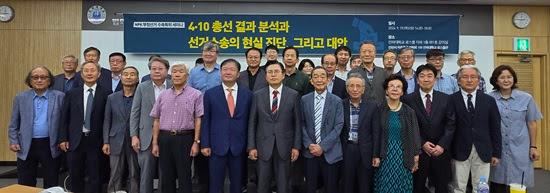 Major guests and speakers pose for a photo at the ‘Analysis of 4.10 General Election Results, Diagnosis of the Reality of Election Litigation, and Alternatives’ seminar held at Inha University Law School in Michuhol-gu, Incheon, at 2 p.m. on the 19th. Attendees include former Prime Minister Hwang Kyo-ahn (center), former National Assembly member Min Kyung-wook (6th from left, front row), Chairman Maeng Joo-sung (6th from right, front row), Professor Emeritus Heo Byung-ki (5th from right, front row), Data Analyst Hong Seong-bin (3rd from right, front row), Dean Hong Seung-gi (2nd from right, front row), NPK Secretary General/VON News CEO Kim Mi-young (1st from right, front row), Attorney Kwon Oh-yong (2nd from left, front row), former Ambassador to Norway Lee Byung-hwa (3rd from right, back row), and former NEC Union Chairman Han Seong-cheon (1st from right, back row).
Reporter Heo Gyeom
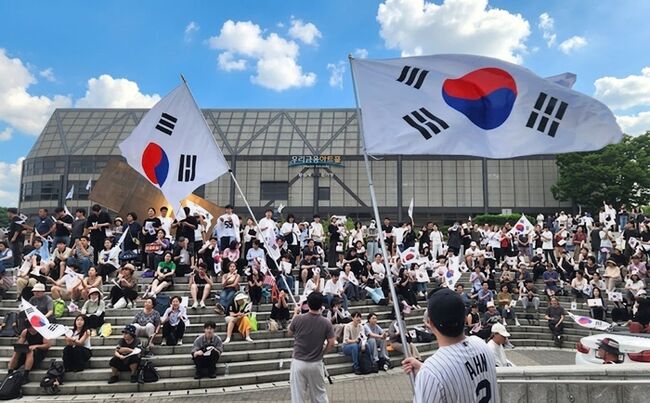 As of September 2026, patriotic citizens are shouting slogans of ‘Election Fraud’ in front of the Handball Stadium at Olympic Park in Songpa-gu, Seoul, strongly yearning for the restoration of election justice. Civil society’s concern that election fraud has been continuously evolving while ignored by institutional politics—despite pointers from numerous experts—is reaching a critical point. ⒸHanmi Ilbo

 [Analysis] Is a ‘Win-Win’ Possible for the U.S. and Venezuela?
U.S. President Donald Trump and Venezuelan Interim President Delcy Rodríguez. The U.S. government has secured a 35% stake in the parent company of the private oil firm NABEP and the rights to acquire
[Analysis] Is a ‘Win-Win’ Possible for the U.S. and Venezuela?
U.S. President Donald Trump and Venezuelan Interim President Delcy Rodríguez. The U.S. government has secured a 35% stake in the parent company of the private oil firm NABEP and the rights to acquire
 PPP's general meeting fails to adopt 'People's Voting Rights Protection Act' as party platform; agrees to further discussions
Floor Leader Jeong Jeom-sik attending the policy general meeting of lawmakers [Seoul=Yonhap News]On the 3rd, the People Power Party planned to adopt as a party platform a bill to reform the National E
PPP's general meeting fails to adopt 'People's Voting Rights Protection Act' as party platform; agrees to further discussions
Floor Leader Jeong Jeom-sik attending the policy general meeting of lawmakers [Seoul=Yonhap News]On the 3rd, the People Power Party planned to adopt as a party platform a bill to reform the National E
 27 legal professionals from the Seoul National University Law School class of '76: "The Blue House’s demand for the reappointment of Supreme Court Justices is unjust."
The Supreme Court of Korea [Seoul=Yonhap News] Twenty-seven legal professionals from the Seoul National University College of Law's class of '76 issued a joint statement on the 3rd, criticizing P
27 legal professionals from the Seoul National University Law School class of '76: "The Blue House’s demand for the reappointment of Supreme Court Justices is unjust."
The Supreme Court of Korea [Seoul=Yonhap News] Twenty-seven legal professionals from the Seoul National University College of Law's class of '76 issued a joint statement on the 3rd, criticizing P
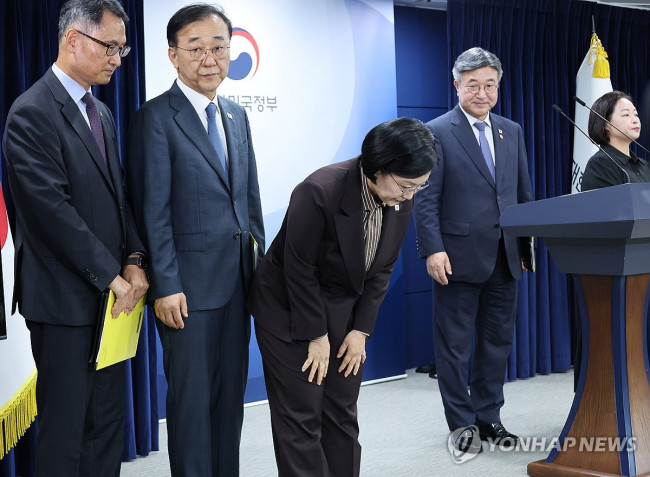 Relocation of Public Institutions to Begin Next Year… "Minimize Retention in Capital Region, Reduce 109 Institutions"
The government will begin the full-scale relocation of administrative and public institutions starting in the first half of next year.It is also launching reforms to reduce the number of public instit
Relocation of Public Institutions to Begin Next Year… "Minimize Retention in Capital Region, Reduce 109 Institutions"
The government will begin the full-scale relocation of administrative and public institutions starting in the first half of next year.It is also launching reforms to reduce the number of public instit
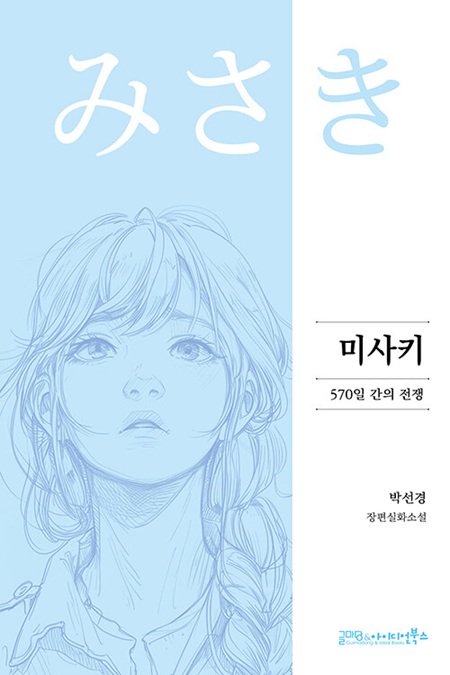 [New Book] The True Face of the Ivory Tower Hidden in the Shadow of Power… Park Sun-kyung’s ‘Misaki’
The university campus, often called a sanctuary of intellect. A new novel has been published that sharply dissects the hypocrisy and absurdity committed within those solid walls of power. &
[New Book] The True Face of the Ivory Tower Hidden in the Shadow of Power… Park Sun-kyung’s ‘Misaki’
The university campus, often called a sanctuary of intellect. A new novel has been published that sharply dissects the hypocrisy and absurdity committed within those solid walls of power. &
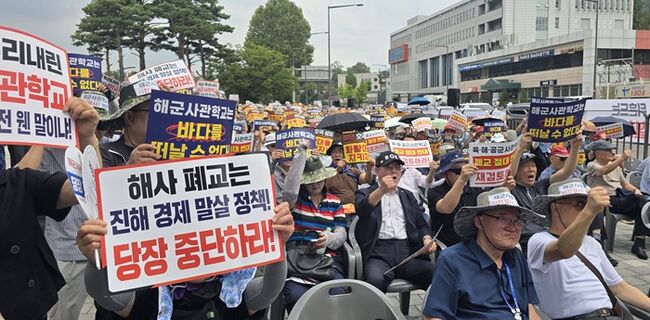 [Photo] “We Oppose the Closing of the Military Academy”… Large-Scale Protest Held in Front of the War Memorial on the 26th
The "National Solidarity for Preventing the Closure of Military Academies" held a rally to protest the closure of military academies at the plaza in front of the War Memorial of Korea in Samgakji, Seo
[Photo] “We Oppose the Closing of the Military Academy”… Large-Scale Protest Held in Front of the War Memorial on the 26th
The "National Solidarity for Preventing the Closure of Military Academies" held a rally to protest the closure of military academies at the plaza in front of the War Memorial of Korea in Samgakji, Seo
 [Trending Destinations] The Leisure of Seoul's Hangang Bus and the Romance of Hong Kong's Star Ferry
Hannam Bridge viewed from the Hangang Bus. [Video = Reporter Lim Yo-hee]With the introduction of the Hangang Bus, Seoul—which previously lacked sufficient water-based public transport—has gained a
[Trending Destinations] The Leisure of Seoul's Hangang Bus and the Romance of Hong Kong's Star Ferry
Hannam Bridge viewed from the Hangang Bus. [Video = Reporter Lim Yo-hee]With the introduction of the Hangang Bus, Seoul—which previously lacked sufficient water-based public transport—has gained a
 [Jung Jae-hak’s From Jeolla-do] Listening to Patti Kim’s ‘Song of September’
Today, as it has been all day long, the heat wave has been sculpting clouds, and the wind has been gathering them. Thus, from the early evening through the night, the sound of rain persists.&nbs
[Jung Jae-hak’s From Jeolla-do] Listening to Patti Kim’s ‘Song of September’
Today, as it has been all day long, the heat wave has been sculpting clouds, and the wind has been gathering them. Thus, from the early evening through the night, the sound of rain persists.&nbs
 [Issue Commentary] 3 Reasons Why the Lee Jae-myung Trial Must Proceed
 [Editorial Cartoon] A Draconian Law That Undermines Freedom of Expression

 List
List