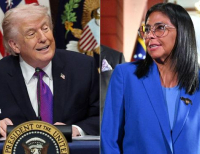
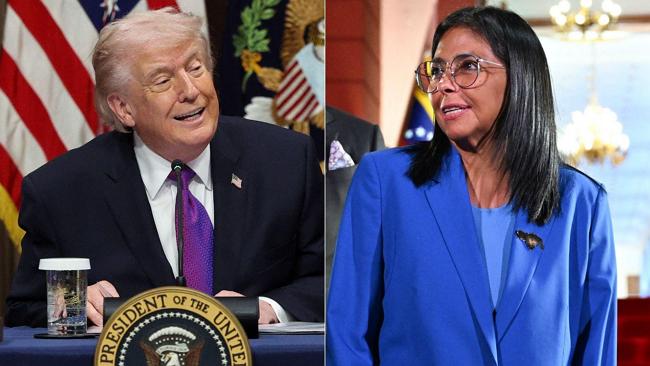
 U.S. President Donald Trump and Venezuelan Interim President Delcy Rodríguez. The U.S. government has secured a 35% stake in the parent company of the private oil firm NABEP and the rights to acquire its crude oil, while Venezuela has finalized an oil agreement to attract up to $100 billion in private investment. [Photo=AFP/Yonhap News]
Details have been revealed regarding the Venezuelan oil field deal, which U.S. President Donald Trump has declared the "largest oil contract in world history." The Venezuelan transitional government has granted private oil company North American Blue Energy Partners (NABEP) 100-year operating rights to 17 oil fields, which hold proven reserves exceeding 65 billion barrels.
The U.S. government has secured a 35% stake in NABEP’s parent company and management participation rights, including veto power over the appointment of directors, without injecting direct tax dollars. Furthermore, the U.S. has secured the right to acquire 20% of the crude oil produced by NABEP at production cost and holds a right of first refusal for the remaining 80%. Venezuela expects to attract up to $100 billion in private investment and generate approximately $200 billion in tax and royalty revenue over the next 25 years.
On the surface, this is an exchange where the U.S. gains stable, low-cost crude oil while Venezuela rebuilds its collapsed oil industry and economy. However, the essence of this deal extends beyond mere oil trading. It is an experiment in which the U.S. government becomes a direct shareholder to guarantee accounting transparency and contractual stability, using this foundation to attract large-scale private capital and rebuild the Venezuelan economy through market-oriented methods.
Turning 65 Billion Barrels into Investable Assets
According to the White House fact sheet, the U.S. Department of State may purchase 20% of all current and future production from oil fields operated by NABEP at production cost, and it holds a right of first refusal for the remaining 80%. The U.S. government maintains veto power over NABEP director appointments, and the majority of the board of directors must consist of U.S. citizens. The project involves U.S. auditors, attorneys, and consultants, with U.S. law applying to the contracts and U.S. courts holding jurisdiction over any disputes.
The U.S. has not acquired ownership of the 65 billion barrels of crude oil itself. Instead, it has secured practical control by combining the stake in NABEP’s parent company, management participation rights, and crude oil acquisition rights. The underground reserves will only translate into actual supply through investments in production facilities and pipelines.
Despite holding the world's largest oil reserves, Venezuela has lost the capital, technology, credit, and sales channels necessary to develop them. This is the result of mismanagement and political misappropriation by the state-run oil company (PDVSA), nationalizations, contract modifications, and continued U.S. sanctions. Production, which exceeded 3 million barrels per day in the late 1990s, has recently fallen to the 1.1 to 1.2 million barrel range.
This deal is an attempt to turn those 65 billion barrels into investable assets. NABEP intends to invest up to $100 billion to restore production facilities, and Venezuela expects to receive approximately $200 billion in taxes and royalties during the first 25 years.
The figure behind NABEP is Venezuelan businessman Alejandro Betancourt. He rose to prominence through power plant contracts with state-owned enterprises and has been subject to investigations by U.S. and European authorities regarding PDVSA-related funds, though no charges or convictions have been confirmed. NABEP claims that it invested approximately $1 billion to increase daily production from 18,000 barrels to over 200,000 barrels in just two years. While his local experience is an asset, the company’s status as a private entity necessitates rigorous accounting oversight by the U.S. government.
The Triple Safeguard Created by the 35% Stake Held by the Department of War
The reasons for the U.S. Department of War’s Strategic Capital Office (OSC) securing a 35% stake in NABEP’s parent company can be distilled into three points.
The first is investment returns. The U.S. government acquired the stake without committing additional cash. As production and corporate value rise, the government can earn dividends and capital gains. This structure ensures that, separate from the right to acquire 20% of crude at cost, the fruits of the company's growth are returned to the American public.
This cannot be viewed merely as a free handout. The U.S. is providing sanctions relief, diplomatic protection, access to financial markets, legal stability, and oil sales channels. In exchange for providing sovereign credit and strategic assets, it received equity. This is not aid that pours money into Venezuela, but a trade where the U.S. shares in the profits as a shareholder if successful.
The second is accounting transparency. Direct participation as a major shareholder is the most reliable way for the U.S. government to control the flow of funds compared to receiving external reports. By combining the 35% stake with veto power over board appointments and the requirement for a U.S.-majority board, the government can internally monitor the use of investment capital, production volume, crude sales, and the payment of taxes and royalties.
Government equity also subjects the project to oversight by the U.S. Congress. Through hearings, budget reviews, and document requests directed at the Department of War and the OSC, Congress can verify the acquisition, management, and valuation of the government’s stake, the receipt of dividends, and potential conflicts of interest. The U.S. Government Accountability Office (GAO) and the Department of War’s Inspector General can also audit the government’s equity management and related activities.
The third is contractual stability. The U.S. government’s stake acts as an "anchor stake" that deters unilateral nationalization and contract repudiation by the Venezuelan government. If NABEP’s business rights and assets were to be arbitrarily infringed upon in the future, it would transcend a dispute with a private company and become an issue of infringing upon assets and strategic supply chains held by the U.S. government. Long-term capital of $100 billion will only move if there is a belief that the contract will remain valid even if the regime changes.
This is distinct from stripping Venezuela of its normal regulatory authority. What the U.S. stake prevents is not legitimate regulation under environmental, labor, and tax laws, but rather political nationalization and arbitrary breach of contract.
Ultimately, the 35% stake is a triple safeguard tying together profit, accounting transparency, and contractual stability. Investors will inject capital trusting not only the promises of the Venezuelan government, but also the business structure in which the U.S. government participates as a shareholder and which is governed by U.S. law and accounting oversight.
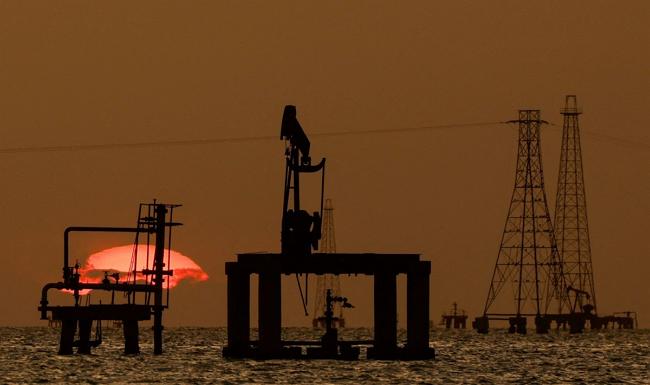 Venezuelan oil drilling facility. NABEP has been granted 100-year operating rights to 17 oil fields with proven reserves of 65 billion barrels. [Photo=Reuters/Yonhap News Archive] How Does This Differ from Chinese-Style Resource Financing?
The Chavez and Maduro regimes expanded resource-backed loans, borrowing large sums from Chinese state banks and repaying them with crude oil. While this method provided immediate cash for the regime, it lacked transparent oversight regarding the use of funds and operational efficiency. Despite receiving vast sums of Chinese money, Venezuela failed to restore its production facilities and market credibility, leaving it saddled with debt and long-term crude supply obligations.
The U.S. approach does not involve entrusting cash directly to the Venezuelan government. It is a capitalist mode of control where the U.S. government acts as a shareholder in a private company to monitor fund flows and raises capital from private markets to invest in production facilities.
Of the 14 new oil field contracts awarded to NABEP, five were reportedly operated by Chinese firms and one by a Russian firm. China has demanded the protection of its legitimate rights and interests, asserting that cooperation between China and Venezuela is protected by international and bilateral laws. How existing joint venture stakes, operating contracts, and unrecovered investments and debts will be settled remains a challenge.
However, the broader direction is clear. While China lent money to the Venezuelan government to be repaid in crude, the U.S. aims to first establish credibility in accounting and contracts before injecting private capital into production facilities. This is a geopolitical realignment shifting the Venezuelan supply chain—which had leaned toward China and Russia—into the U.S. economic sphere, as well as an attempt to replace the Chinese-style state-led resource financing model (which failed to restore production bases) with a market-centric model.
The Path Paved by the Republic of Korea
The White House described this deal as the cornerstone of a "three-stage plan for stabilization, economic reconstruction, and reconciliation leading to democratic transition." The assessment is that free elections and regime change are difficult to root in a state where the economy has collapsed and citizens rely on government handouts and benevolence.
Democracy is not achieved through a single election. Contracts must be upheld regardless of changes in government, private property must be protected, and national tax and resource revenues must be managed transparently. As private investment and production increase, leading to job creation and the growth of the middle class, citizens become less dependent on the handouts of those in power and can demand the rule of law and government accountability. While market capitalism does not automatically guarantee democratization, it creates the economic and civic foundation necessary to sustain democracy.
The Republic of Korea is the nation that most successfully demonstrated this path of development. Immediately following the Korean War, South Korea was one of the world's poorest nations, having lost its industrial facilities, capital, and technology. The U.S. guaranteed security through the ROK-U.S. alliance, provided aid, technology, and financing, and opened the world's largest market to South Korean goods. With security ensured, the South Korean government and businesses were able to engage in long-term investment and exports.
South Korea’s success was not achieved through U.S. support alone. It was the combination of the Korean people’s zeal for education, labor, entrepreneurship, and the government’s promotion of export industries. On the fundamental pillars of private property, private enterprise, and the global market, industrialization and the middle class created the foundation that sustains democracy.
Venezuela, a resource-dependent economy, and South Korea, which grew through manufacturing exports, have different development conditions. However, the principle remains the same: security and contractual stability invite private investment, while the growth of industry and the middle class serves as the foundation for democracy.
Venezuela now stands on a similar testbed. If the U.S. government can mitigate political risk and guarantee the credibility of accounting and contracts, can $100 billion in private capital be attracted? Can that capital create production, jobs, and a middle class, leading to a democratic transition?
This deal is difficult to view as a unilateral resource grab solely for U.S. interests. The U.S. gains stable, low-cost crude, equity profits, and strategic influence in the Western Hemisphere. Venezuela gains an opportunity to use U.S. credit, private capital, technology, and markets to transform its underground resources into productive assets.
Of course, success is not guaranteed. It remains to be seen whether NABEP can actually raise $100 billion and increase production as planned, whether taxes and royalties will actually return to the Venezuelan people, and whether the rights of existing operators like China can be legally settled.
However, the design’s direction is clear. Instead of pouring cash into the country, the U.S. is providing credit, the rule of law, accounting oversight, and market access. Venezuela is providing resource development rights and rebuilding its production base with private capital. If the market and the middle class grow, an economic foundation for democracy to take root will also be built.
If this experiment succeeds, the deal will hold significance beyond being the "largest oil contract in world history." Just as South Korea achieved both industrialization and democratization based on security and the market economy, this could become a new model for developing nation reconstruction, showing that Venezuela can also break free from the "resource curse" and the failure of state socialism.

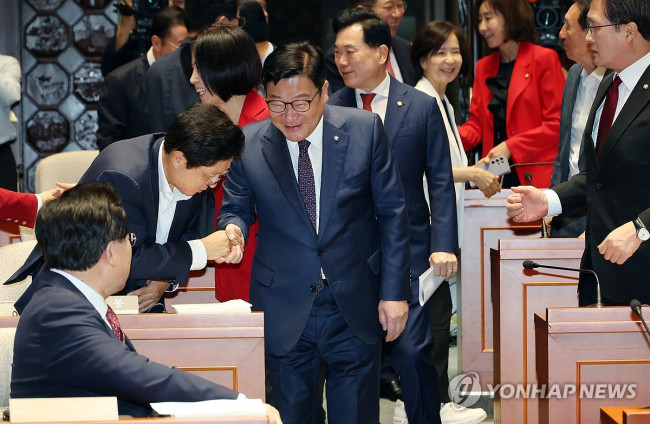 PPP's general meeting fails to adopt 'People's Voting Rights Protection Act' as party platform; agrees to further discussions
Floor Leader Jeong Jeom-sik attending the policy general meeting of lawmakers [Seoul=Yonhap News]On the 3rd, the People Power Party planned to adopt as a party platform a bill to reform the National E
PPP's general meeting fails to adopt 'People's Voting Rights Protection Act' as party platform; agrees to further discussions
Floor Leader Jeong Jeom-sik attending the policy general meeting of lawmakers [Seoul=Yonhap News]On the 3rd, the People Power Party planned to adopt as a party platform a bill to reform the National E
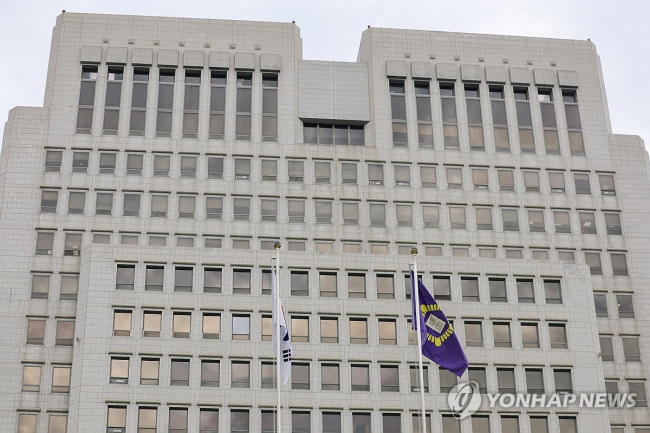 27 legal professionals from the Seoul National University Law School class of '76: "The Blue House’s demand for the reappointment of Supreme Court Justices is unjust."
The Supreme Court of Korea [Seoul=Yonhap News] Twenty-seven legal professionals from the Seoul National University College of Law's class of '76 issued a joint statement on the 3rd, criticizing P
27 legal professionals from the Seoul National University Law School class of '76: "The Blue House’s demand for the reappointment of Supreme Court Justices is unjust."
The Supreme Court of Korea [Seoul=Yonhap News] Twenty-seven legal professionals from the Seoul National University College of Law's class of '76 issued a joint statement on the 3rd, criticizing P
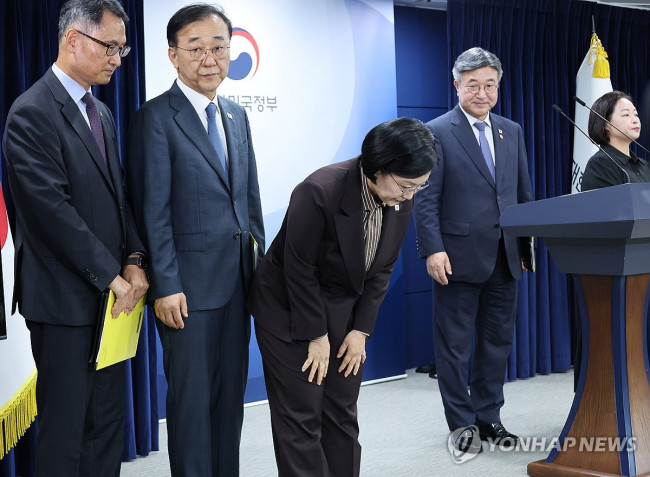 Relocation of Public Institutions to Begin Next Year… "Minimize Retention in Capital Region, Reduce 109 Institutions"
The government will begin the full-scale relocation of administrative and public institutions starting in the first half of next year.It is also launching reforms to reduce the number of public instit
Relocation of Public Institutions to Begin Next Year… "Minimize Retention in Capital Region, Reduce 109 Institutions"
The government will begin the full-scale relocation of administrative and public institutions starting in the first half of next year.It is also launching reforms to reduce the number of public instit
 [New Book] The True Face of the Ivory Tower Hidden in the Shadow of Power… Park Sun-kyung’s ‘Misaki’
The university campus, often called a sanctuary of intellect. A new novel has been published that sharply dissects the hypocrisy and absurdity committed within those solid walls of power. &
[New Book] The True Face of the Ivory Tower Hidden in the Shadow of Power… Park Sun-kyung’s ‘Misaki’
The university campus, often called a sanctuary of intellect. A new novel has been published that sharply dissects the hypocrisy and absurdity committed within those solid walls of power. &
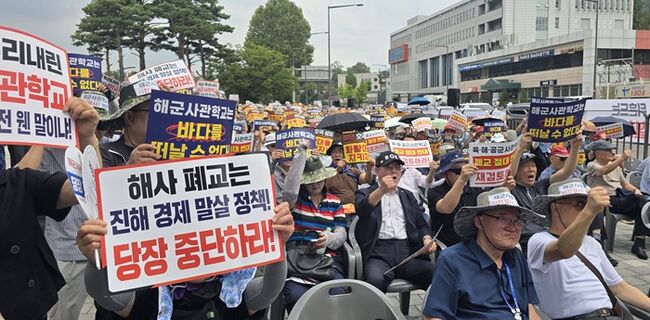 [Photo] “We Oppose the Closing of the Military Academy”… Large-Scale Protest Held in Front of the War Memorial on the 26th
The "National Solidarity for Preventing the Closure of Military Academies" held a rally to protest the closure of military academies at the plaza in front of the War Memorial of Korea in Samgakji, Seo
[Photo] “We Oppose the Closing of the Military Academy”… Large-Scale Protest Held in Front of the War Memorial on the 26th
The "National Solidarity for Preventing the Closure of Military Academies" held a rally to protest the closure of military academies at the plaza in front of the War Memorial of Korea in Samgakji, Seo
 [Trending Destinations] The Leisure of Seoul's Hangang Bus and the Romance of Hong Kong's Star Ferry
Hannam Bridge viewed from the Hangang Bus. [Video = Reporter Lim Yo-hee]With the introduction of the Hangang Bus, Seoul—which previously lacked sufficient water-based public transport—has gained a
[Trending Destinations] The Leisure of Seoul's Hangang Bus and the Romance of Hong Kong's Star Ferry
Hannam Bridge viewed from the Hangang Bus. [Video = Reporter Lim Yo-hee]With the introduction of the Hangang Bus, Seoul—which previously lacked sufficient water-based public transport—has gained a
 [Jung Jae-hak’s From Jeolla-do] Listening to Patti Kim’s ‘Song of September’
Today, as it has been all day long, the heat wave has been sculpting clouds, and the wind has been gathering them. Thus, from the early evening through the night, the sound of rain persists.&nbs
[Jung Jae-hak’s From Jeolla-do] Listening to Patti Kim’s ‘Song of September’
Today, as it has been all day long, the heat wave has been sculpting clouds, and the wind has been gathering them. Thus, from the early evening through the night, the sound of rain persists.&nbs
 [Issue Commentary] 3 Reasons Why the Lee Jae-myung Trial Must Proceed
 [Editorial Cartoon] A Draconian Law That Undermines Freedom of Expression

 List
List