Kim Il-sung appears with Soviet troops at the 'Pyongyang Citizens' Rally to Welcome the Red Army' in the autumn of 1945.
If one were to pinpoint a single original sin of pro-North Korea left-wing discourse, it would be the initial framing that "made Kim Il-sung a liberation hero."
This is not merely a matter of assessing an individual's character. It is at this point that the technique of transforming facts into myth and, based on that myth, overturning the judgment criteria of Korean society began.
The chaos and lack of information immediately after liberation are understandable. However, chaos is merely an ingredient for explanation; it cannot be a get-out-of-jail-free card. The responsibility is even greater for discourse that has distorted facts under the guise of "nationalism."
Chistiakov Introduces Kim Il-sung as a National Hero
The mass rally held on October 14, 1945, at the Pyongyang Public Stadium, then the Pyongyang Municipal Stadium, is a symbolic event. Records show that Soviet General Ivan Mikhailovich Chistiakov introduced Kim Il-sung to the crowd as a "famous guerrilla leader" and a "national hero."
The core of this scene is not the adjectives. It is about who, with what authority, and in what context, defined that person as a hero.
Liberation heroes are formed through public scrutiny and the accumulation of time. However, the moment an occupying force general declares from a platform, "This person is a hero," it exerts power not as a national narrative but as a political project of the occupying power.
This scene clearly shows that Kim Il-sung was not a leader who emerged as a result of popular consensus but a figurehead required by the occupying power.
The Soviet military administration controlled the administrative, security, and propaganda systems in the northern region and needed a symbol to legitimize the new order. Kim Il-sung was chosen as that symbol.
The first distortion committed by the pro-North Korea left-wing is precisely in erasing the nature of this scene. It transformed a stage set by an occupying power into a heroic narrative created by the nation itself.
Pro-North Korea Leftists Fabricated Kim Il-sung's Heroic Narrative
Kim Il-sung reigned as the leader of North Korea after the establishment of the Democratic People's Republic of Korea on September 9, 1948. He became Chairman of the State Affairs Commission in 1972 and never relinquished power until his death on July 8, 1994.
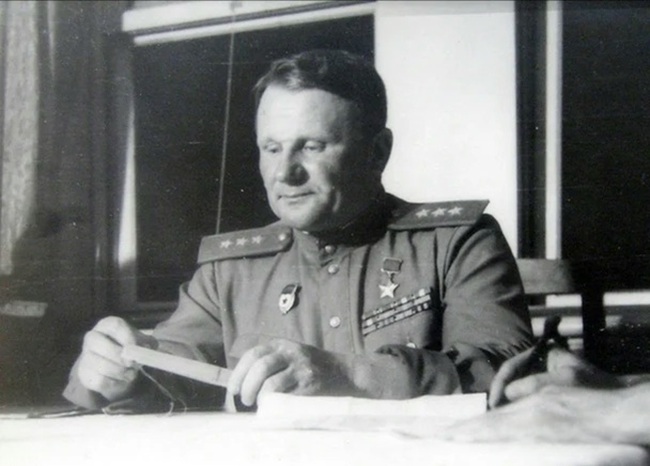 Ivan Chistiakov, Commander of the 25th Army and the highest military commander of the Soviet army that entered north of the 38th parallel after liberation. [Photo: Media Korean Studies]
This simple timeline is sufficient to explain the nature of power. However, in pro-North Korea left-wing discourse, this timeline has been used not as a tool to explain facts but as a background device to solidify a myth.
Starting with the term "liberation hero," it ultimately established an unassailable sanctuary. A heroic narrative is the cheapest device to block questions and criticism.
There is one question that must be addressed here. By whose hands was liberation achieved? Japan's defeat in August 1945 was not the achievement of any specific individual but the outcome of the entire Pacific War. It was the result of the combined efforts of the United States and its allies in fighting the war, and the Soviet Union's participation against Japan.
The Soviet army entered Manchuria and northern Korea in August, and the northern region was soon reorganized under the Soviet military administration. Under these conditions, the path for a specific individual to emerge as a "liberation hero" was already predetermined.
When an occupying power holds the machinery of administration, security, and propaganda, and that machinery bestows a halo upon an individual, the public is prone to accept that image due to a lack of information. This is especially true in situations like immediately after liberation when the media was not yet organized and alternative information flow was blocked.
The responsibility of the pro-North Korea left-wing lies precisely here. They repackaged an image created by an occupying power as if it were a truth independently verified by the nation. This was not a simple misunderstanding but an active distortion.
The immediate counterargument is always the same: "But the North carried out reforms." Indeed, the land reform spearheaded by the Provisional People's Committee for North Korea was promulgated on March 5, 1946, and executed in a short period. However, the existence of reforms does not automatically grant the qualification of a hero.
More importantly, under what power structure and at the cost of what freedoms were those reforms implemented? Reforms carried out in a state where opposition parties were systematically suppressed, and freedom of the press and association, and electoral competition were eliminated, are nothing more than an oppressive ruling technique, not a citizen's choice.
The Pillar Supporting the Myth: 'Silence'
The logic of the pro-North Korea left-wing always stops at this point. They repeatedly talk about "what was done," but they do not talk about "what freedoms were eliminated."
They mention land reform but erase the political competition eliminated and the opposition figures purged during that process. The myth of the hero is sustained by this silence. What is not said becomes the pillar supporting the myth.
The narrative that frames Kim Il-sung as a liberation hero becomes a very convenient weapon within Korean society. Criticizing Kim Il-sung leads to being branded as "negating the nation," and criticizing the North Korean regime leads to accusations of "solidifying division."
The moment this frame operates, the discussion ends. What remains is not argumentation but faith. The pro-North Korea left-wing mocks religion, but the Kim Il-sung myth they have created is more fragile and more dangerous than religion.
Religion, at least, strives to refine its doctrines, undergo internal debates, and maintain a certain logical consistency.
In contrast, the Kim Il-sung myth does not even demand such intellectual integrity. It is maintained solely by taboos, stigmatization, and moral coercion. The moment one questions, one is excluded; the moment one quibbles, one is attacked. This is not an ideology but a remnant of dictatorial power.
The act of making Kim Il-sung a "liberation hero" immediately after liberation was not an evaluation of facts but a choice to uncritically accept the propaganda apparatus of the occupying power. And to justify that choice, the pro-North Korea left-wing has spent 80 years covering up countless realities and silencing countless questions.
Everything began to go wrong from here. They did not erect a hero; they erected an idol that could not be criticized. And a society where an idol is erected inevitably heads towards tragedy.
Poet, Historian, Philosopher, Translator
◆ Songsan
A poet and researcher of history and philosophy, Songsan previously served as a director of the Syngman Rhee Institute. Currently, he is a research advisor for the Korea Modern and Contemporary History Research Society and the representative of the Philosophy Forum Lyceum. He has published four poetry collections and co-translated "Hero of Hook Goji." Songsan is a pseudonym.

 [Statement by the Seo-beo-kka Korea Military Academy Save-the-Nation Comrades Association] ㉛ Recount the Votes Publicly, as the Previous Recount Concealed Election Fraud
Tongyeong Mayoral Election Recount [Photo=Yonhap News]South Korea's liberal democracy is dying. The National Election Commission (NEC) and the judiciary, which have plummeted into criminal syndicates
[Statement by the Seo-beo-kka Korea Military Academy Save-the-Nation Comrades Association] ㉛ Recount the Votes Publicly, as the Previous Recount Concealed Election Fraud
Tongyeong Mayoral Election Recount [Photo=Yonhap News]South Korea's liberal democracy is dying. The National Election Commission (NEC) and the judiciary, which have plummeted into criminal syndicates
 What is the significance of the "Trump 2028" red hats that keep making a comeback?
It is noteworthy that President Donald Trump is "intentionally" fueling controversy over whether he can actually run in the 2028 presidential election, even though it is "highly likely he is seriously
What is the significance of the "Trump 2028" red hats that keep making a comeback?
It is noteworthy that President Donald Trump is "intentionally" fueling controversy over whether he can actually run in the 2028 presidential election, even though it is "highly likely he is seriously
 Jin Cummings: "North Korea says it will increase the number of spies, so what is the government doing?"
U.S. political columnist Gene Cummings has publicly questioned the South Korean government, asking, "North Korea is announcing plans to increase its number of spies, yet what is the South Korean
Jin Cummings: "North Korea says it will increase the number of spies, so what is the government doing?"
U.S. political columnist Gene Cummings has publicly questioned the South Korean government, asking, "North Korea is announcing plans to increase its number of spies, yet what is the South Korean
 Attorney Do Tae-woo: “Discrepancies in Voter Count and Improper Sealing Confirmed in Tongyeong Mayoral Recount… Official Request for Additional Verification Submitted to Gyeongnam Election Commission”
A bundle of mail-in early voting ballots captured by lawyer Do Tae-woo at the Tongyeong mayoral election recount site. A clear solid line, raising suspicions of election fraud, is visible on the side
Attorney Do Tae-woo: “Discrepancies in Voter Count and Improper Sealing Confirmed in Tongyeong Mayoral Recount… Official Request for Additional Verification Submitted to Gyeongnam Election Commission”
A bundle of mail-in early voting ballots captured by lawyer Do Tae-woo at the Tongyeong mayoral election recount site. A clear solid line, raising suspicions of election fraud, is visible on the side
 Stock Market Crash 'Black Tuesday'… KOSPI down 10.8%, KOSDAQ down 7.7%
The KOSPI fell by more than 5% in early trading on the 28th, triggering a sell-side sidecar.On the 28th, the KOSPI plunged by more than 10%.Due to the sharp decline, a sell-side sidecar—a temporary
Stock Market Crash 'Black Tuesday'… KOSPI down 10.8%, KOSDAQ down 7.7%
The KOSPI fell by more than 5% in early trading on the 28th, triggering a sell-side sidecar.On the 28th, the KOSPI plunged by more than 10%.Due to the sharp decline, a sell-side sidecar—a temporary
 [World Heritage Committee] 25 New World Heritage Sites Inscribed in Busan… South Korea Successfully Expands 'Getbol' Listing
The Chairperson of the World Heritage Committee speaks at the plenary session of the 48th session of the World Heritage Committee, held at BEXCO in Busan on the 20th. [Photo: Yonhap News]A total of 25
[World Heritage Committee] 25 New World Heritage Sites Inscribed in Busan… South Korea Successfully Expands 'Getbol' Listing
The Chairperson of the World Heritage Committee speaks at the plenary session of the 48th session of the World Heritage Committee, held at BEXCO in Busan on the 20th. [Photo: Yonhap News]A total of 25
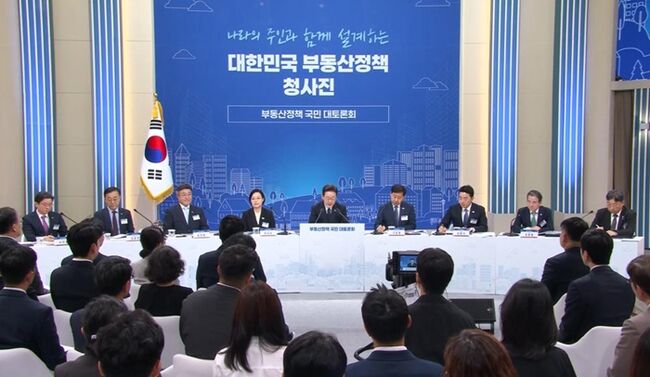 [Liberal Democratic Party Statement] Calling it a Grand Real Estate Debate… It Was Nothing More Than a Private Party Among Themselves
The 'National Grand Debate on Real Estate Policy' held on July 23rd and 27th. [Photo=Yonhap News]The 'National Grand Debate on Real Estate Policy,' hosted by the Lee Jae-myung administration under the
[Liberal Democratic Party Statement] Calling it a Grand Real Estate Debate… It Was Nothing More Than a Private Party Among Themselves
The 'National Grand Debate on Real Estate Policy' held on July 23rd and 27th. [Photo=Yonhap News]The 'National Grand Debate on Real Estate Policy,' hosted by the Lee Jae-myung administration under the
 [Photo] Evidence of Election Fraud Flooding U.S. Media… Trump Had 2.7 Million Votes Stolen
 [Video] U.S. Semiquincentennial Air Show... 'Art in the Sky' streaks across New York
 [Editorial Cartoon] A Draconian Law That Undermines Freedom of Expression

 List
List