First President Syngman Rhee declares the establishment of the Republic of Korea at the Central Government Building in Jongno-gu, Seoul, on August 15, 1948. [Photo=Public Domain]
A framework like “South Korea as the perpetrator vs. North Korea as the victim” is not historical explanation but political propaganda.
The division was not a confrontation between good and evil, but the cumulative result of great power occupation and the political choices made under them. However, pro-North Korea left-wing discourse has transformed the division, from the immediate aftermath of liberation to the present, from a matter of fact into a game of finding a culprit.
That game ends with the conclusion that “the responsibility for division lies with South Korea, or the United States.” It's a very convenient method. Because it allows the elimination of the choices made by the North and the Soviet occupation rule in their entirety. In other words, it erases the North's decisions, which were one of the forces that created the division, from reality and puts only South Korea on trial.
Emphasis on ‘US Military Government’, Downplaying ‘Soviet Military Government’
Immediately after liberation, the Korean Peninsula was a space militarily occupied by the US and the Soviet Union. Without considering this point, a fair analysis of the division is impossible. The North was reorganized under the Soviet military and administrative system, which typically lasted from 1945 to 1948.
Its nature was closer to “politics designed and managed by the occupying power” rather than “politics decided by Koreans themselves.” Administrative personnel, public security, political organizations, and propaganda systems were under the control of the occupying forces, and pluralistic political competition was structurally not allowed.
However, pro-North Korea leftists blur this basic premise when discussing the division. They exaggerate the ‘US Military Government’ and downplay the ‘Soviet Military Government’. In this unbalanced historical narrative, the conclusion is already predetermined.
The Moscow Three-Power Foreign Ministers' Conference in December 1945 was an attempt to resolve the Korean issue within an international framework. The trusteeship plan discussed here envisioned an administrative system involving four countries: the US, the Soviet Union, the UK, and China. This decision provoked a violent backlash in Korean society, and the debate between pro-trusteeship and anti-trusteeship took center stage in politics.
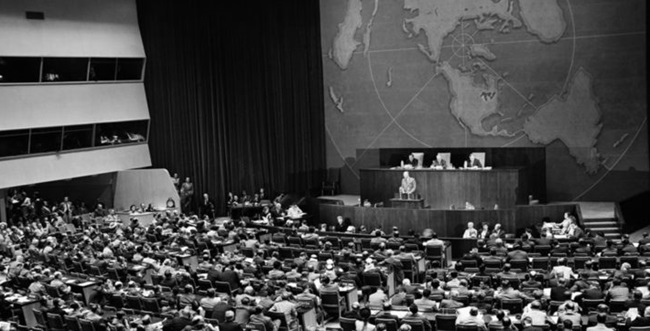 The General Assembly meeting hall in Flushing, New York, USA, used from 1946 to 1951. UN General Assembly Resolution 112, adopted on November 14, 1947, resolved to establish an independent government by holding free general elections throughout North and South Korea based on population proportion, in relation to the independence and unification of the Korean Peninsula. [Photo=Public Domain]
However, what is important is not whether one supported or opposed trusteeship. What determined the division was not slogans, but which systems and procedures actually operated afterward. Pro-North Korea leftists have evaded this question.
Instead, they left a simplistic scheme that “South Korea used anti-trusteeship to create the division.” However, whether it was pro-trusteeship or anti-trusteeship, division does not happen automatically just by itself. Division is completed through the choices of power and the solidification of institutions.
In November 1947, the UN General Assembly became seriously involved in the Korean issue. The establishment of the United Nations Temporary Commission on Korea (UNTCOK) was an attempt to establish a government on the Korean Peninsula through minimal international procedures.
UN General Assembly Resolution 112 (II) clearly stated the intention to elect representatives through elections and proceed to establish a government with those representatives. At this point, the core is the procedure of ‘election’. While elections do not guarantee unification, they at least provide a starting point for legitimacy.
However, in reality, elections could not be held throughout the entire Korean Peninsula. This was because the UN's observation and access were blocked by the North. In a situation where UN bodies could not enter the northern region, elections for the entire Korean Peninsula became physically impossible.
Under these conditions, South Korea faced a choice. Should they indefinitely postpone the elections and maintain a power vacuum, or should they form a state within the possible scope? Ultimately, general elections were held in South Korea on May 10, 1948, and the government of the Republic of Korea was established on August 15 of the same year.
Hypocrisy of Shifting the Blame for the Failure of a Unified Government to South Korea
This process was not because “South Korea wanted the division,” but rather a result of choosing a realistically possible procedure amidst conditions where the division was already solidifying due to occupation and the North's closure.
Conversely, the North also made a choice. On August 25, 1948, the North claimed to have held elections for the Supreme People's Assembly, institutionalizing its system, and on September 9, declared the establishment of its state.
This was not a simple reaction to the establishment of the South's government but a choice by the North itself to nationalize. In other words, the institutional solidification of the division was not solely an act by the South but was completed with the establishment of a separate state by the North. Without recognizing this symmetry, the history of division becomes propaganda, not explanation.
Pro-North Korea left-wing discourse intentionally dismantles this symmetry. While characterizing the South's government establishment as the “original sin of division,” they propagandize the North's state establishment as an “unavoidable defense” or “historical inevitability.”
However, in reality, both are state establishments. Both resulted in the effective dismantling of the goal of a unified government on the Korean Peninsula. Despite this, the responsibility is attributed solely to South Korea. This is hypocrisy.
What is more cowardly is that this discourse always cloaks itself in morality. It begins with words like ‘peace’, ‘nation’, and ‘unification’, but in reality, it evades factual verification and responsibility analysis.
If we are to assign responsibility for the division, at least several questions cannot be avoided. Why is the process by which the North solidified a one-party system under Soviet military rule and eliminated its opponents excluded from the list of causes for division?
Why is the reality that prevented UN procedures from operating throughout the entire Korean Peninsula reduced solely to South Korea's responsibility? Why is the fact that separate elections and separate state establishments in 1948 institutionalized the division sanitized with the words “justified response”?
In the face of these questions, pro-North Korea leftists are always silent. Or they wield the shield of emotion, saying, “Is this the time to say that?” However, emotion is not explanation. Once division occurs, all subsequent generations pay the price. The costs of security, diplomacy, and internal conflict accumulate across generations. Therefore, when discussing responsibility for division, a minimum of honesty is required.
The discourse of pro-North Korea leftists, which shifts the blame solely to South Korea, is not honest. It is self-absolution that “we are always right,” and a distortion of history that erases the formation of the North Korean regime and the intervention of Soviet occupying power.
Cowardly pro-North Korea leftists have claimed to want to overcome the division, but in reality, they have been more focused on gaining moral superiority by exploiting the division. The result is that the division remains, the propaganda grows, and the responsibility disappears.
Poet, Historian & Philosopher
◆ Song San (송산)
A poet and researcher of history and philosophy. He is a former director of the Syngman Rhee Academy and currently serves as a research advisor for the Korean Modern and Contemporary History Research Association and as the representative of the Philosophical Forum Lyceum. He has published four poetry collections and co-translated ‘The Hero of Hooko’. Song San is a pen name.

 [Statement by the Seo-beo-kka Korea Military Academy Save-the-Nation Comrades Association] ㉛ Recount the Votes Publicly, as the Previous Recount Concealed Election Fraud
Tongyeong Mayoral Election Recount [Photo=Yonhap News]South Korea's liberal democracy is dying. The National Election Commission (NEC) and the judiciary, which have plummeted into criminal syndicates
[Statement by the Seo-beo-kka Korea Military Academy Save-the-Nation Comrades Association] ㉛ Recount the Votes Publicly, as the Previous Recount Concealed Election Fraud
Tongyeong Mayoral Election Recount [Photo=Yonhap News]South Korea's liberal democracy is dying. The National Election Commission (NEC) and the judiciary, which have plummeted into criminal syndicates
 What is the significance of the "Trump 2028" red hats that keep making a comeback?
It is noteworthy that President Donald Trump is "intentionally" fueling controversy over whether he can actually run in the 2028 presidential election, even though it is "highly likely he is seriously
What is the significance of the "Trump 2028" red hats that keep making a comeback?
It is noteworthy that President Donald Trump is "intentionally" fueling controversy over whether he can actually run in the 2028 presidential election, even though it is "highly likely he is seriously
 Jin Cummings: "North Korea says it will increase the number of spies, so what is the government doing?"
U.S. political columnist Gene Cummings has publicly questioned the South Korean government, asking, "North Korea is announcing plans to increase its number of spies, yet what is the South Korean
Jin Cummings: "North Korea says it will increase the number of spies, so what is the government doing?"
U.S. political columnist Gene Cummings has publicly questioned the South Korean government, asking, "North Korea is announcing plans to increase its number of spies, yet what is the South Korean
 Attorney Do Tae-woo: “Discrepancies in Voter Count and Improper Sealing Confirmed in Tongyeong Mayoral Recount… Official Request for Additional Verification Submitted to Gyeongnam Election Commission”
A bundle of mail-in early voting ballots captured by lawyer Do Tae-woo at the Tongyeong mayoral election recount site. A clear solid line, raising suspicions of election fraud, is visible on the side
Attorney Do Tae-woo: “Discrepancies in Voter Count and Improper Sealing Confirmed in Tongyeong Mayoral Recount… Official Request for Additional Verification Submitted to Gyeongnam Election Commission”
A bundle of mail-in early voting ballots captured by lawyer Do Tae-woo at the Tongyeong mayoral election recount site. A clear solid line, raising suspicions of election fraud, is visible on the side
 Stock Market Crash 'Black Tuesday'… KOSPI down 10.8%, KOSDAQ down 7.7%
The KOSPI fell by more than 5% in early trading on the 28th, triggering a sell-side sidecar.On the 28th, the KOSPI plunged by more than 10%.Due to the sharp decline, a sell-side sidecar—a temporary
Stock Market Crash 'Black Tuesday'… KOSPI down 10.8%, KOSDAQ down 7.7%
The KOSPI fell by more than 5% in early trading on the 28th, triggering a sell-side sidecar.On the 28th, the KOSPI plunged by more than 10%.Due to the sharp decline, a sell-side sidecar—a temporary
 [World Heritage Committee] 25 New World Heritage Sites Inscribed in Busan… South Korea Successfully Expands 'Getbol' Listing
The Chairperson of the World Heritage Committee speaks at the plenary session of the 48th session of the World Heritage Committee, held at BEXCO in Busan on the 20th. [Photo: Yonhap News]A total of 25
[World Heritage Committee] 25 New World Heritage Sites Inscribed in Busan… South Korea Successfully Expands 'Getbol' Listing
The Chairperson of the World Heritage Committee speaks at the plenary session of the 48th session of the World Heritage Committee, held at BEXCO in Busan on the 20th. [Photo: Yonhap News]A total of 25
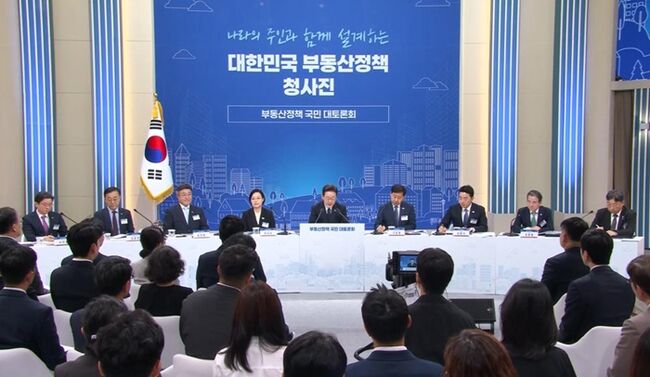 [Liberal Democratic Party Statement] Calling it a Grand Real Estate Debate… It Was Nothing More Than a Private Party Among Themselves
The 'National Grand Debate on Real Estate Policy' held on July 23rd and 27th. [Photo=Yonhap News]The 'National Grand Debate on Real Estate Policy,' hosted by the Lee Jae-myung administration under the
[Liberal Democratic Party Statement] Calling it a Grand Real Estate Debate… It Was Nothing More Than a Private Party Among Themselves
The 'National Grand Debate on Real Estate Policy' held on July 23rd and 27th. [Photo=Yonhap News]The 'National Grand Debate on Real Estate Policy,' hosted by the Lee Jae-myung administration under the
 [Photo] Evidence of Election Fraud Flooding U.S. Media… Trump Had 2.7 Million Votes Stolen
 [Video] U.S. Semiquincentennial Air Show... 'Art in the Sky' streaks across New York
 [Editorial Cartoon] A Draconian Law That Undermines Freedom of Expression

 List
List