On the 22nd, Supreme Council Member Shin Dong-wook speaks at a Supreme Council meeting of the People Power Party. [Photo = Screenshot from Pen & Mic]
The priorities of the Democratic Party have once again been revealed to the public.
Despite the unprecedented incident where voters' right to vote was effectively blocked due to a shortage of ballots in the June 3rd local elections, the Democratic Party is framing demands for a state audit and special prosecutor investigation into this issue as "political exploitation." Conversely, they are persistently clinging to the idea of a special prosecutor for a fabricated indictment, or the withdrawal of charges, targeting the criminal trial of Lee Jae-myung.
The public cannot help but ask: For the Democratic Party, which is more important, the people's vote or the criminal trial of a key figure in power?
We (referring to the publication) view this incident, where voters' opportunities to vote were actually blocked due to a shortage of ballots, as an election fraud involving the deprivation of the right to participate in politics through dereliction of duty.
Elections are not justified solely by the vote count. An election requires that voters can cast their ballots without obstruction at the designated time and place. If the nation fails to properly prepare the ballots, preventing people from voting, it is not a simple administrative error. It is an election fraud case where the right to participate in politics, guaranteed by the constitution, has been deprived.
The June 3rd election fraud incident should not be minimized for the benefit of any specific political party.
It has been revealed that voters could not vote due to a shortage of ballots, voting was suspended at some polling stations, and the National Election Commission's reporting and command structure did not function properly.
It has also come to light that the Seoul Metropolitan Election Commission decided to extend voting hours without reporting or discussing it with the National Election Commission, and in Songpa-gu, counting began before voting had concluded, which is a confirmed issue.
This is not a mere procedural flaw but a problem where the temporal boundary between voting and vote counting has been blurred.
Given this, an independent investigation and state audit are not options but minimum procedures. This is a matter of constitutional order that cannot be resolved solely by an internal investigation and disciplinary action within the Election Commission.
Through a special prosecutor and state audit, we must ascertain who made the incorrect prediction of ballot demand, why the reporting system failed, why the on-site response collapsed, how many voters were actually unable to exercise their right to vote, and who is responsible.
However, the Democratic Party is notably defensive on this matter.
When the People Power Party demands a special prosecutor, they react by calling it an attempt to "tarnish the Lee Jae-myung administration." While they claim they would open a special prosecutor investigation if necessary, they are actually directing their political energy elsewhere: towards a special prosecutor to address the fabricated indictment (withdrawal of charges) in Lee Jae-myung's criminal trial.
The first-instance guilty verdict in the perjury case involving Lee Hwa-young, former Vice Governor of Gyeonggi Province, concerning the 'salmon liquor party' has further clarified the Democratic Party's stance. The Suwon District Court sentenced Lee to four months in prison for violating the National Assembly Audit and Inspection Act.
While this is not a final ruling, at least the first-instance court has judged the key testimony related to the so-called 'salmon liquor party' as perjury.
Until now, the Democratic Party has used this suspicion as grounds for claims of prosecutorial misconduct, impeachment and disciplinary action against prosecutors, parliamentary hearings and state audits, and a special prosecutor for fabricated indictments. This suspicion has also served as a significant spark in portraying the North Korean remittance case involving Lee Jae-myung as political oppression.
However, if the court has determined the key testimony to be perjury, the Democratic Party's first course of action should be to explain and apologize to the public, not to insist on a special prosecutor.
Yet, the Democratic Party's response was different. They offered the interpretation, "The verdict is guilty, but the substance is not guilty."
When the outcome of a criminal trial is guilty, stating "the substance is not guilty" based on political necessity is a dangerous reinterpretation of the rule of law.
If an uncomfortable guilty verdict is called "substantively not guilty," and an uncomfortable election administration failure is called "political exploitation," then the law, elections, and the public will ultimately be subservient to the language of power.
The offensive launched by the Supreme Council members of the People Power Party against the Democratic Party on the 22nd cannot be seen merely as a simple inter-party dispute.
Supreme Council Member Shin Dong-wook criticized the 'salmon liquor party' allegations as a "grand deception of the public" and demanded an apology from the Democratic Party. Supreme Council Member Kim Min-soo argued that the essence of the illegal North Korean remittance case is obscured behind these allegations.
Regardless of the intensity of the expression, the core issue is one: Is it truly normal to push for a special prosecutor to withdraw charges based on testimony deemed perjured?
If the Democratic Party truly wishes to speak of democracy and the rule of law, the order must be reversed. The truth-finding investigation into the June 3rd election fraud, where the public's right to vote was effectively blocked, must come first.
An independent investigation must reveal why the Election Commission failed to prepare sufficient ballots, why the reporting system collapsed, why vote counting began before voting concluded, and who should bear what responsibility.
Conversely, the special prosecutor for fabricated indictments (withdrawal of charges) is intrinsically linked to the criminal trial of Lee Jae-myung. While the Democratic Party may package this as prosecutorial reform, to the public, it can only appear as legislation to shield a key figure in power from trial risks.
If the issue of a powerful individual's criminal trial takes precedence over the issue of the entire public's right to participate in politics, it is not reform. It is the privatization of the rule of law.
The Democratic Party must now answer.
Is a special prosecutor to withdraw charges more important than a special prosecutor for the June 3rd election fraud? Is Lee Jae-myung's trial more important than the public's vote? How long will they continue to apply a double standard, calling allegations of deprivation of the right to participate in politics "political disputes" while labeling efforts related to a powerful figure's trial as "reform"?
The credibility of elections is the minimum foundation of democracy. If that foundation has been shaken, it is the duty of a responsible political party, regardless of party affiliation, to pursue the truth.
If the Democratic Party insists on a special prosecutor for fabricated indictments without an apology, the public will conclude the following:
A special prosecutor that turns away from the public's vote is not reform. It is merely protective legislation for Lee Jae-myung.

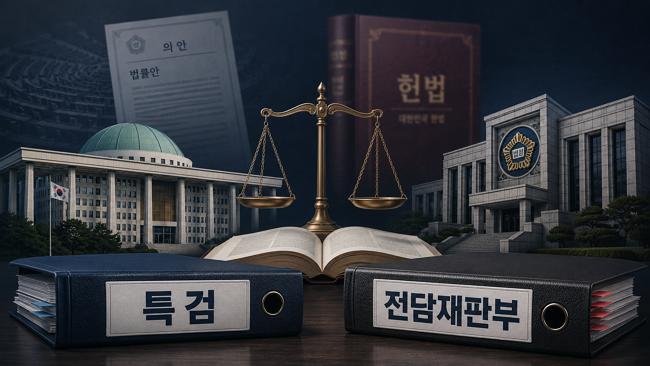 [Special Feature - Disenfranchisement National Assembly Investigation ③] Constitutional Amendment is a Long-term Task, the Law on the Special Court for Insurrection Should Be Applied
Image symbolizing the need for a special prosecutor and dedicated court panels within the existing judicial system to investigate the criminal responsibility for the June 3rd disenfranchisement incide
[Special Feature - Disenfranchisement National Assembly Investigation ③] Constitutional Amendment is a Long-term Task, the Law on the Special Court for Insurrection Should Be Applied
Image symbolizing the need for a special prosecutor and dedicated court panels within the existing judicial system to investigate the criminal responsibility for the June 3rd disenfranchisement incide
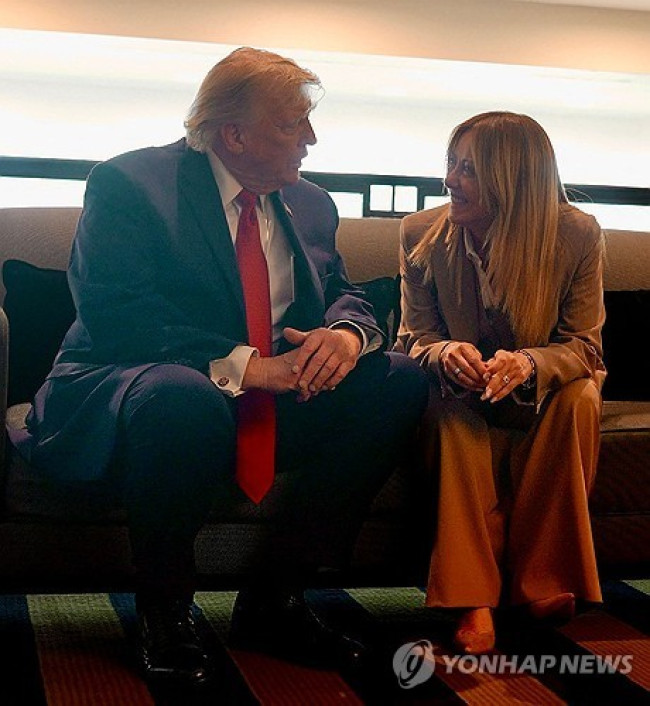 Trump to Italian Prime Minister amid conflict, "We protected you, but you turned away"
U.S. President Donald Trump and Italian Prime Minister Giorgia Meloni converse at the G7 Summit. [AFP=Yonhap News]U.S. President Donald Trump continued his criticism of Italian Prime Minister Gi
Trump to Italian Prime Minister amid conflict, "We protected you, but you turned away"
U.S. President Donald Trump and Italian Prime Minister Giorgia Meloni converse at the G7 Summit. [AFP=Yonhap News]U.S. President Donald Trump continued his criticism of Italian Prime Minister Gi
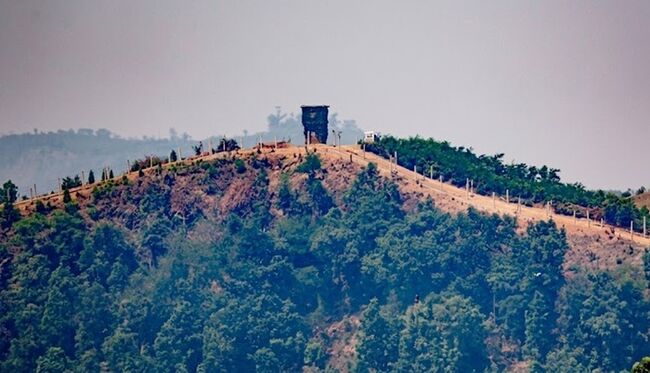 North Korea lays barbed wire and landmines right up to the MDL... JCS "Clear violation of the Armistice Agreement"
A structure believed to be a fence is installed at a North Korean guard post in Kaepung County, viewed from the border area in Paju, Gyeonggi Province. Photographed on the 19th. [Photo=Yonhap News]Nor
North Korea lays barbed wire and landmines right up to the MDL... JCS "Clear violation of the Armistice Agreement"
A structure believed to be a fence is installed at a North Korean guard post in Kaepung County, viewed from the border area in Paju, Gyeonggi Province. Photographed on the 19th. [Photo=Yonhap News]Nor
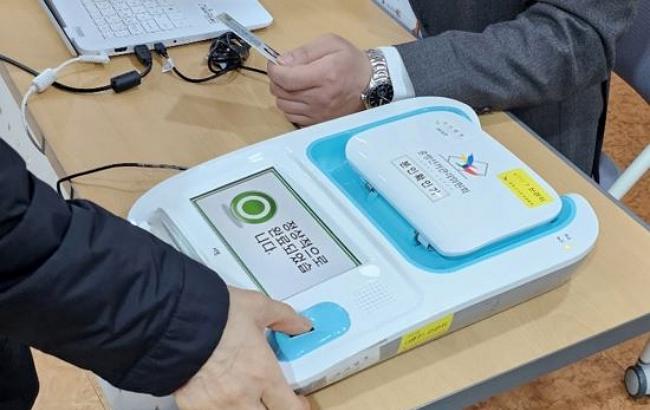 [Analysis] "Identity Verification Devices" as seen in the Daegu Case... Concerns of Voting Rights Infringement "Become Reality"
Identity verification device installed at a prior voting station. [Photo=Yonhap News] The First Gateway to Guaranteeing Voting Rights Has Been Breached The core issue of the prior voting ide
[Analysis] "Identity Verification Devices" as seen in the Daegu Case... Concerns of Voting Rights Infringement "Become Reality"
Identity verification device installed at a prior voting station. [Photo=Yonhap News] The First Gateway to Guaranteeing Voting Rights Has Been Breached The core issue of the prior voting ide
 [HANMI DATA LAB] June Week 3 (15-19) Money Insight
The left side of the screen contrasts growth assets such as AI, semiconductors, automobiles, and industrial equipment, while the right side displays defensive assets like the Federal Reserve, banks, a
[HANMI DATA LAB] June Week 3 (15-19) Money Insight
The left side of the screen contrasts growth assets such as AI, semiconductors, automobiles, and industrial equipment, while the right side displays defensive assets like the Federal Reserve, banks, a
 [Travel Destinations for the Month of National Defense] ③ Walking the Border Area of the Demilitarized Zone... DMZ Peace Trail Goseong Course
'DMZ Peace Road,' where visitors can see the ecological, cultural, and historical resources of the border areas of the Demilitarized Zone and experience the preciousness of peace firsthand. [Photo by
[Travel Destinations for the Month of National Defense] ③ Walking the Border Area of the Demilitarized Zone... DMZ Peace Trail Goseong Course
'DMZ Peace Road,' where visitors can see the ecological, cultural, and historical resources of the border areas of the Demilitarized Zone and experience the preciousness of peace firsthand. [Photo by
 [Photo] Freedom High School Alliance installs banner in Gangdong-gu, Seoul: "June 3rd Fraudulent Election Rerun, In-person Voting, On-site Counting"
The Korea High School Union installed a banner in the Gangdong-gu district of Seoul on the 21st with the slogan "June 3rd Fraudulent Election Re-election, Same-Day Vote Count." The banner also states,
[Photo] Freedom High School Alliance installs banner in Gangdong-gu, Seoul: "June 3rd Fraudulent Election Rerun, In-person Voting, On-site Counting"
The Korea High School Union installed a banner in the Gangdong-gu district of Seoul on the 21st with the slogan "June 3rd Fraudulent Election Re-election, Same-Day Vote Count." The banner also states,
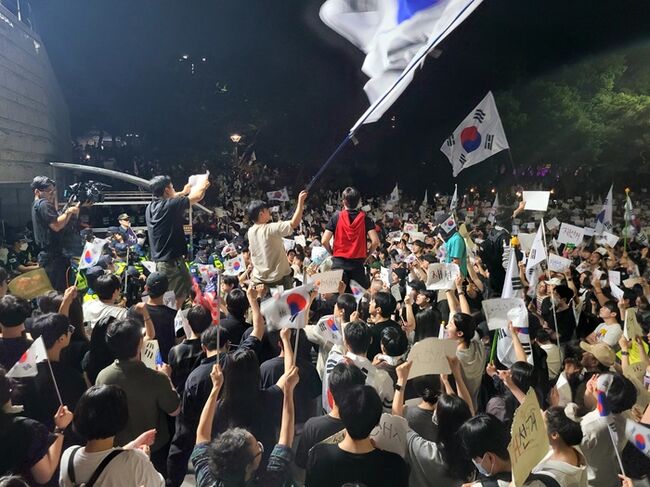 [Kim Jae-soo Column] The Last Chance to Abolish the Election Commission and Achieve Transparent Elections
The Republic of Korea is currently outraged by an unprecedented situation in its history and a globally unparalleled reality of disenfranchisement. ⒸKorea-Japan DailyIs Lee Jae-myung the only one un
[Kim Jae-soo Column] The Last Chance to Abolish the Election Commission and Achieve Transparent Elections
The Republic of Korea is currently outraged by an unprecedented situation in its history and a globally unparalleled reality of disenfranchisement. ⒸKorea-Japan DailyIs Lee Jae-myung the only one un
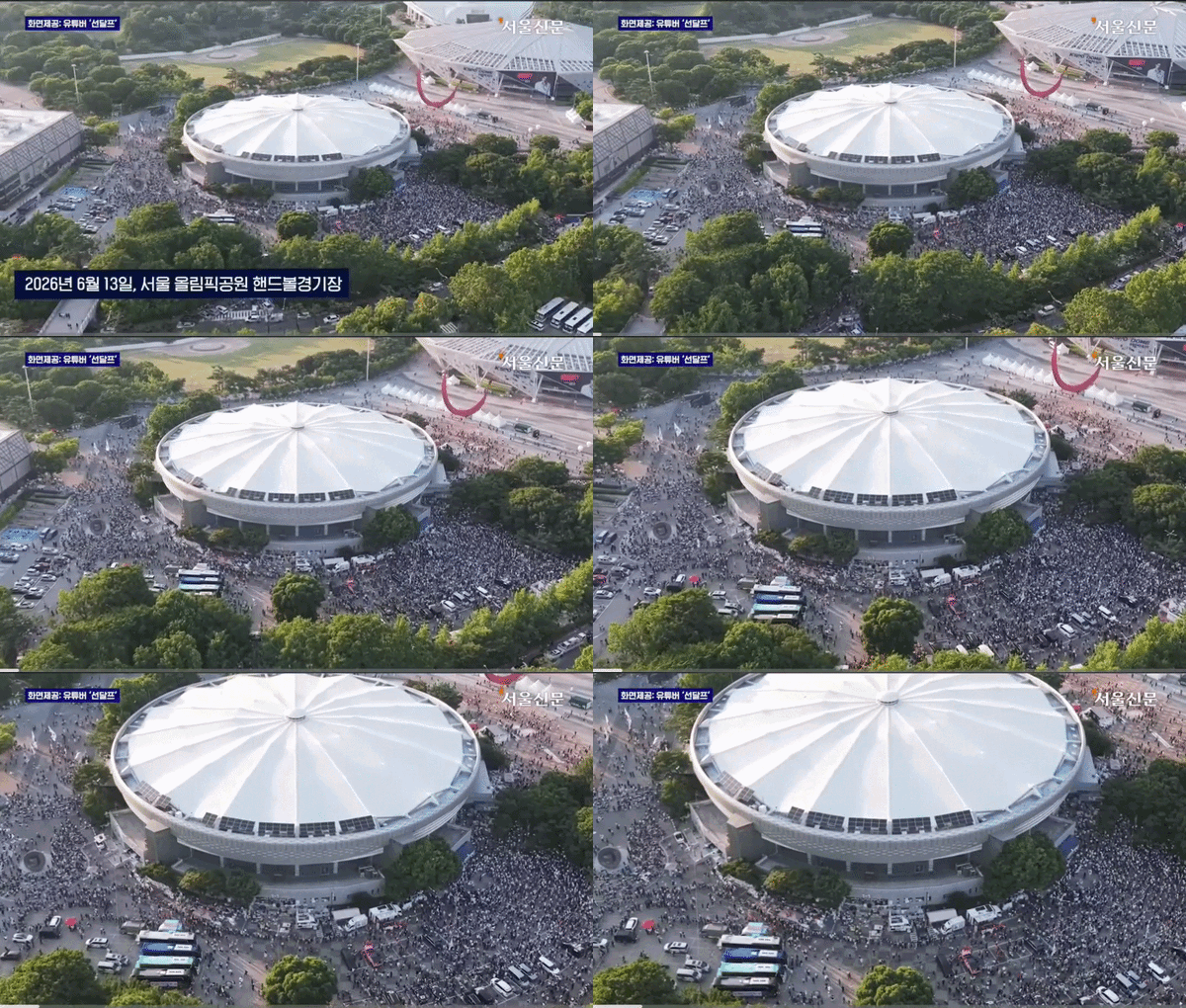 [Video] The Scene of the 'Jamsil Democratization Movement' as Seen from the Sky
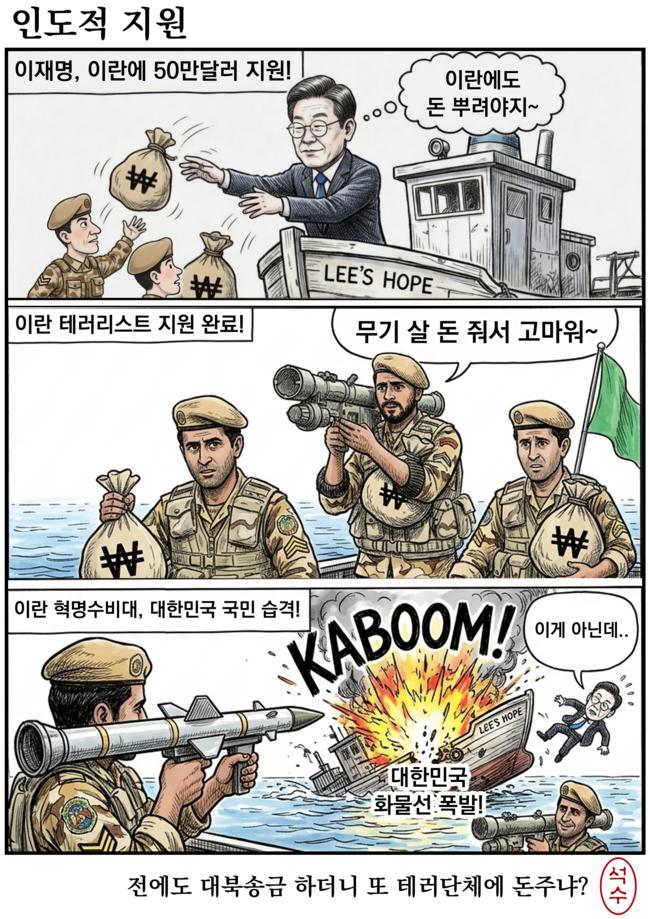 [Editorial Cartoon] Humanitarian Aid

 List
List