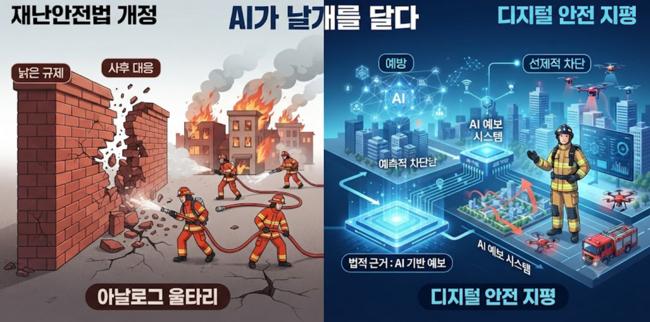
In the middle of the 21st century, South Korea's disaster safety system remains trapped behind the "analog fences" of the 20th century. Even more deplorable is that while the nature of disasters is becoming increasingly complex and violent due to climate change, the bureaucracy in charge of safety policies and regulations remains idle, failing to even include the word "AI (Artificial Intelligence)" in its legislation.
1. Archaic Disaster Management Practices Unsuited for the Advanced Scientific Era
While technology is knocking on the doors of the field with breathtaking advancements, those in charge of the law remain complacent, comfortable in their vested interests. They stifle the seeds of innovation by citing "unverified safety" and "regulatory walls," while relevant government departments engage in a game of ping-pong to avoid responsibility, claiming that incorporating AI into legislation is a new, untested endeavor. Do these bureaucrats truly not realize that such negligence constitutes a dereliction of duty that leaves the public's safety abandoned?
We live in an era where unprecedented disasters—such as massive wildfires, electrical fires in complex urban buildings, and battery thermal runaways—threaten our daily lives. Yet, our fire safety system remains stuck in a reactive mode of "detecting, reporting, and deploying to suppress after a fire has already broken out."
2. Why We Must Reform the Disaster and Safety Management Act First
It is time to clearly introduce the concept of "forecasting" into the Disaster and Safety Management Act and the Fire Prevention Act. This is because the damage caused by a disaster is a function of time. Insisting solely on post-disaster response in the face of fires that spread by the second is inadequate for protecting human lives. Legislating "forecasting" is both a testament to our resolve to shift the paradigm of national disaster response and safety policy from "recovery-centered" to "preemptive prevention," and a fundamental duty of the state. The reasons for prioritizing the amendment of the Disaster and Safety Management Act are as follows:
∆ Codifying the legal definition of "AI-based forecasting": An "early warning system," through which AI detects and notifies of precursor patterns before disasters and fires occur, must be mandated as a legal requirement.
∆ Making forecasting systems mandatory for state-managed facilities: A legal basis for mandatory adoption must be established so that innovative private technologies can be immediately implemented in the public sector.
∆ Removing barriers to technology adoption through regulatory innovation: We must introduce flexible technical standard guidelines that allow AI technology to be integrated into the field without being constrained by outdated facility standards.
∆ Reorganizing field operations based on data: The national disaster management paradigm must be completely transformed from "post-disaster recovery" to "preemptive prevention based on digital data."
∆ Institutional basis for digital safety platforms: The legal responsibilities and authority for technology utilization must be clearly defined so that AI can function as a core tool for disaster situation rooms and on-site command.
3. Expected Benefits of Integrating the "AI-based Forecasting" Concept into the Disaster and Safety Management Act
∆ A grand shift in the disaster management paradigm: Reflecting the concept of "AI-based forecasting" in the Disaster and Safety Management Act will drive a national paradigm shift from "reactive response" to "preemptive prevention," contributing to a safer human civilization.
∆ Maximizing response capabilities: AI can analyze report contents in real-time to secure a golden time and suggest optimal dispatch routes, thereby increasing the success rate of initial suppression.
∆ Ensuring firefighter safety through the scientific approach of field command: Digital twins and AI simulations can predict fire spread paths to prevent misjudgment by on-site fire commanders, while thermal imaging drones can visualize hidden risks to minimize casualties among rescue personnel.
∆ Blocking disasters at the source through constant monitoring: By combining IoT sensors and data analysis algorithms, we can proactively detect high-risk factors like aging facilities and batteries, creating an intelligent, 24/7 preventive safety net.
4. Disasters Are Not an Unavoidable Fate; We Must Reduce Them Through Human Will
Disasters are subjects of management that can be predicted and controlled through data. We must conduct a comprehensive review of the outdated regulations hiding behind the complacency of the bureaucrats who draft safety policies, remove those that do not fit the era of scientific advancement, and allow the law to give wings to AI technology.
Moving toward an era of digital safety that blocks disasters at the source is the most solid duty of a nation to protect the lives of its people and an inevitable task of our time. Relevant safety departments must contribute to building a safer world by adopting AI-based technological innovation. I sincerely hope that this advice regarding South Korea's safety management is taken to heart.

◆ Young-jin Cho, CEO
CEO of Roze AI

 [Statement by the Seo-beokka Korea Military Academy Save-the-Nation Comrades Association] ㉖ Suppressing a Just Struggle for Sovereignty is a Violation of the Constitution and a Grave Crime Equivalent to Insurrection
National Election Commission. [Photo=Yonhap News]The ‘ballot paper shortage’ during the June 3 local elections was an act of constitutional destruction that shook the foundations of South Korean d
[Statement by the Seo-beokka Korea Military Academy Save-the-Nation Comrades Association] ㉖ Suppressing a Just Struggle for Sovereignty is a Violation of the Constitution and a Grave Crime Equivalent to Insurrection
National Election Commission. [Photo=Yonhap News]The ‘ballot paper shortage’ during the June 3 local elections was an act of constitutional destruction that shook the foundations of South Korean d
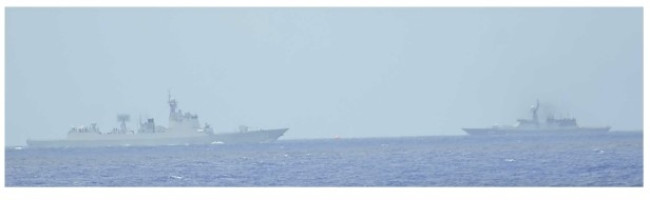 Japan's Ministry of Defense: "China and Russia conduct live-fire naval exercises in Japan's EEZ... China also fires machine guns"
Japan’s Ministry of Defense announced on the 21st that Chinese and Russian naval forces conducted live-fire exercises within Japan's Exclusive Economic Zone (EEZ) on the 19th, including machine gun
Japan's Ministry of Defense: "China and Russia conduct live-fire naval exercises in Japan's EEZ... China also fires machine guns"
Japan’s Ministry of Defense announced on the 21st that Chinese and Russian naval forces conducted live-fire exercises within Japan's Exclusive Economic Zone (EEZ) on the 19th, including machine gun
 Blue House: "We will respect any conclusion on the right to request supplementary investigations... A prompt decision is needed to minimize confusion."
The Blue House [Photo by Lee Jung-hoon] 2025.12.8Regarding the issue of the prosecution's supplementary investigative authority, the Blue House stated on the 21st, "The decision on whether to abolish
Blue House: "We will respect any conclusion on the right to request supplementary investigations... A prompt decision is needed to minimize confusion."
The Blue House [Photo by Lee Jung-hoon] 2025.12.8Regarding the issue of the prosecution's supplementary investigative authority, the Blue House stated on the 21st, "The decision on whether to abolish
 'Oldarc' who blocked access to Jamsil counting station faces arrest warrant hearing… 4 Olympic Park protesters also under review
A woman in her 30s, accused of obstructing business by blocking sports organization staff from entering the indoor office at the Olympic Park Handball Gymnasium—which served as a vote counting
'Oldarc' who blocked access to Jamsil counting station faces arrest warrant hearing… 4 Olympic Park protesters also under review
A woman in her 30s, accused of obstructing business by blocking sports organization staff from entering the indoor office at the Olympic Park Handball Gymnasium—which served as a vote counting
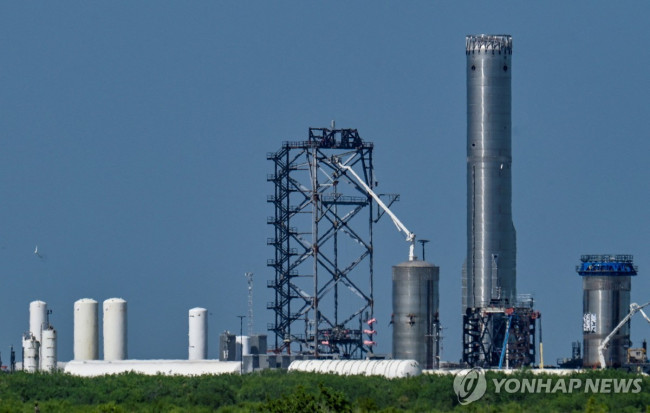 SpaceX overtakes Meta, pushing it down to 8th place in U.S. market capitalization
SpaceX Starship launch delayed [Reuters=Yonhap News]SpaceX has seen its market capitalization evaporate by over $1 trillion (1,489 trillion won) since peaking about a month ago, causing it to fall to
SpaceX overtakes Meta, pushing it down to 8th place in U.S. market capitalization
SpaceX Starship launch delayed [Reuters=Yonhap News]SpaceX has seen its market capitalization evaporate by over $1 trillion (1,489 trillion won) since peaking about a month ago, causing it to fall to
 The Summer of 2026 in Jeju, documented by me… Kirin Villa Resort, August Summer Event
Kylin Villa Resort is launching its collaborative summer event, the "Kylin Summer Passport," which will run for one month starting August 1st.Kylin Villa Resort is launching its collaborative summer e
The Summer of 2026 in Jeju, documented by me… Kirin Villa Resort, August Summer Event
Kylin Villa Resort is launching its collaborative summer event, the "Kylin Summer Passport," which will run for one month starting August 1st.Kylin Villa Resort is launching its collaborative summer e
 [Column by Park Joo-hyun] Shouldn't we put a price tag on the rise of my home value...?
[This image was created with the help of AI]Since you managed to sell your house well while defending your asking price, there is a point I have been wanting to make that I must address now. A sp
[Column by Park Joo-hyun] Shouldn't we put a price tag on the rise of my home value...?
[This image was created with the help of AI]Since you managed to sell your house well while defending your asking price, there is a point I have been wanting to make that I must address now. A sp
 [Photo] Evidence of Election Fraud Flooding U.S. Media… Trump Had 2.7 Million Votes Stolen
 [Video] U.S. Semiquincentennial Air Show... 'Art in the Sky' streaks across New York
 [Editorial Cartoon] A Draconian Law That Undermines Freedom of Expression

 List
List