Stalin (left) and a young Khrushchev in Red Square in the 1930s. The 20th Congress of the Communist Party of the Soviet Union, held from February 14 to 25, 1956, at the Kremlin in Moscow, was a decisive turning point in communist history.
On the dawn of February 25, the last day of the congress, Nikita Khrushchev, then First Secretary of the Communist Party of the Soviet Union, delivered a special closed-door report. Its official title was "On the Cult of Personality and Its Consequences." This report would overturn the landscape of the global communist movement.
The figure he singled out for criticism was none other than Joseph Stalin.
Khrushchev Criticized Stalin but Maintained Imperial Control
Stalin seized power after Lenin's death in 1924 and, through the Great Purge of the 1930s, eliminated large numbers of party members, military personnel, and intellectuals.
Hundreds of thousands were executed during the Great Purge of 1937-38 alone, and millions were sent to the Gulag, the system of forced labor camps. While Stalin gained international prestige with victory in World War II, his internal rule was one of terror.
Khrushchev revealed the reality of this reign of terror through internal party documents and testimonies. The issue was not simply the personal morality of a leader. The structure of how the communist system justified absolute power to itself was brought into question.
The cult of personality around Stalin was not merely a psychological phenomenon but a product of power concentration.
Although this speech was initially kept secret, it soon spread through Eastern Europe and Western intelligence agencies. The repercussions were immediate.
Workers' protests broke out in Poznań, Poland, in June 1956, followed by the Hungarian Revolution in October. Hungarian citizens demanded a multi-party system and the withdrawal of Soviet troops.
Ultimately, the Soviet Union intervened with tanks to suppress the uprising. While Stalin was criticized, imperial control was maintained. This contradiction revealed a fundamental tension within the communist movement.
"Criticism of Stalin is a Retreat from Revolution; the Soviet Union is a Revisionist State"
Let us now turn our attention to the Korean Peninsula. After the armistice in July 1953, North and South Korea stood on the front lines of the Cold War. North Korea's power structure was rapidly reorganized around Kim Il Sung after the establishment of the government in 1948.
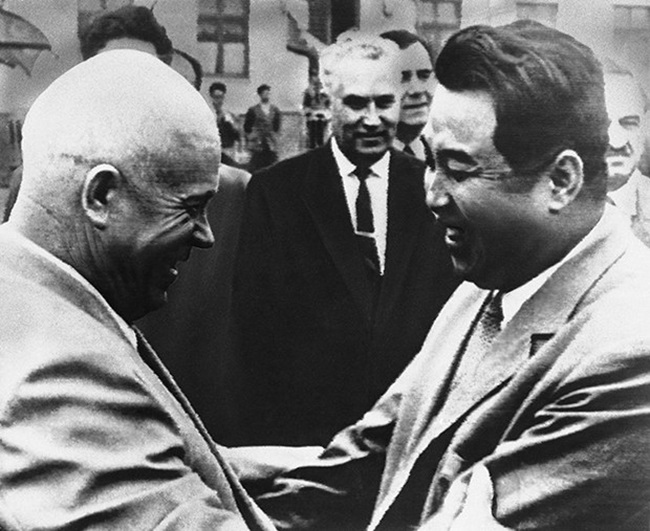 Secretary Khrushchev welcomes Chairman Kim Il Sung during his visit to Moscow. [Photo=AP]
However, 1956 was also a turbulent year within North Korea. The so-called "August Faction Incident" occurred, in which some members of the Soviet and Yan'an factions criticized Kim Il Sung's centralized personal power. They demanded a system of collective leadership, similar to Khrushchev's.
But the result was purges. Kim Il Sung eliminated these individuals and further consolidated his power. North Korea subsequently moved towards a "unique ideology system." This system, which dictates thinking as Kim Il Sung thinks and acting as he directs, is a fundamental principle for building the Workers' Party of Korea.
In the same year that criticism of Stalin emerged in the Soviet Union, North Korea moved towards institutionalizing a cult of personality. This is less an irony of history and more a reflection of the nature of power.
Pro-North Korean activist circles in South Korea also received this development with complexity. After the 1960s, some radical factions labeled the Soviet Union a "revisionist state." In their view, the criticism of Stalin was a retreat from revolution. They believed that maintaining revolutionary purity was more important than revising ideology.
In this context, China's path emerged as an alternative. The Cultural Revolution, which began in 1966, became a powerful symbol for radical youth movements.
Herein lies an interesting point: 1956 was the first official moment within the communist system that acknowledged its own errors. Ideology had an opportunity to examine itself in the face of practical failures.
However, pro-North Korean leftists labeled this as "betrayal." Instead of supplementing the doctrine, they intensified its rigor. They pushed aside empirical facts to maintain logical consistency.
Ideology That Loses Flexibility Isolates Itself
For political ideology to remain alive, it must interact with reality. When an experiment fails, modifying the hypothesis is the scientific approach. However, if failures are attributed to external conspiracies or revisionism, the ideology becomes a closed system. A closed system may strengthen internal cohesion but weakens its ability to explain external reality.
The choices surrounding 1956 were not confined to internal Soviet matters. They played a crucial role in shaping the direction of the communist movement in East Asia, particularly the character of the North Korean regime. North Korea moved towards absolute leader worship rather than de-Stalinization, which led to the 1972 Socialist Constitution and the subsequent system of sole leadership.
For pro-North Korean leftists, 1956 is an uncomfortable year because it was the year Stalin's errors were exposed. Acknowledging the mass purges and human rights abuses committed by the Stalinist regime would also undermine the legitimacy of the line that had espoused that regime as an ideal.
As a result, Khrushchev became a "revisionist," and Stalin remained a "guardian of the revolution."
Ideology should exist for humans, not the other way around. The hall of the 1956 Moscow congress was the place where this standard was tested. Some factions sought change by accepting reality, while others moved toward closure by adhering to doctrine.
Looking at history in the long term, systems that embrace self-criticism seek paths of gradual change. Systems that reject self-criticism rely increasingly on internal consolidation. It is necessary to calmly reflect on the traces left by the choices that ignored 1956 on the political trajectory of the subsequent decades.
This scene is not simply a story from the past. It is a question of how ideology responds when it clashes with reality. Revision is not a retreat. Revision is a survival strategy.
The attitude that rejected 1956 may have intensified the rigor of the doctrine, but it lost the flexibility of ideology. And ideology that loses flexibility eventually isolates itself.
History sometimes speaks quietly. Opportunities to face the truth do not come often. 1956 was such an opportunity. How that opportunity was handled explains the trajectory of the following 70 years.
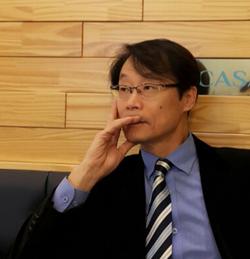
◆ Matsuyama
Poet and researcher of history and philosophy. Former director of the Syngman Rhee Academy. Currently serves as a research advisor for the Korean Modern and Contemporary History Research Society and as the representative of the philosophy forum Lyceum. He has published four poetry collections, co-translated "Heroes of Hukoguji," and authored the historical psychology commentary "Joseon, Which Became a Myth" (2026). He is actively engaged in research and practice for the liberal cultural movement. Matsuyama is a pen name.

 Trump pressures for rate cut again ahead of FOMC... "Should be the lowest in the world"
U.S. President Donald Trump. [Photo = The White House] U.S. President Donald Trump once again pressured the Federal Reserve, the U.S. central bank, to lower interest rates on the 27th (local time
Trump pressures for rate cut again ahead of FOMC... "Should be the lowest in the world"
U.S. President Donald Trump. [Photo = The White House] U.S. President Donald Trump once again pressured the Federal Reserve, the U.S. central bank, to lower interest rates on the 27th (local time
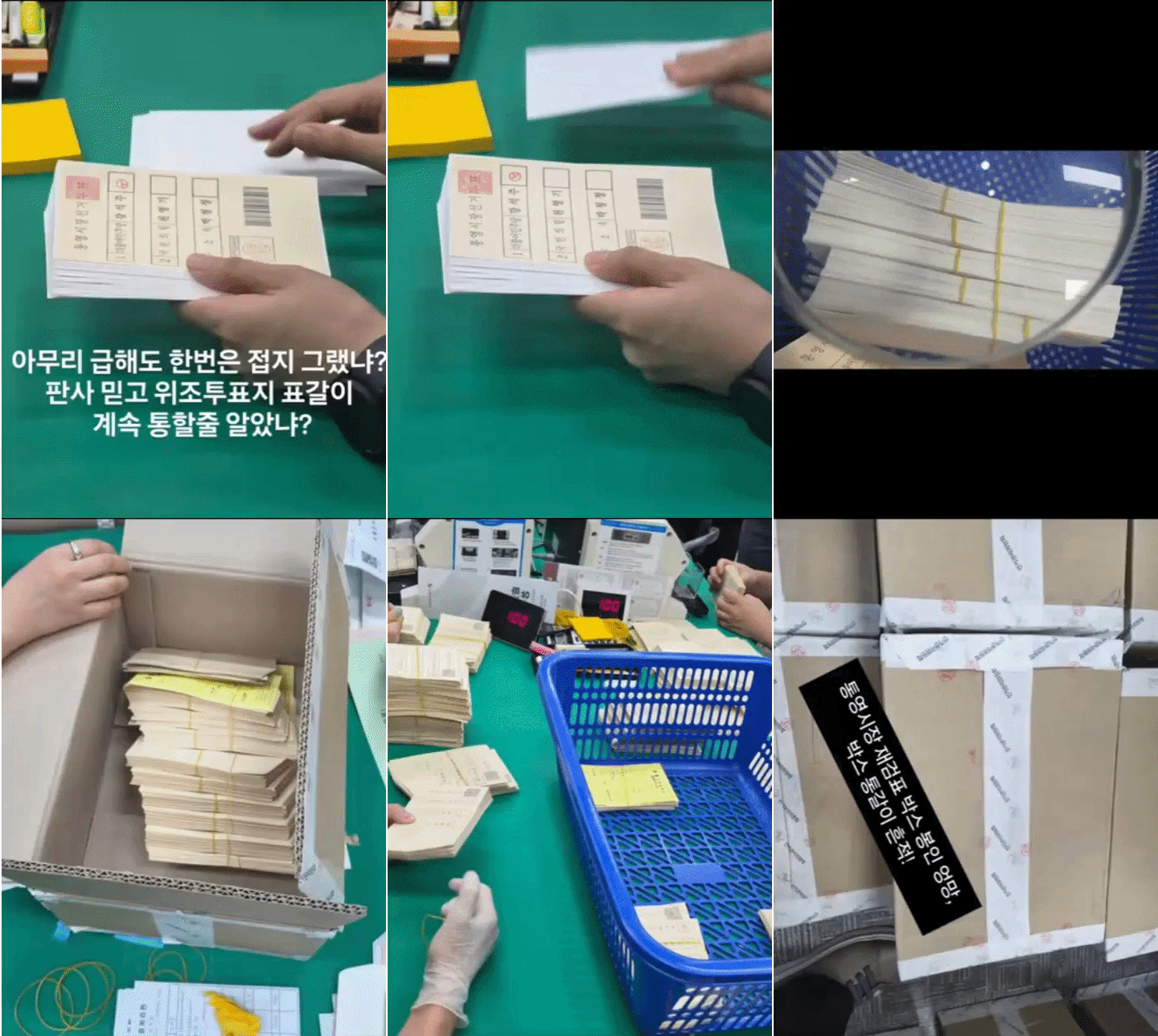 “Ignoring crisp ballots and damaged seals”… Tongyeong mayoral recount concludes with ‘no change in outcome,’ leaving suspicions and public outrage behind
Suspected counterfeit ballots discovered in Tongyeong [GIF from social media of Representative Hwang Kyo-ahn / Attorney Park Joo-hyun]During a recount of the Tongyeong mayoral election in South Gyeong
“Ignoring crisp ballots and damaged seals”… Tongyeong mayoral recount concludes with ‘no change in outcome,’ leaving suspicions and public outrage behind
Suspected counterfeit ballots discovered in Tongyeong [GIF from social media of Representative Hwang Kyo-ahn / Attorney Park Joo-hyun]During a recount of the Tongyeong mayoral election in South Gyeong
 President Yoon, regarding the first-instance ruling on the Public Official Election Act: “An excessive political verdict that distorts the facts… We will appeal immediately.”
The first-instance sentencing hearing for President Yoon Suk Yeol regarding violations of the Public Official Election Act is being broadcast live at Seoul Station on the 27th. [Photo=Yonhap News]Pres
President Yoon, regarding the first-instance ruling on the Public Official Election Act: “An excessive political verdict that distorts the facts… We will appeal immediately.”
The first-instance sentencing hearing for President Yoon Suk Yeol regarding violations of the Public Official Election Act is being broadcast live at Seoul Station on the 27th. [Photo=Yonhap News]Pres
 WSJ: "SK Hynix ADR Premium Is a Sign of AI Trading Overheat"
Advertisement for SK Hynix ADR listing in New York's Times Square [Reuters=Yonhap News file photo]The Wall Street Journal (WSJ) has pointed out that the price of SK Hynix’s American Depositary Recei
WSJ: "SK Hynix ADR Premium Is a Sign of AI Trading Overheat"
Advertisement for SK Hynix ADR listing in New York's Times Square [Reuters=Yonhap News file photo]The Wall Street Journal (WSJ) has pointed out that the price of SK Hynix’s American Depositary Recei
 'Godfather of Japanese Mystery Novels' Keigo Higashino Passes Away After Battle with Cancer at 68
Famous Japanese mystery novelist Keigo Higashino [AFP=Yonhap News]It has been belatedly reported that Keigo Higashino, the "godfather of Japanese mystery novels" and author of bestsellers such as "The
'Godfather of Japanese Mystery Novels' Keigo Higashino Passes Away After Battle with Cancer at 68
Famous Japanese mystery novelist Keigo Higashino [AFP=Yonhap News]It has been belatedly reported that Keigo Higashino, the "godfather of Japanese mystery novels" and author of bestsellers such as "The
 [Park Pil-kyu Security Column] To the Ignorant Trying to Clothe a Beast in Sheep's Clothing
Rep. Kim Byung-joo of the Democratic Party of Korea [Photo=Yonhap News]“The Air Force Academy doesn't teach you how to fly a plane!” “The Army, Navy, and Air Force academies are exactly the
[Park Pil-kyu Security Column] To the Ignorant Trying to Clothe a Beast in Sheep's Clothing
Rep. Kim Byung-joo of the Democratic Party of Korea [Photo=Yonhap News]“The Air Force Academy doesn't teach you how to fly a plane!” “The Army, Navy, and Air Force academies are exactly the
 [Issue Diagnosis] Two Effects of the Election Petition Review
 [Photo] Evidence of Election Fraud Flooding U.S. Media… Trump Had 2.7 Million Votes Stolen
 [Video] U.S. Semiquincentennial Air Show... 'Art in the Sky' streaks across New York
 [Editorial Cartoon] A Draconian Law That Undermines Freedom of Expression

 List
List