North Korean leader Kim Jong-un inspected a major weapons test organized by national defense science research institutions on the 25th, the Korean Central News Agency (KCNA) reported on the 26th. A tactical ballistic missile is seen spewing flames as it launches from a coastal platform. [Pyongyang, KCNA=Yonhap News]
North Korea fired on June 25th. And it wasn't just a simple multiple rocket launcher. They mixed tactical ballistic missiles, new rocket launchers, and extended-range artillery shells. On the very day the war began with North Korea's southward invasion, a tactical weapons test aimed at the South was conducted while Kim Jong-un looked on.
This fact was officially confirmed on the 29th. During a regular briefing, the Ministry of National Defense stated that South Korean and U.S. intelligence had tracked and detected multiple projectiles launched by North Korea in real-time between 7:27 a.m. and 8:20 a.m. on June 25th. However, they explained that the reason they did not announce it immediately, as usual, was that they were "in the process of analyzing various intelligence."
Ultimately, the issue was not a failure of detection. It was the silence—the failure to inform the public despite having detected the launches.
Look at the dates. The launch was on the 25th. North Korea revealed Kim Jong-un’s inspection of the weapons test via state media on the 26th. The Ministry of National Defense only issued its official explanation that it had "tracked and detected them in real-time" on the 29th.
Counting the calendar days—the 25th, 26th, 27th, 28th, and 29th—that is a full five days. The public learned about this not through an alert from the Republic of Korea's Ministry of National Defense, but first through the propaganda reports of North Korean state media.
Is this normal?
Furthermore, if it was a tactical ballistic missile launch as disclosed by North Korea, the gravity of the matter changes. North Korea's ballistic missile launches are potential violations of UN Security Council sanctions resolutions. The UN Security Council has demanded that North Korea cease all activities related to its ballistic missile program and prohibit launches that use ballistic missile technology.
Yet, the ROK Ministry of National Defense did not immediately inform the public, despite having tracked and detected multiple North Korean projectiles in real-time on the morning of June 25th.
What the public is questioning is not the detection capability. It is why, knowing that a tactical ballistic missile—which potentially violates UN sanctions—was fired, they failed to provide a proper explanation to the people for five whole days.
The Ministry of National Defense claims that "detailed analysis was required." Of course, analysis is necessary. If North Korea mixed rocket launchers with tactical ballistic missiles and operated the missiles with different ranges than usual, analysis could indeed take time.
However, the need for analysis is no excuse for concealing the fact that a launch occurred.
They could have simply stated, "North Korea has launched multiple projectiles; the ROK and U.S. are tracking them in real-time, and we are analyzing the detailed specifications." They could have announced that "the ROK and U.S. are conducting a joint analysis, including whether these were ballistic missiles." The public is capable of understanding that level of explanation.
The problem is the sequence. It was not the Ministry of National Defense that informed the public first. North Korea revealed it first. Only after the Korean Central News Agency and Rodong Sinmun published news of Kim Jong-un's inspection on the 26th did the public learn that North Korea had fired a mix of tactical ballistic missiles, new rocket launchers, and extended-range artillery shells on June 25th.
The Ministry of National Defense's "real-time detection and tracking" explanation came only after that.
This is the very essence of the matter. It is not about whether they detected it; it is about why, having detected it, they explained it to the public later than North Korea did.
June 25th is not just any day. It is the day the Korean War began in 1950 with North Korea’s southward invasion. It is a day etched with the memory of a country defended by the blood of South Korean soldiers, citizens, and UN forces.
That North Korea specifically chose that day to fire tactical weapons aimed at the South is not a simple weapons test. It is psychological warfare targeting the war memories of the South Korean people; it is a complex provocation intended to shake the ROK-U.S. detection and response system; and it is a political launch testing just how long the South Korean government would remain silent.
And what did the Ministry of National Defense do? Instead of immediately alerting the public to North Korea's political provocation, they offered an excuse five days later that they had "detected it in real-time." And when criticism arose, they responded by saying, "Do not politically interpret and disparage the hard work of ROK and U.S. soldiers."
This is a classic case of the pot calling the kettle black.
It is easy to understand why the public petition for the impeachment of Defense Minister An Gyu-baek has neared 230,000 signatures. This petition stems from controversy over the dissolution of the Defense Counterintelligence Command and concerns over the safety of soldiers. As of 8:45 a.m. on June 30th, the "Petition for the Impeachment of Defense Minister An Gyu-baek" on the National Assembly's public petition board had reached 227,964 signatures.
The public does not want to undermine the military. The public does not want to disparage soldiers. On the contrary, they are asking the exact opposite.
With the controversies surrounding the Defense Counterintelligence Command and the safety of soldiers, now compounded by the five-day silence over North Korea's June 25th ballistic missile launch, the public is asking who exactly the Ministry of National Defense exists to serve.
What the public is questioning now is not the soldiers who performed their duties at the front lines and monitoring posts. The soldiers detected and tracked the North Korean projectiles. The problem lies with what happened after. It lies with the leadership and policy chain responsible for reporting, judgment, disclosure, and explanation after detection.
The military leadership must not use the dedication of its soldiers as a shield to cover up the Ministry's failure in public affairs and its flawed command decisions.
Who is politicizing national security? The question the public is asking is not whether the soldiers detected the North Korean projectiles. It is: if they detected them in real-time, why did they not inform the public in real-time?
Why did our citizens have to learn only after North Korean media reports that North Korea fired tactical weapons aimed at the South on June 25th? Framing this question as "disparaging soldiers" is itself the ultimate politicization of national security.
The Ministry of National Defense, which dismisses the public’s right to know and legitimate inquiries into the security authorities' accountability as "political games," is the most political entity in this entire situation.
It is obvious why North Korea chose June 25th. They tested tactical weapons aimed at the South on the anniversary of the day they launched their invasion. The strategy of mixing tactical ballistic missiles with new rocket launchers also serves to test the ROK-U.S. detection and analysis system.
In particular, if the tactical ballistic missiles were operated with a shorter-than-usual range, it is hard not to suspect an intention to complicate initial detection, classification, and response decisions.
North Korea chose the date—June 25th—for political reasons. Yet, the Ministry of National Defense did not provide that political message to the public in a timely manner.
It is already clear at this stage who was playing politics.
This scene is not unfamiliar.
In March 2021, during the Moon Jae-in administration, North Korea fired two cruise missiles into the West Sea, but the military did not immediately disclose it. The public learned about the North Korean missile launch first through foreign media reports.
The explanation back then was similar: "We were aware of it," and "We do not disclose all intelligence." The fact that security authorities were aware of the situation is no absolution. Instead, it makes their failure to disclose it even heavier.
At that time, the left-wing government, with its pro-North Korea appeasement policy, was accustomed to minimizing North Korean provocations.
When North Korea fired, they downplayed it as a "projectile"; when it was a provocation, they packaged it as "managing tensions"; and when the public asked questions, they replied that they were "in the middle of analysis."
National security was not treated as a matter to warn the public about, but as a public relations task to be managed so as not to undermine the government’s North Korea policy.
The Ministry of National Defense's current attitude is a continuation of that old inertia. North Korea fires, the government stays silent, they explain only after North Korea makes it public, and when criticism arises, they strike back by accusing the public of "political disparagement."
This is not security administration. This is an attitude that treats national security as a subordinate tool of politics.
The Ministry of National Defense should stop hiding behind its soldiers and clearly clarify four things.
First, the exact time the North Korean projectiles were first detected on the morning of the 25th and the initial reporting line.
Second, the time when the situation was shared among the Joint Chiefs of Staff, the Ministry of National Defense, and the national security apparatus.
Third, who made the decision not to provide an immediate public announcement, and what was the basis for that decision?
Fourth, what the criteria will be for informing the public when North Korea engages in complex launches or unidentified projectile launches in the future.
The public does not demand a perfect analysis. The public demands an honest explanation. If you are analyzing, just say you are analyzing. If it is before confirmation, say it is before confirmation. However, saying nothing and then, when criticism arises, claiming, "We detected it in real-time," is not an explanation. Instead, it raises a bigger question: "Then why did you hide it?"
Real-time detection is no excuse. Real-time detection is the beginning of responsibility. If you saw the North Korean provocation in real-time, you should have provided an explanation to the public that was commensurate with that real-time awareness. What the Ministry of National Defense truly needs to protect is not the face of the government, but the trust of the people.
North Korea fired on June 25th. If it was a tactical ballistic missile launch as disclosed by North Korea, it is a provocation that potentially violates UN sanctions. Yet, the Ministry of National Defense failed to offer a clear explanation to the public for five days.
The public asks only one thing: Was North Korea's provocation political, or was the silence that hid that provocation the real politics?
A security vacuum is frightening, but security concealment is even more dangerous.
And the Ministry of National Defense, which scolds the public by saying "do not interpret this politically" in the face of suspicions of security concealment, is the most political entity of all right now.

 [In-depth Analysis] Will the U.S. House Report on Coupang Deal a 'Direct Blow' to Semiconductors?
Interim staff report by the U.S. House Judiciary Committee Republicans [Photo = Captured from report cover]The "Interim Staff Report by the U.S. House Judiciary Committee Republicans" is escalating be
[In-depth Analysis] Will the U.S. House Report on Coupang Deal a 'Direct Blow' to Semiconductors?
Interim staff report by the U.S. House Judiciary Committee Republicans [Photo = Captured from report cover]The "Interim Staff Report by the U.S. House Judiciary Committee Republicans" is escalating be
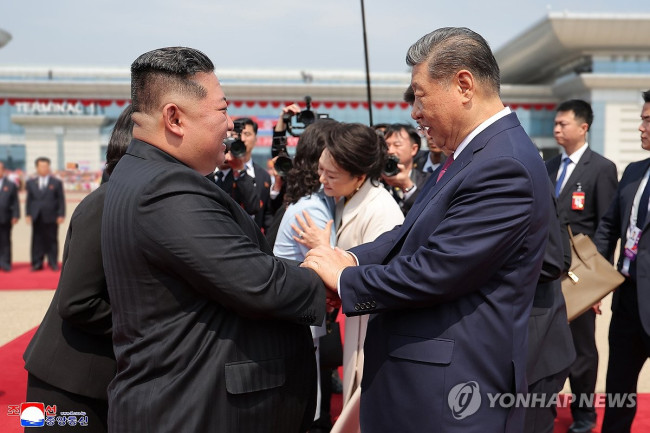 Xi Jinping Sends Reply to Kim Jong Un… "Developing DPRK-China Relations Stably and Long-Term"
According to a report by the Korean Central News Agency (KCNA) on the 10th, Chinese President Xi Jinping and his wife, Peng Liyuan, departed Pyongyang by private plane on the afternoon of the 9th, con
Xi Jinping Sends Reply to Kim Jong Un… "Developing DPRK-China Relations Stably and Long-Term"
According to a report by the Korean Central News Agency (KCNA) on the 10th, Chinese President Xi Jinping and his wife, Peng Liyuan, departed Pyongyang by private plane on the afternoon of the 9th, con
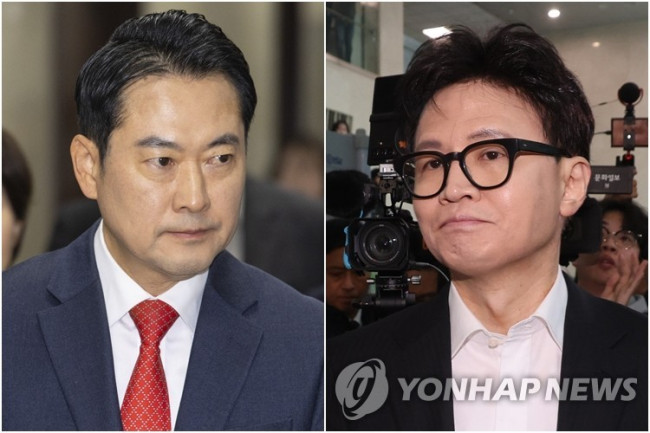 Jang Dong-hyeok, casting out the pro-Han faction first?… PPP on high alert over the 'coming soon' politics of disciplinary action
Representative Jang Dong-hyeok (left) and former representative Han Dong-hoon [Yonhap News] A palpable sense of tension is building within the People Power Party on the 5th as the central party's
Jang Dong-hyeok, casting out the pro-Han faction first?… PPP on high alert over the 'coming soon' politics of disciplinary action
Representative Jang Dong-hyeok (left) and former representative Han Dong-hoon [Yonhap News] A palpable sense of tension is building within the People Power Party on the 5th as the central party's
 [Exclusive Investigation] The Fatal Boomerang of the 5·18 ‘Gwang-su Ruling’… The ‘Genocide’ Bomb Thrown by Dr. Ji Man-won
Dr. Ji Man-won ©Hanmi IlboA new legal debate is igniting within the legal and historical communities surrounding the 1980 Gwangju Democratization Movement (May 18), which has been the most volati
[Exclusive Investigation] The Fatal Boomerang of the 5·18 ‘Gwang-su Ruling’… The ‘Genocide’ Bomb Thrown by Dr. Ji Man-won
Dr. Ji Man-won ©Hanmi IlboA new legal debate is igniting within the legal and historical communities surrounding the 1980 Gwangju Democratization Movement (May 18), which has been the most volati
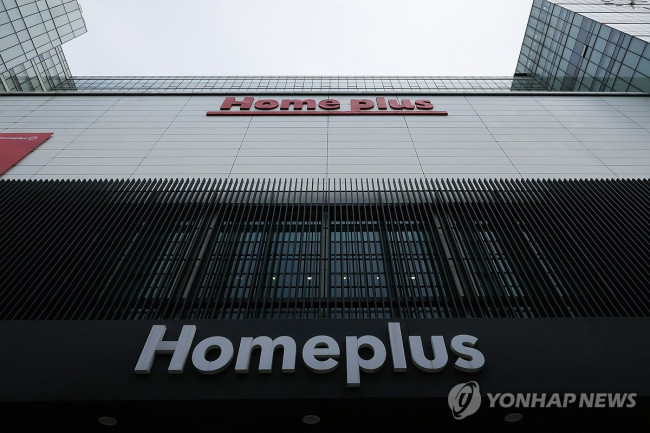 Homeplus effectively heading toward bankruptcy… Court terminates rehabilitation proceedings
Homeplus submits revised rehabilitation plan incorporating store closures and cost-cutting measures [Yonhap News file photo]Homeplus, the major discount store chain, is now headed toward bankruptcy as
Homeplus effectively heading toward bankruptcy… Court terminates rehabilitation proceedings
Homeplus submits revised rehabilitation plan incorporating store closures and cost-cutting measures [Yonhap News file photo]Homeplus, the major discount store chain, is now headed toward bankruptcy as
 [Cool Summer Destinations] ➀ Korea’s ‘Tate Modern’: MMCA Cheongju
As Cheongju City transformed the former tobacco manufacturing plant into the 'National Museum of Modern and Contemporary Art, Cheongju,' it preserved the 20-meter chimney and the building's exterior w
[Cool Summer Destinations] ➀ Korea’s ‘Tate Modern’: MMCA Cheongju
As Cheongju City transformed the former tobacco manufacturing plant into the 'National Museum of Modern and Contemporary Art, Cheongju,' it preserved the 20-meter chimney and the building's exterior w
 [Seobokka Yuksa Gukguk Comrades Association Statement] ㉑ Eradicate the Election Fraud Cartel through an Opposition-Led Special Prosecutor and Reclaim the Stolen Republic of Korea
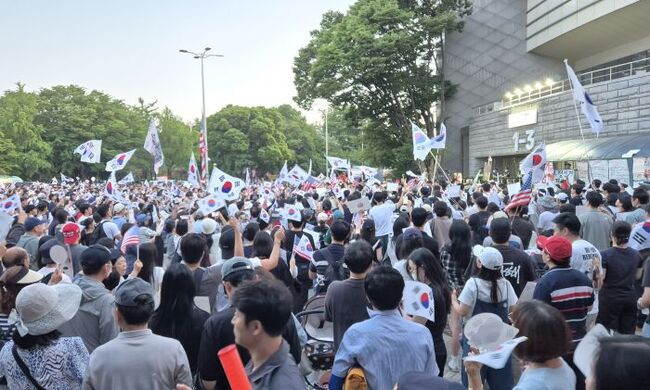
Citizens condemning the National Election Commission’s violation of suffrage and calling for a "rerun of the fraudulent election!" ⒸHanmi Ilbo A month has passed since the truth was revealed
[Seobokka Yuksa Gukguk Comrades Association Statement] ㉑ Eradicate the Election Fraud Cartel through an Opposition-Led Special Prosecutor and Reclaim the Stolen Republic of Korea
Citizens condemning the National Election Commission’s violation of suffrage and calling for a "rerun of the fraudulent election!" ⒸHanmi Ilbo A month has passed since the truth was revealed
 [Photo] “Don’t hang the Taegeukgi upside down”… Did BewhY take a jab at Kim Min-seok?
 [Video] U.S. Semiquincentennial Air Show... 'Art in the Sky' streaks across New York
 [Editorial Cartoon] A Comparative Visualization of the 7,460kg of Ballot Papers Shredded by the NEC

 List
List