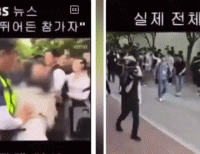
The Korea Baseball Softball Association (KBSA) recently suspended the Baejae High School baseball team from participating in tournaments for six months because its players shouted "Let's go to Starbucks" toward players from Gwangju Ilbo during the Blue Dragon National High School Baseball Championship.
However, Starbucks Korea, which sparked controversy with its 5·18 anniversary "Tank Day" event, did not face a six-month business suspension. Similarly, left-wing YouTuber Choi Wook, who caused another stir by suggesting during a broadcast that protesters should be "crushed by a tank" in relation to the controversy, was never subjected to a six-month broadcasting ban.
Furthermore, when Democratic Party lawmakers such as Woo Sang-ho, Song Young-gil, and Kim Min-seok were criticized for visiting a hostess bar called "New Millennium NHK" with female escorts after attending the 5·18 eve ceremony in Gwangju on May 17, 2000—an act many felt tarnished the 5·18 spirit—none of them faced any professional repercussions for the incident.
Why, then, is the Baseball Association responding so sensitively and excessively to a simple chant of "Let's go to Starbucks" during a game played by young students?
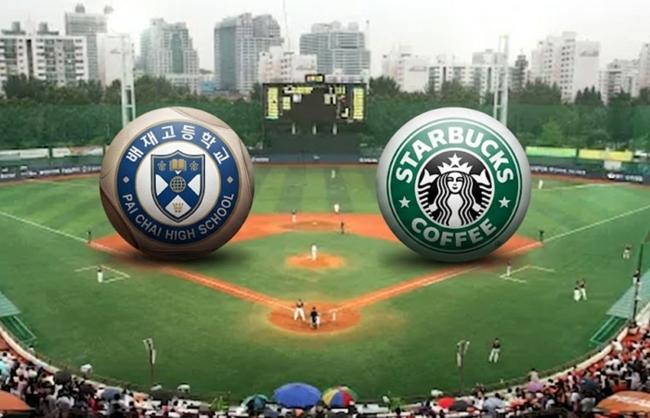 A baseball stadium where the game itself has vanished, leaving only political theater.
It is the politics of fear orchestrated by President Lee Jae-myung and the ruling Democratic Party. When the Starbucks Tank Day controversy erupted, Lee stated at a senior aides' meeting: "We must use all available means to strongly punish malicious fake news, such as the theory of North Korean military intervention in the 5·18, as well as acts that glorify state violence or insult its victims."
In addition, Minister of the Interior and Safety Yoon Ho-joong declared a boycott of Starbucks, stating, "We will not provide products from companies that treat the history and social values of democracy lightly or use them for commercial purposes," with other government ministries following suit.
Lee Jae-myung and the Democratic Party repeatedly push for legislation and measures that suppress freedom of expression—the very foundation of democracy—while claiming to uphold democratic values. During the Moon Jae-in administration, the Democratic Party passed the unconstitutional "5·18 Defamation Prohibition Act," imposing prison sentences of up to five years or fines of up to 50 million won for violations.
Lee and the Democratic Party are currently pushing for a constitutional amendment to explicitly include the 5·18 spirit in the preamble, and they seek to impose punitive damages of up to 1 billion won on media outlets and YouTubers through an "Anti-Fake News Act."
They have also removed the National Election Commission from the Board of Audit and Inspection's oversight and amended the Referendum Act to impose up to 10 years in prison for spreading false information related to election management, such as allegations of electoral fraud.
Following the regimes of Kim Dae-jung, Roh Moo-hyun, and Moon Jae-in, Lee Jae-myung is more overtly seizing control of the media. Through amendments to the Broadcasting Act and direct pressure, he seeks to oust the chair of the Korea Communications Commission appointed by the Yoon Suk Yeol administration, as well as management at KBS, MBC, EBS, YTN, and Yonhap News TV.
Lee Jae-myung repeatedly makes remarks that deny liberal democracy and the market economy, such as claiming "there is no market that can defeat the government." To implement his anti-market philosophy, the President and his government exert tangible and intangible pressure on companies like Samsung Electronics and SK Hynix to force astronomical investments into the Honam region, despite severe shortages of water, electricity, labor, materials, parts, equipment, and logistics.
It is clear that the democracy Lee Jae-myung and the Democratic Party speak of is not liberal democracy, but rather the "people's democracy" dictatorship of North Korea and China, characterized by communist controlled economies. This is why some suggest that the Democratic Party of Korea should rename itself the "Communist Party of Korea."
The Starbucks "Tank Day" event featured a water tank design, which is unrelated to combat tanks; the dictionary definition of "tank" also refers to liquid storage vessels, such as water tanks or oil tanks.
However, once the President and government ministries initiated a boycott, creating a climate of fear through a power-driven witch hunt, Chairman Chung Yong-jin apologized in person, Starbucks executives resigned, and the company staged a farce by mandating history education sessions for its employees.
This is the typical propaganda, agitation, and witch-hunt methodology seen during the mad cow disease protests, the Sewol ferry incident, and the impeachment processes of Presidents Park Geun-hye and Yoon Suk Yeol, employed by the Democratic Party and pro-North Korean leftists.
Lee Jae-myung and the Democratic Party react so sensitively to the 5·18 issue because, as the saying goes, "a thief feels the prick of his own conscience"—they fear the reality of the "5·18 Democratization Movement" myth they have carefully constructed.
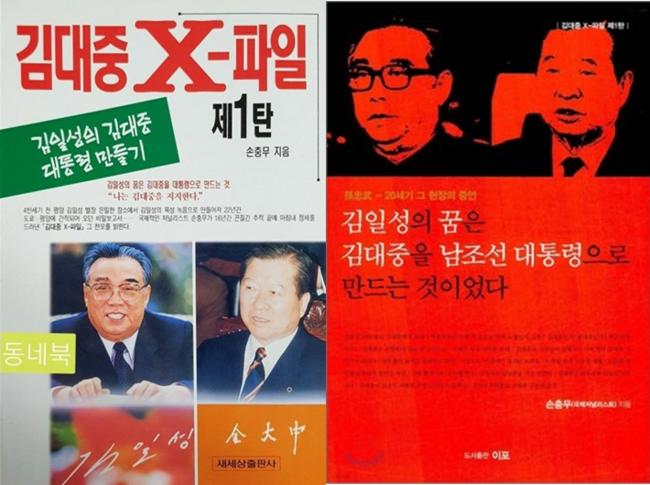 "Kim Dae-jung X-File" by Son Chung-mu: "Kim Il-sung's dream was to make Kim Dae-jung the president of South Korea."
The initial Supreme Court ruling identified 5·18 as an armed riot and insurrection incited by Kim Dae-jung. In 1981, Kim Dae-jung was sentenced to death for insurrection related to 5·18, but he was later pardoned and reinstated by the Chun Doo-hwan administration.
It was Kim Young-sam who changed the designation of 5·18 from a "Kim Dae-jung-led insurrection" to a "democratization movement." When the Roh Tae-woo slush fund scandal broke, Kim Young-sam enacted the 5·18 Special Act to punish Chun Doo-hwan and Roh Tae-woo for the 12·12 insurrection and violation of the Political Funds Act, thereby concealing the illegal political funds he and Kim Dae-jung had also received.
Long before his 1980 death sentence for the 5·18 insurrection, Kim Dae-jung faced suspicions of links to North Korean communist groups from the beginning of his political career. According to Son Chung-mu's "Kim Dae-jung X-File" and "Kim Il-sung's Dream Was to Make Kim Dae-jung the President of South Korea," documents from the Japanese public security authorities reveal that Kim Dae-jung signed an application to join the South Korea Labor Party (Namnodang) shortly after liberation in 1945.
Confidential documents secured by Son Chung-mu indicate that during the 1967 general election, Kim Dae-jung received significant operating funds and support from North Korean agents to be elected as a National Assembly member in Mokpo.
Kim Dae-jung engaged in long-term dealings with Kim Il-sung through the pro-North Korean Japanese politician Tokuma Utsunomiya, and Kim Il-sung provided continuous support. When Kim Dae-jung was selected as the Democratic Party's presidential candidate in 1971, Kim Byung-sik, the international department director of the General Association of Korean Residents in Japan (Ch총련), delivered $200,000 in campaign funds to Kim Dae-jung at the Tokyo Plaza Hotel. In 1971, $200,000 was equivalent to about $20 million today (approximately 30.85 billion won).
When Kim Dae-jung was arrested by the Martial Law Command for the 1980 5·18 insurrection, the Joint Investigation Headquarters discovered that Ch총련 had delivered 6.1 billion yen (approximately 17.08 billion won at the time, or 80 billion won in today's terms) in North Korean funds to Kim Dae-jung.
Just before the 2000 inter-Korean summit, Kim Dae-jung withdrew a total of 10 billion yen (30 billion won at the time, or 150 billion won today), consisting of the 6.1 billion yen deposited in his name at a Japanese bank plus 30 years of interest, and delivered it to Kim Jong-il.
In 2007, the Tokyo Metropolitan Police raided the headquarters of Ch총련 and seized confidential ledgers revealing the funds provided to Kim Dae-jung and Hanmintong. However, Japan did not pursue the issue because Kim Dae-jung had handed over the fertile fishing grounds near Dokdo to Japan during his presidency.
According to Son's book, Kim Dae-jung was a communist who never renounced his affiliation after joining the South Korea Labor Party. In 1974, at a meeting with pro-North Korean Japanese Socialist and Liberal Democratic Party politicians in Pyongyang, Kim Il-sung stated that he trusted Kim Dae-jung more than any other South Korean politician and that Kim Dae-jung had never betrayed North Korea.
After being elected president in 1997, Kim Dae-jung rewarded the support he had received from Kim Il-sung and Kim Jong-il for decades by delivering $800 million (1.56 trillion won at the time) to Kim Jong-il before their summit in Pyongyang. Over ten years, the Kim Dae-jung and Roh Moo-hyun administrations transferred $7 billion (approximately 11 trillion won) to Kim Jong-il, aiding North Korea's development of nuclear weapons and missiles.
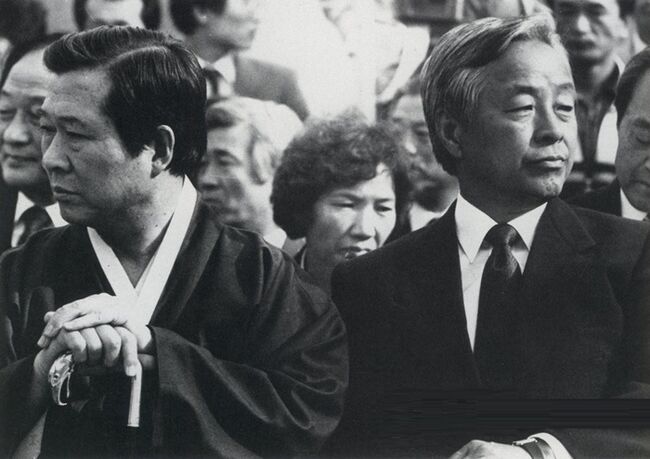 Kim Dae-jung (left) and Kim Young-sam. [Yonhap News Archive]
By enacting the 5·18 Special Act, Kim Young-sam became the host for the Juche ideology faction proliferating in South Korea and a vanguard for the nation's leftward shift. The incompetence of Kim Young-sam, which triggered the IMF financial crisis, is minor compared to his "achievement" of being the primary contributor to South Korea's leftward drift.
Kim Young-sam's logic—that the "nation" takes precedence over ideology—is equivalent to saying that as long as the nation is united, it does not matter if it is communized. The incompetent and corrupt Kim Young-sam could not foresee the consequences the 5·18 Special Act would bring to the future of the Republic of Korea.
Chants of "nation, democracy, and self-reliance" are part of the repertoire used by North Korean communists, the remnants of the South Korea Labor Party (Juche faction), and their followers for agitation and propaganda to communize the Republic of Korea.
Anti-Americanism, anti-imperialism, and self-reliant unification are the three main tenets of the pro-North Korean Juche faction. It is the cry of Kim Il-sung, who was thwarted at the threshold of communizing the Korean Peninsula by the U.S. intervention in the Korean War, aiming to separate South Korea from American and Japanese imperialism to achieve communized unification.
In 1990, Kim Young-sam, then president of the opposition Reunification Democratic Party, merged with the ruling Democratic Justice Party to form the Democratic Liberal Party and was elected president in 1992. During the election process, Roh Tae-woo delivered 300 billion won in illegal campaign funds to Kim Young-sam.
Two years into Kim Young-sam's presidency, when the 400 billion won Roh Tae-woo slush fund scandal broke in 1995, Kim Young-sam ordered the enactment of the 5·18 Special Act to cover his own slush funds and initiated an investigation into Chun Doo-hwan and Roh Tae-woo for the 12·12 military insurrection and corruption.
Immediately after the launch of the Kim Young-sam administration in 1993, the prosecution investigated Chun Doo-hwan and Roh Tae-woo for the 12·12 military insurrection. The investigation concluded with the prosecution dropping the charges based on the logic that "a successful coup cannot be punished."
When the 400 billion won Roh Tae-woo slush fund scandal broke in 1995, Kim Young-sam used the excuse of "rectifying history" to create the 5·18 Special Act and ordered a reinvestigation of Chun and Roh. They were sentenced to life imprisonment and 17 years, respectively, for the 12·12 military insurrection and bribery. They remained in prison until late 1997, when they were pardoned and released just before Kim Young-sam left office.
Under Kim Young-sam's 5·18 Special Act, the 12·12 event—previously viewed as the Security Command's "legitimate enforcement of the law" to detain Martial Law Commander Chung Seung-hwa in connection with the assassination of President Park Chung-hee—was reclassified as a "rebellion." Similarly, 5·18 was changed from a "Gwangju riot" to a "democratization movement."
In addition to their prison sentences, Chun Doo-hwan and Roh Tae-woo were ordered to pay 220 billion won and 260 billion won in forfeitures, respectively, and were required to continue paying until their deaths, even after being pardoned.
When his slush fund scandal broke, Roh Tae-woo apologized to the public through a press conference, claiming it was customary practice at the time. However, he did not reveal that he had delivered 300 billion won to Kim Young-sam, hoping for leniency.
If Roh Tae-woo had boldly revealed that he had delivered funds to both Kim Young-sam and Kim Dae-jung, Kim Young-sam would not have been able to proceed with such an aggressive investigation, as he and Kim Dae-jung would have also been targets.
However, the cowardice of the incompetent opportunist Roh Tae-woo gave Kim Young-sam the green light. Kim Young-sam used the 5·18 Special Act as a tool to cover his own slush funds, and this act became the cornerstone for South Korea's slide toward, and perhaps into, communization.
In his memoirs, Roh Tae-woo stated that he delivered 300 billion won in campaign funds to Kim Young-sam during the 1992 presidential election, but no one is interested in the past. An article in the April 16, 1998 issue of *Weekly Donga* confirms that the illegal campaign funds used by the Democratic Liberal Party candidate Kim Young-sam amounted to 303.4 billion won.
When the Roh Tae-woo slush fund scandal broke, Kim Dae-jung admitted to receiving 2 billion won in political funds from Roh during the 1992 election. Unlike Roh, however, Kim Dae-jung immediately countered by demanding that as an opposition candidate, if he received 2 billion won, the public deserved to know how much the ruling party candidate Kim Young-sam had received. The Democratic Liberal Party raised the "2 billion won + alpha" theory and urged the full disclosure of Kim Dae-jung's political funds.
Ahead of the 1997 presidential election, the New Korea Party, the successor to the Democratic Liberal Party, accused opposition candidate Kim Dae-jung of managing a 37.8 billion won slush fund and filed charges with the Supreme Prosecutors' Office. On a Sunday, Kim Young-sam secretly summoned Prosecutor General Kim Tae-jung to the Blue House and ordered him to delay the investigation into Kim Dae-jung's slush fund until after the presidential election.
Kim Young-sam stated in his memoirs that the reason was that investigating Kim Dae-jung's corruption two months before the election would lead to his arrest, cause riots in Jeolla and Seoul, and result in political chaos that would make it impossible to hold the election.
Lee Hoi-chang, the candidate for the ruling New Korea Party who lost the 1997 election to Kim Dae-jung due to Kim Young-sam's betrayal, wrote in his memoirs that Kim Young-sam's decision was actually driven by fears that an investigation into Kim Dae-jung would lead back to an investigation of his own 1992 campaign funds. Kim Tae-jung, who halted the investigation into Kim Dae-jung's illegal political funds per Kim Young-sam's orders, became Minister of Justice after Kim Dae-jung took office, and the bribery investigation was buried.
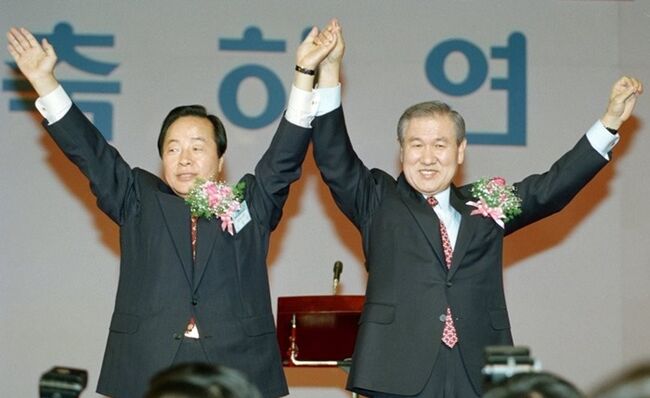 May 1992: President Roh Tae-woo (right) holds up the hand of Kim Young-sam, the candidate for the Democratic Liberal Party, at the party's national convention at COEX in Seoul. [Yonhap News Archive]
Kim Young-sam's "rectifying history" was a ploy to cover up his own suspicions of illegal political fund solicitation that kept resurfacing throughout his term. Even in 1993, early in his administration, the Donghwa Bank slush fund scandal, which involved both Roh Tae-woo and Kim Young-sam, erupted, but due to pressure from the Kim Young-sam administration, it ended as a half-baked investigation with only a few subordinates arrested.
Although no politician was free from the decades-long practice of illegal political funds since liberation, the result of Kim Young-sam's abuse of power was that Chun Doo-hwan and Roh Tae-woo were sentenced to prison and faced massive forfeitures, while the slush fund investigations into Kim Young-sam and Kim Dae-jung were buried.
When a lawsuit was filed challenging the constitutionality of the 5·18 Special Act on the grounds of retroactive legislation, the Constitutional Court split 5 to 4 in favor of constitutionality—failing to reach the 6-vote quorum required for a ruling of unconstitutionality.
Thousands of "men of merit" for democratization receive compensation and privileges funded by taxpayers under the 5·18 Special Act, yet the Ministry of Patriots and Veterans Affairs refuses to disclose their names or specific merits. Despite citing privacy protection, there is suspicion that this is simply a distribution of "blind money" without any legitimate basis for compensation.
The individuals who carried out key tactical operations during 5·18—such as the May 21st ambush on the 20th Division, the theft of weapons from 44 armories across Gwangju and South Jeolla Province, and the attack on the Gwangju Prison—are not on the list of men of merit.
In 2020, the Moon Jae-in administration passed the "5·18 History Distortion Punishment Act" to prevent criticism of the events, and in 2022, the Constitutional Court dismissed a request for adjudication on the unconstitutionality of Article 8, Paragraph 1 of the 5·18 Special Act.
The charges against Chun Doo-hwan, who was indicted after the investigation following Kim Young-sam's enactment of the 5·18 Special Act, were limited to the 12·12 rebellion and bribery. The Kim Young-sam administration could not even indict Chun for 5·18 because there was no testimony or evidence to prove his involvement.
Lee Hee-sung, the Martial Law Commander during 5·18, stated in media interviews that Chun Doo-hwan had nothing to do with 5·18 and that the responsibility, if any, lay with himself and the Minister of National Defense. He added that there was no "order to fire," and that there were only accidental responses by martial law troops as a self-defense measure against the preemptive fire from armed protesters.
He further noted that while there were suspicions of North Korean involvement due to acts that civilians could not perform—such as the looting of armories, the assault on the prison, and the organized attack on the 20th Division—the investigation could not proceed due to President Choi Kyu-hah's instruction that stabilizing the public mind was the priority after 5·18 ended.
Prosecution records also indicate that military commanders testified that they frequently detected protesters communicating in North Korean dialects via wiretaps, but could not intervene for fear of incidents that would occur if martial law troops entered.
Even the investigation results of the Kim Young-sam administration revealed that Chun Doo-hwan had nothing to do with 5·18, yet pro-North Korean leftists continuously agitate and propagandize that Chun is the "5·18 butcher." Brainwashed by this, Chun's grandson, Chun Woo-won, visited the 5·18 cemetery in Gwangju to apologize on behalf of his grandfather.
Kim Young-sam, the host of the pro-North Korean leftists who died in 2016, is buried in the National Cemetery in Dongjak-gu, but the remains of Chun Doo-hwan, who died in 2021, have yet to find a resting place and remain at his residence in Yeonhui-dong.
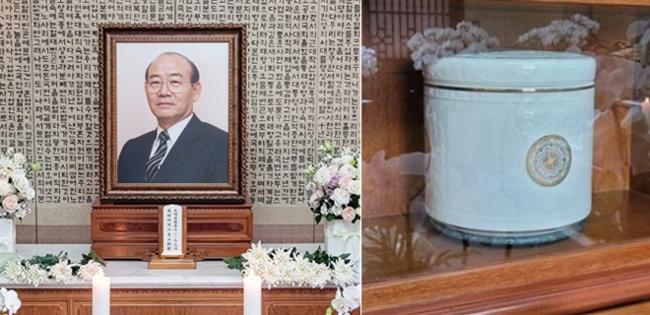 The portrait and remains of President Chun Doo-hwan, left without a resting place and kept at his home. ⒸHanmi Ilbo
Because of his criminal record for rebellion, he could not be buried in the National Cemetery. His bereaved family prepared a gravesite in Paju, Gyeonggi Province, near the border, in accordance with Chun's will to be buried in a place where he could see North Korea, but they had to abandon the plan due to propaganda, agitation, and protest demonstrations by pro-North Korean leftists.
Despite the 5·18 Special Act, the event remains a deeply divisive issue between the left and the right, and constitutional challenges are constantly being filed.
Despite the anti-defamation law, prosecution records and testimonies regarding North Korean military intervention in 5·18 continue to emerge. Kwon Young-hae, Director of the Agency for National Security Planning under the Kim Young-sam administration, testified that during his tenure, he confirmed the existence of a hero cemetery in Chongjin for North Korean spies killed in 5·18, noting that this is even recorded in North Korean textbooks.
The selection of nearly 6,000 "men of merit" for 5·18 is handled by the groups themselves, not the state, yet they receive hundreds of millions to billions of won in government support per person. With national tax money, the recipients and their descendants are showered with various forms of compensation and privileges.
The Truth and Reconciliation Commission, centered on 5·18 beneficiary groups, excludes any testimony or evidence related to the armed riot or North Korean involvement. The list of beneficiaries and the reasons for their selection are not disclosed. In media interviews, Hwang Jang-yop stated that when asked about North Korean intervention in 5·18, the truth would naturally be revealed once unification occurred.
This was a cautious remark made after the Lee Myung-bak administration came to power, as Hwang had spent the previous ten years under the Kim Dae-jung and Roh Moo-hyun left-wing regimes in virtual house arrest, with no opportunity to testify about North Korea's involvement.
It was a statement made because it was burdensome to speak properly during the Lee Myung-bak administration, whose ideological identity was vague and focused on "pragmatism" after a decade of suppression by left-wing regimes. Hwang even restrained Kim Duk-hong, a fellow defector who intended to speak out, leading Kim to protest why he was being silenced.
The 5·18 uprising, the Jeju 4·3 incident, and the Yeosu-Suncheon rebellion are all suspected of being insurrections and rebellions by remnants of the South Korea Labor Party, supported by North Korea, to overthrow the South Korean government. Many innocent citizens who were either swept up in their incitement or forced to join are considered victims of these events.
The prevailing opinion is that the demonization of military and police forces who suppressed these armed rebellions, while glorifying the rebels and embellishing them as a "democratization movement," is the viewpoint of North Korean communists and pro-North Korean leftists. If things continue this way, the citizens of the Republic of Korea will end up slaves to the North Korean communist regime, enjoying only a "dirty peace."
Pro-North Korean leftist forces transformed 5·18 from an armed riot and insurrection into a democratization movement, but because they cannot hide the sun with their hands, they are living in fear and anxiety. However, it is only a matter of time before 5·18 is re-classified as an insurrection through retrials, and this will signify the end of the Democratic Party and the anti-state, pro-North Korean leftist forces.
◆ Hwang Doo-hyung
Former Washington Correspondent for Yonhap News
Former Deputy Managing Editor of Yonhap News

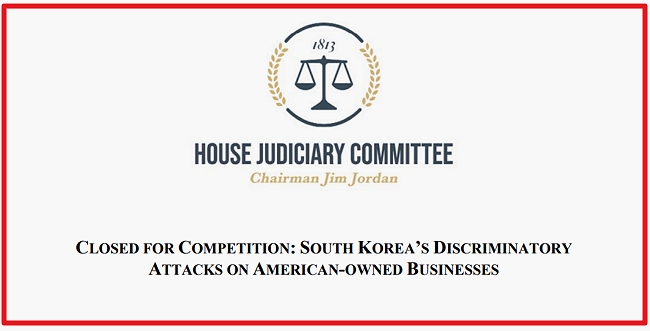 [In-depth Analysis] Will the U.S. House Report on Coupang Deal a 'Direct Blow' to Semiconductors?
Interim staff report by the U.S. House Judiciary Committee Republicans [Photo = Captured from report cover]The "Interim Staff Report by the U.S. House Judiciary Committee Republicans" is escalating be
[In-depth Analysis] Will the U.S. House Report on Coupang Deal a 'Direct Blow' to Semiconductors?
Interim staff report by the U.S. House Judiciary Committee Republicans [Photo = Captured from report cover]The "Interim Staff Report by the U.S. House Judiciary Committee Republicans" is escalating be
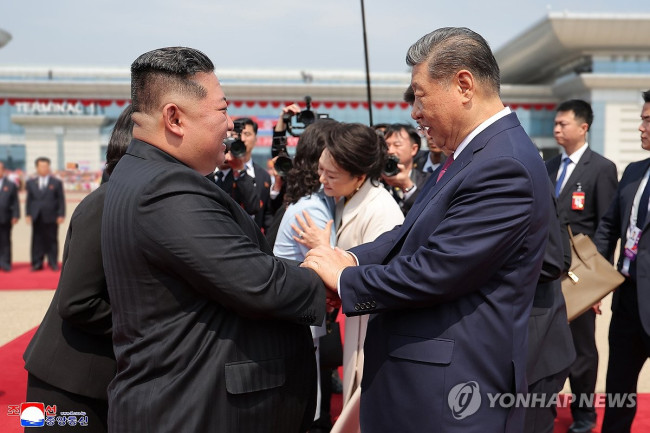 Xi Jinping Sends Reply to Kim Jong Un… "Developing DPRK-China Relations Stably and Long-Term"
According to a report by the Korean Central News Agency (KCNA) on the 10th, Chinese President Xi Jinping and his wife, Peng Liyuan, departed Pyongyang by private plane on the afternoon of the 9th, con
Xi Jinping Sends Reply to Kim Jong Un… "Developing DPRK-China Relations Stably and Long-Term"
According to a report by the Korean Central News Agency (KCNA) on the 10th, Chinese President Xi Jinping and his wife, Peng Liyuan, departed Pyongyang by private plane on the afternoon of the 9th, con
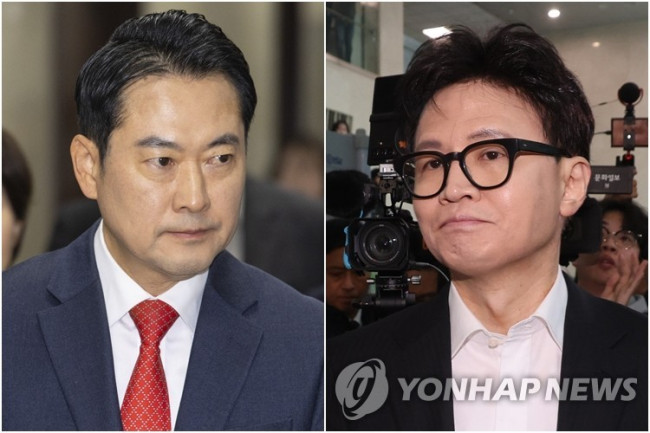 Jang Dong-hyeok, casting out the pro-Han faction first?… PPP on high alert over the 'coming soon' politics of disciplinary action
Representative Jang Dong-hyeok (left) and former representative Han Dong-hoon [Yonhap News] A palpable sense of tension is building within the People Power Party on the 5th as the central party's
Jang Dong-hyeok, casting out the pro-Han faction first?… PPP on high alert over the 'coming soon' politics of disciplinary action
Representative Jang Dong-hyeok (left) and former representative Han Dong-hoon [Yonhap News] A palpable sense of tension is building within the People Power Party on the 5th as the central party's
 [Exclusive Investigation] The Fatal Boomerang of the 5·18 ‘Gwang-su Ruling’… The ‘Genocide’ Bomb Thrown by Dr. Ji Man-won
Dr. Ji Man-won ©Hanmi IlboA new legal debate is igniting within the legal and historical communities surrounding the 1980 Gwangju Democratization Movement (May 18), which has been the most volati
[Exclusive Investigation] The Fatal Boomerang of the 5·18 ‘Gwang-su Ruling’… The ‘Genocide’ Bomb Thrown by Dr. Ji Man-won
Dr. Ji Man-won ©Hanmi IlboA new legal debate is igniting within the legal and historical communities surrounding the 1980 Gwangju Democratization Movement (May 18), which has been the most volati
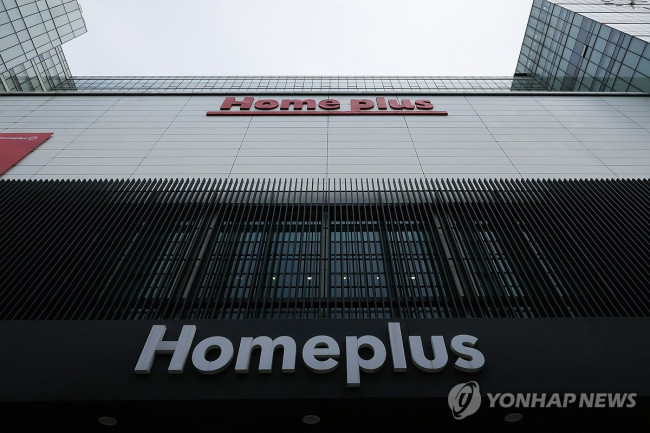 Homeplus effectively heading toward bankruptcy… Court terminates rehabilitation proceedings
Homeplus submits revised rehabilitation plan incorporating store closures and cost-cutting measures [Yonhap News file photo]Homeplus, the major discount store chain, is now headed toward bankruptcy as
Homeplus effectively heading toward bankruptcy… Court terminates rehabilitation proceedings
Homeplus submits revised rehabilitation plan incorporating store closures and cost-cutting measures [Yonhap News file photo]Homeplus, the major discount store chain, is now headed toward bankruptcy as
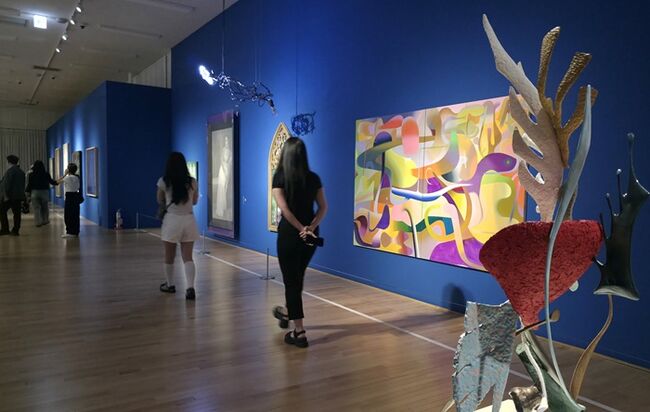 [Cool Summer Destinations] ➀ Korea’s ‘Tate Modern’: MMCA Cheongju
As Cheongju City transformed the former tobacco manufacturing plant into the 'National Museum of Modern and Contemporary Art, Cheongju,' it preserved the 20-meter chimney and the building's exterior w
[Cool Summer Destinations] ➀ Korea’s ‘Tate Modern’: MMCA Cheongju
As Cheongju City transformed the former tobacco manufacturing plant into the 'National Museum of Modern and Contemporary Art, Cheongju,' it preserved the 20-meter chimney and the building's exterior w
 [Seobokka Yuksa Gukguk Comrades Association Statement] ㉑ Eradicate the Election Fraud Cartel through an Opposition-Led Special Prosecutor and Reclaim the Stolen Republic of Korea
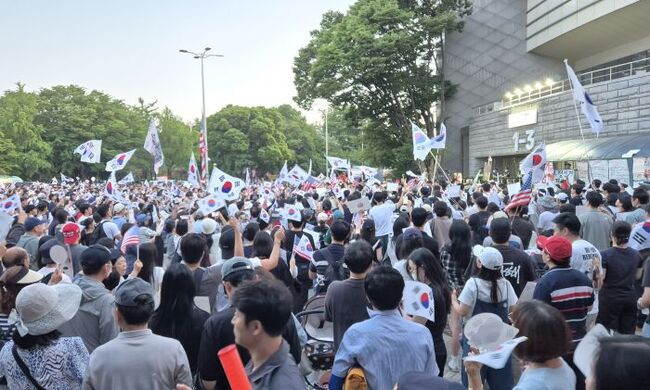
Citizens condemning the National Election Commission’s violation of suffrage and calling for a "rerun of the fraudulent election!" ⒸHanmi Ilbo A month has passed since the truth was revealed
[Seobokka Yuksa Gukguk Comrades Association Statement] ㉑ Eradicate the Election Fraud Cartel through an Opposition-Led Special Prosecutor and Reclaim the Stolen Republic of Korea
Citizens condemning the National Election Commission’s violation of suffrage and calling for a "rerun of the fraudulent election!" ⒸHanmi Ilbo A month has passed since the truth was revealed
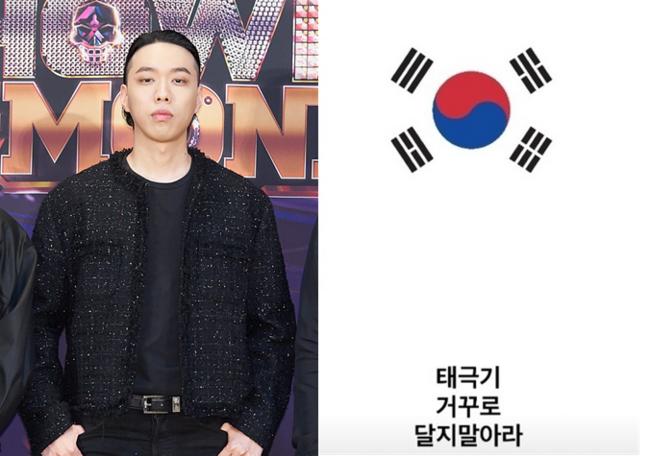 [Photo] “Don’t hang the Taegeukgi upside down”… Did BewhY take a jab at Kim Min-seok?
 [Video] U.S. Semiquincentennial Air Show... 'Art in the Sky' streaks across New York
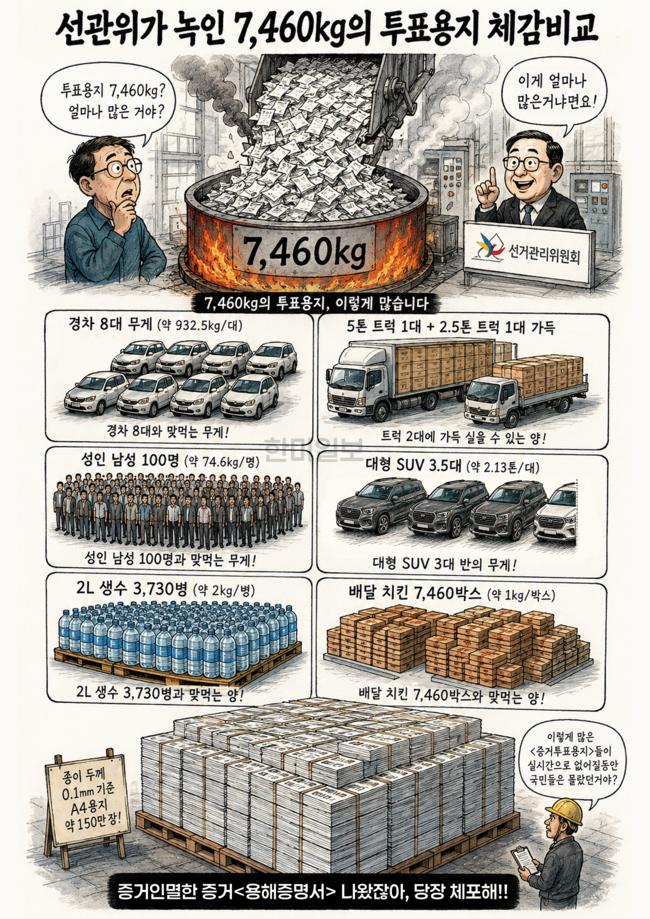 [Editorial Cartoon] A Comparative Visualization of the 7,460kg of Ballot Papers Shredded by the NEC

 List
List