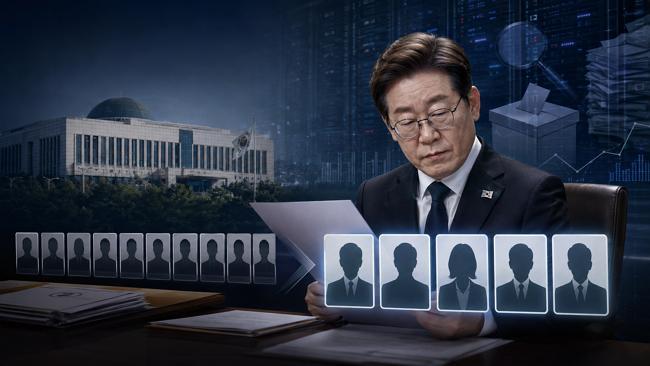
As the appointment of a special prosecutor to investigate the ballot paper shortage during the June 3 local elections and allegations related to the National Election Commission (NEC) becomes imminent, attention is shifting to the composition of the five assistant special prosecutors.
The Special Prosecutor Act specifies not only the shortage of ballot papers but also the manipulation of voter turnout and election statistics, as well as mismanagement, security failures, and operational weaknesses of the election management system as subjects for investigation. Consequently, whether the assistant special prosecutors will include legal experts with experience in election litigation, recount procedures, and the verification of voting statistics and electronic data has become a matter of paramount concern.
On the 14th, the Special Prosecutor Candidate Recommendation Committee recommended former Seoul Southern District Prosecutors' Office Criminal Division 4 Chief Lee Tae-han and former Seoul High Prosecutors' Office Prosecutor Lee Hyuk as the final candidates to Lee Jae-myung. Lee Jae-myung must appoint one of the two as the special prosecutor by the 17th. If no appointment is made by the deadline, the older candidate, Lee Hyuk, will be deemed appointed as the special prosecutor.
The first hurdle following the appointment of the special prosecutor is the selection of the assistant special prosecutors. According to Article 9 of the NEC Special Prosecutor Act, the special prosecutor can select 10 candidates for assistant special prosecutor from among individuals with at least seven years of legal experience, such as judges, prosecutors, or lawyers, and request their appointment by the President. The President must appoint five of these candidates within five days of receiving the request.
While the special prosecutor has the power to form the candidate pool, the final choice rests with Lee Jae-myung. Even if the special prosecutor includes legal experts with experience in election litigation and election statistics/IT systems among the 10 candidates, they cannot join the investigation leadership if Lee Jae-myung selects five others.
In the event that the President fails to appoint the assistant special prosecutors within the deadline, a provision applies whereby the oldest among the candidates is automatically appointed. However, how this provision will be specifically applied to the selection of five out of 10 candidates remains a matter of legal interpretation and practical implementation.
12 Subjects of Investigation Divided into 5 Specialized Fields
The importance of the expertise of assistant special prosecutors is evident in the 12 subjects of investigation defined by the Special Prosecutor Act. A single special prosecutor's act encompasses election law and suffrage, IT and digital forensics, statistical and accounting tracing, and special anti-corruption investigations and public prosecution maintenance.
The following classification is not based on the organizational structure or division of labor defined by law, but is a functional reorganization of the 12 investigation subjects and prosecution tasks by Hanmi Ilbo.
The law does not mandate specific areas of responsibility for each assistant special prosecutor. However, analyzing the 12 investigation targets and subsequent prosecution tasks by function reveals five major specialized areas. As there are five assistant special prosecutors, the key criterion for selection will be whether they can form an investigation leadership team capable of taking responsibility for each field.
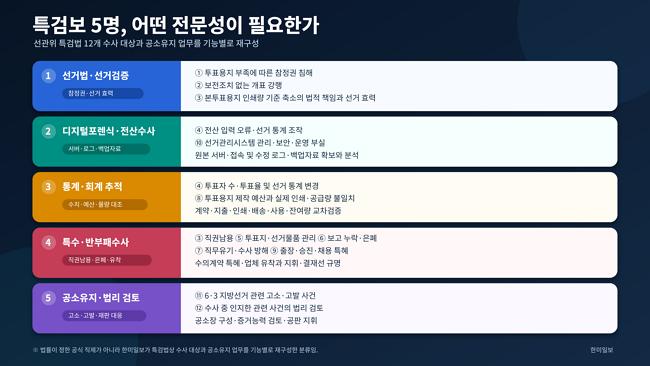
If the five assistant special prosecutor positions are filled only by those with general special investigation experience, the allegations regarding election statistics and IT systems—which the law identifies as subjects for investigation—could be sidelined.
In particular, Article 2, Paragraph 1, Subparagraph 4 of the Special Prosecutor Act specifies "cases involving errors in electronic input of the election management system, such as manipulation of voter turnout counts, and allegations of election statistics manipulation." Subparagraph 10 stipulates allegations of mismanagement, security failures, and operational irregularities in the election management system.
The assistant special prosecutor in charge of this area does not necessarily need to be a programmer or a statistician. However, they must be able to identify the evidence to be secured—such as original servers, backup data, access and modification logs, and the creation/modification history of ballot image files—and provide accurate analytical directives to digital forensic and statistical experts.
The ability to maintain the identity and integrity of evidence during seizure, sealing, duplication, and analysis, and to structure the analysis results into evidence admissible in criminal court, is also required. Since post-facto recovery is difficult if the targets are incorrectly identified during the initial search and seizure stage, the expertise of the assistant special prosecutor is directly linked to the success or failure of the investigation.
The Most Prominent Position: ‘Election Law & Election Verification’ Assistant Special Prosecutor
Among the five assistant special prosecutors, the most attention will be focused on the election law and election verification field. This is because this special investigation must directly verify not just ordinary election offenses, but the NEC’s management of voting and ballot counting, the integrity of ballots, the creation and modification processes for voter counts and turnout rates, and the actual operational status of the election management system.
Previous election investigations focused on identifying bribery, illegal campaigning, and the dissemination of false information by candidates. This special investigation requires a different kind of expertise. Experience in filing election nullification lawsuits and election petitions, conducting evidence preservation and legal recounts, and handling the structure and limitations of materials submitted by the NEC is necessary.
As the special prosecutor has not yet been appointed, the pool of candidates for assistant special prosecutors has not been officially formed. However, lawyers Park Joo-hyun and Kwon Oh-yong are being prominently mentioned in legal circles and among those involved in election litigation as potential candidates for the election verification field.
Lawyer Park has handled numerous election nullification lawsuits and accusations against NEC officials since the 2020 general election. He has consistently tracked issues regarding changes in voter counts and turnout, election data processing, and ballot management, and has also served as a member of the expert group for the National Police Agency's Cyber Terror Investigation Bureau.
Lawyer Park is a law school graduate who passed the 2nd Bar Examination in 2013 and does not have a Judicial Research and Training Institute rank. With over seven years of legal experience, he meets the qualification requirements for an assistant special prosecutor. Since he is a legal junior to both candidates Lee Hyuk and Lee Tae-han, there is no issue of seniority reversal between the special prosecutor and the assistant.
Lawyer Kwon is a former prosecutor and a graduate of the 17th class of the Judicial Research and Training Institute. As the legal representative for the election nullification lawsuit in Yeonsu-eul, Incheon, following the 2020 general election, he directly participated in the court-ordered recount and raised issues regarding anomalous ballots and ballot storage and management. His strength lies in his experience with both the argumentation and verification processes of election nullification lawsuits and physical ballot inspection.
However, Lawyer Kwon is three classes senior to candidate Lee Hyuk and six classes senior to candidate Lee Tae-han. While there is no legal restriction requiring an assistant special prosecutor to be junior to the special prosecutor, seniority reversal could become a variable in actual appointments, considering the status of an assistant special prosecutor under the direction and supervision of the special prosecutor and the culture of the prosecution organization.
As both have actively raised allegations of election fraud, controversies regarding political neutrality are also expected. On the other hand, the fact that they have personally experienced what materials the NEC submits, what it fails to provide, and the extent to which court verification has been carried out, is a form of expertise that those with general special investigation backgrounds lack.
It does not mean that both have received offers to participate from the office of the special prosecutor yet to be appointed, or that they are already included in the pool of 10 candidates. They are simply potential candidates currently being discussed for the election verification role prior to the appointment of the special prosecutor.
Lack of Election Experts May Lead to Controversies over Precision and Fairness
If the five assistant special prosecutors do not include individuals with experience in election law and election verification, the precision and fairness of the special investigation may be questioned from the start.
If the investigation leadership team lacks a legal professional experienced in election nullification lawsuits, legal recounts, and evidence preservation procedures, they may fail to properly grasp the meaning and limitations of materials submitted by the NEC. It is also difficult to rule out the possibility of missing critical items during initial search and seizure, such as original servers, logs, ballot image files, and electoral roll reconciliation data.
Fairness does not mean predetermining a specific conclusion. Neither blindly accepting allegations of election fraud nor starting the investigation while assuming the NEC's explanations are factual can be considered a fair stance. The starting point for fairness lies in verifying physical ballots, original data, and electronic logs against the same standards to determine the truth.
If all legal professionals who have raised election allegations are excluded and the investigation leadership is composed solely of those with general special investigation experience, the team may face suspicions of "excluding the possibility of election manipulation from the start." Conversely, if the team consists only of those who have raised such allegations, it may be criticized for conducting an investigation with a predetermined conclusion.
This is why it is necessary to deploy both those with experience in election litigation and recounts alongside neutral digital forensics and statistical investigation experts, and to verify allegations and NEC explanations using identical criteria.
Hanmi Ilbo Concretizes 12 Investigation Subjects of the Special Prosecutor Act into Verification Tasks
In an article published on July 27, before the passage of the Special Prosecutor Act, titled "[In-depth Analysis] 2 Key Investigation Subjects Missing from the 'Election Fraud Special Prosecutor Act'," Hanmi Ilbo pointed out that if the investigation focuses solely on the shortage of ballot papers, allegations of electronic manipulation in regions where no shortage occurred, records of early voting paper issuance, access data to the integrated electoral roll, and records of outbound early voting ballot returns could be left outside the scope of the investigation.
Three days later, on July 30, the National Assembly passed the NEC Special Prosecutor Act, defining 12 subjects for investigation, including errors in electronic input of the election management system, such as manipulation of voter turnout counts, allegations of election statistics manipulation, and mismanagement, security failures, and operational irregularities of the election management system. The law was promulgated and enforced on August 4.
In a report titled "[Special Report] People, Ballots, Numbers, Accountability... 12 Things a Fraud Election Special Prosecutor Must Verify," published on August 12 after the law's enforcement, Hanmi Ilbo concretized the legal investigation subjects into actual verification tasks.
At the time, Hanmi Ilbo proposed three priority measures to be implemented immediately after the appointment of the special prosecutor: (1) freezing evidence, (2) securing original data directly, and (3) forming an independent verification team. It also emphasized the need to cross-check the history of changes in voter counts and turnout, original IT logs, physical ballots and image files, and the printing, supply, and distribution quantities of ballot papers.
Hanmi Ilbo raised the question of "what should be investigated" before the Special Prosecutor Act was passed, and after the law came into effect, it suggested "what evidence should be secured and how it should be verified."
The key now is whether an investigation leadership team capable of actually digging into the subjects defined by law will be formed. An assistant special prosecutor is not merely an advisor. They are responsible for investigations and public prosecution under the command and supervision of the special prosecutor, and they direct and supervise special investigators and dispatched officials. They are the practical leaders who decide the direction of each investigation team and the targets of compulsory investigations.
The selection of assistant special prosecutors should be evaluated in two stages. First, one must check whether the 10 candidates selected by the special prosecutor include those with experience in election litigation and IT/statistical verification. Next, one must confirm whether those capable of taking charge of these fields are among the five finally appointed by Lee Jae-myung.
Including election verification experts among the assistant special prosecutors is not a matter of accommodating the demands of a specific political camp. As long as the Special Prosecutor Act has explicitly designated election statistics manipulation and election management system failures as subjects of investigation, appointing investigation commanders who understand these fields is the minimum requirement to fulfill the mission granted by the law.
The Special Prosecutor Act has opened the door to investigating allegations of election statistics manipulation and mismanagement of the election management system. What remains is to appoint the right people as assistant special prosecutors to actually walk through that door. The difference between the 10 people put forward by the special prosecutor and the 5 selected by Lee Jae-myung will likely be the first indicator of the will and direction of this special investigation.

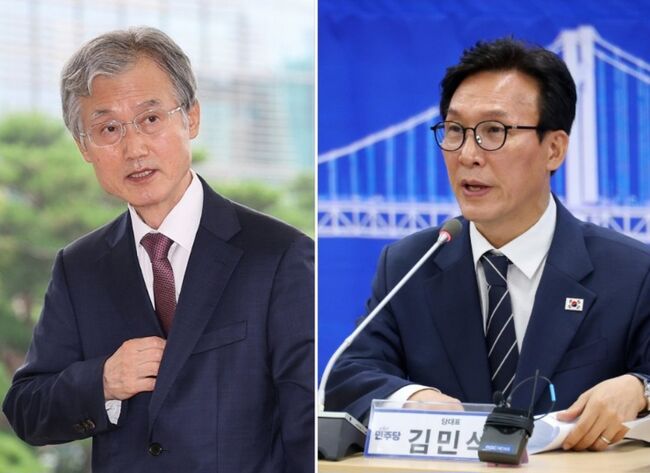 [Statement by the Seo-beo-kka Korea Military Academy Patriotic Comrades Association] ㊷ We Condemn the Ruling Party Leader's Intimidation and Mockery of Supreme Court Justices, and Acts of Destroying the Judiciary
Chief Justice of the Supreme Court Cho Hee-de (left) and Democratic Party of Korea Leader Lee Jae-myung [Photo=Yonhap News]We are witnessing an unprecedented situation where the newly inaugurated lead
[Statement by the Seo-beo-kka Korea Military Academy Patriotic Comrades Association] ㊷ We Condemn the Ruling Party Leader's Intimidation and Mockery of Supreme Court Justices, and Acts of Destroying the Judiciary
Chief Justice of the Supreme Court Cho Hee-de (left) and Democratic Party of Korea Leader Lee Jae-myung [Photo=Yonhap News]We are witnessing an unprecedented situation where the newly inaugurated lead
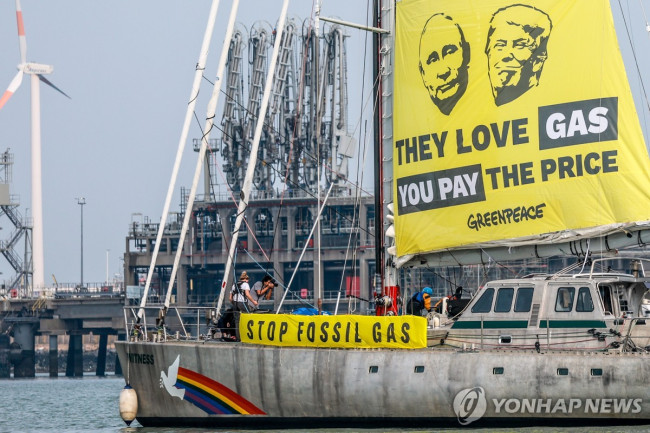 Criticizing Trump, yet… Europe also backsliding on climate change response
Greenpeace, an environmental organization calling for renewable energy policies [EPA=Yonhap News file photo]European nations, which previously criticized U.S. President Donald Trump's rollback of clim
Criticizing Trump, yet… Europe also backsliding on climate change response
Greenpeace, an environmental organization calling for renewable energy policies [EPA=Yonhap News file photo]European nations, which previously criticized U.S. President Donald Trump's rollback of clim
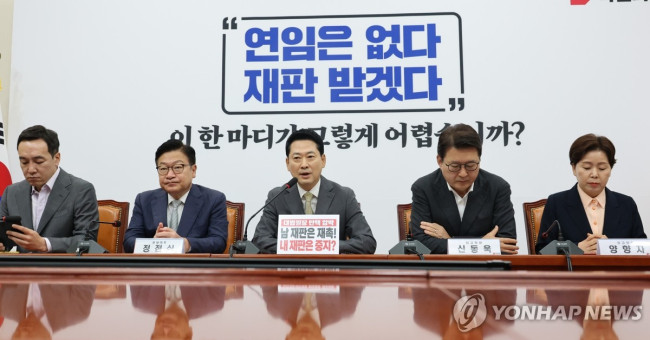 PPP on Nomination of 'Ruling Party-Recommended' Special Inspector Candidate: "We Will Rigorously Verify Them at the Hearing"
People Power Party representative Jang Dong-hyeok is speaking at the Supreme Council meeting held at the National Assembly on the 24th. [Yonhap News] On the 24th, the People Power Party stated th
PPP on Nomination of 'Ruling Party-Recommended' Special Inspector Candidate: "We Will Rigorously Verify Them at the Hearing"
People Power Party representative Jang Dong-hyeok is speaking at the Supreme Council meeting held at the National Assembly on the 24th. [Yonhap News] On the 24th, the People Power Party stated th
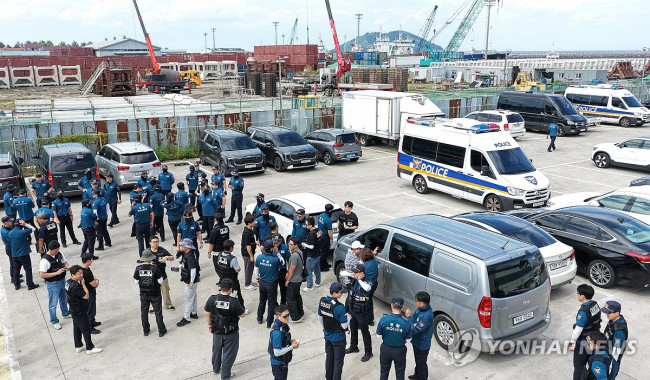 [Comprehensive] Another body of a missing person discovered in Jeju… 4th in three days
Police conducting an intensive search for missing persons [Yonhap News file photo]Recently, bodies suspected to be those of missing persons have been discovered in succession on Jeju Island. This mark
[Comprehensive] Another body of a missing person discovered in Jeju… 4th in three days
Police conducting an intensive search for missing persons [Yonhap News file photo]Recently, bodies suspected to be those of missing persons have been discovered in succession on Jeju Island. This mark
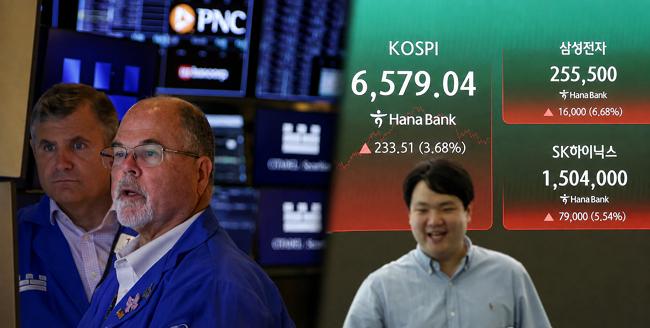 [Korea-US Data Lab] 3rd Week of August (18th–21st) Money Insight
In the U.S., rising long-term Treasury yields lowered the future cash value of tech stocks, while in Korea, shareholder returns from Samsung Electronics and SK Hynix drove a rebound in major semicondu
[Korea-US Data Lab] 3rd Week of August (18th–21st) Money Insight
In the U.S., rising long-term Treasury yields lowered the future cash value of tech stocks, while in Korea, shareholder returns from Samsung Electronics and SK Hynix drove a rebound in major semicondu
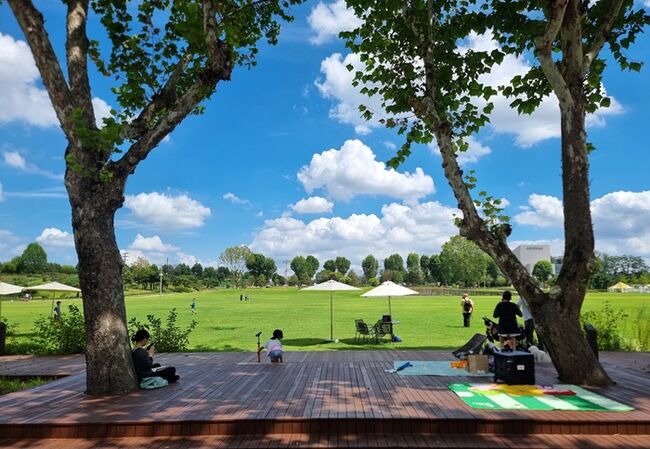 [Trending Travel Destinations] Unlocking a Century of Secrets: ‘Yongsan Children’s Garden’
Family visitors resting in the shade on a picnic mat. [Photo by Reporter Yohi Lim]Throughout history, the wealthy in both the East and the West have enjoyed greenery by creating private gardens on vas
[Trending Travel Destinations] Unlocking a Century of Secrets: ‘Yongsan Children’s Garden’
Family visitors resting in the shade on a picnic mat. [Photo by Reporter Yohi Lim]Throughout history, the wealthy in both the East and the West have enjoyed greenery by creating private gardens on vas
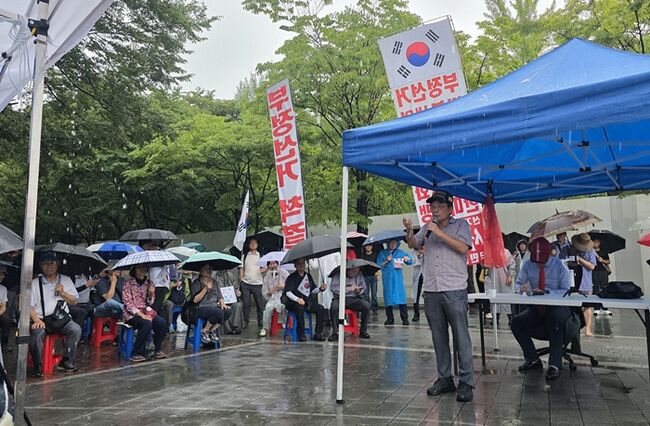 [Photo] Btooyun “We are recruiting 1,600 members for the Olympic Park Scientific Verification Team”… The rainy scenery of Olympic Park on the 22nd
On Saturday the 22nd, amid rainy weather at Olympic Park, the National Coalition for Election Fraud Struggle held a public forum on election integrity. They argued that the "Olympic Park Scientific Ve
[Photo] Btooyun “We are recruiting 1,600 members for the Olympic Park Scientific Verification Team”… The rainy scenery of Olympic Park on the 22nd
On Saturday the 22nd, amid rainy weather at Olympic Park, the National Coalition for Election Fraud Struggle held a public forum on election integrity. They argued that the "Olympic Park Scientific Ve
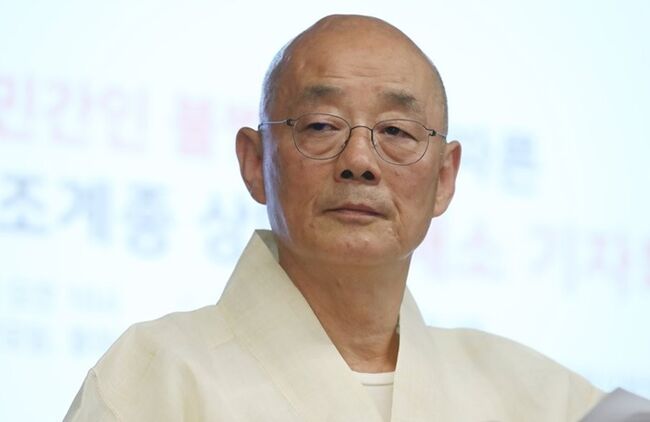 [Special Contribution: Songsan] The Life of a Political Monk Must Also Be Evaluated… What the Passing of Venerable Myeongjin Leaves Behind
Venerable Myeongjin, former head monk of Bongeunsa Temple, passed away on the 22nd. He was 76 years old and had been a monk for 52 years. [Yonhap News File Photo]Various narratives are emerging follow
[Special Contribution: Songsan] The Life of a Political Monk Must Also Be Evaluated… What the Passing of Venerable Myeongjin Leaves Behind
Venerable Myeongjin, former head monk of Bongeunsa Temple, passed away on the 22nd. He was 76 years old and had been a monk for 52 years. [Yonhap News File Photo]Various narratives are emerging follow
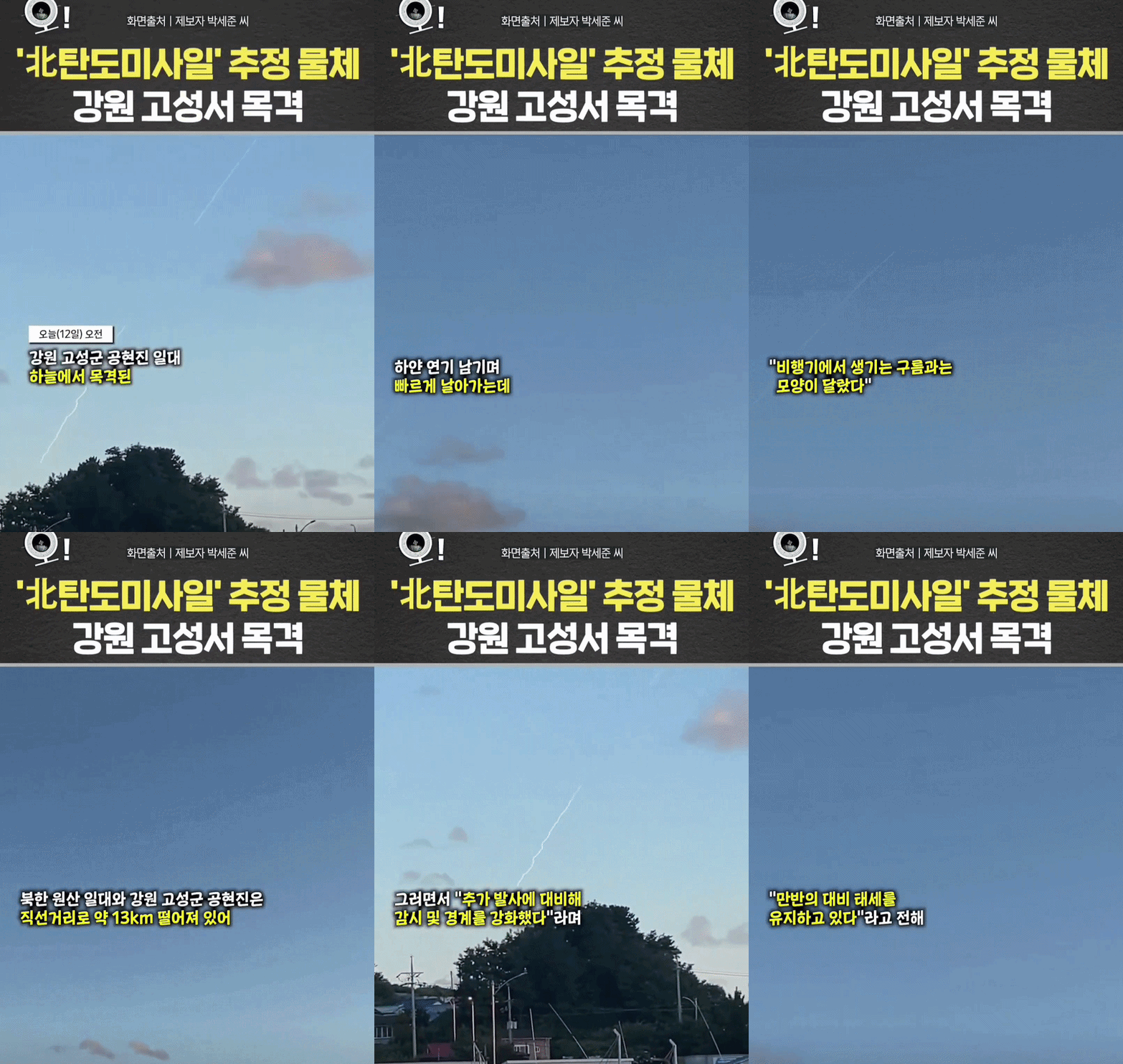 [Video] North Korean ballistic missile filmed by a civilian in Goseong, Gangwon-do
 [Editorial Cartoon] A Draconian Law That Undermines Freedom of Expression

 List
List