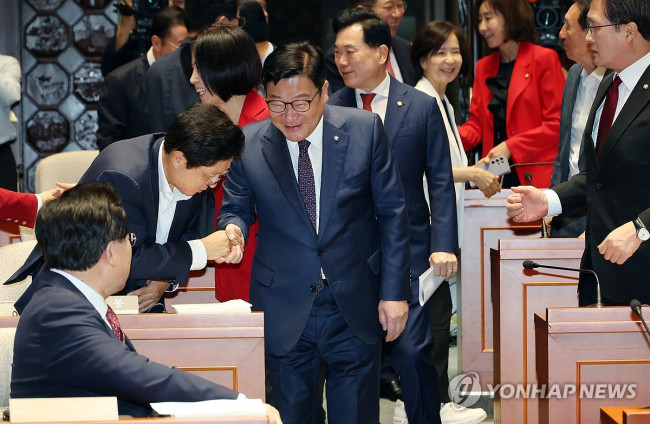
People Power Party representatives Kim Do-eup and Lee Jong-bae attend a meeting of senior lawmakers with four or more terms on July 13 (left). Representative Jang Dong-hyuk arrives at a press conference marking his first anniversary as party leader at the central party headquarters in Yeouido, Seoul, on the 26th (right). [Photo = Yonhap News]
Senior lawmakers of the People Power Party with four or more terms in office have gathered. They reportedly agreed that "the party cannot win the 2028 general election in its current state." While their diagnosis was serious, the prescription they offered was pathetic.
Their requests were to hold regular meetings with Representative Jang Dong-hyuk, to regularize these meetings if possible, and to carefully reconsider the disciplinary actions against lawmakers Cho Kyoung-tae, Kwon Young-jin, Seo Beom-soo, and Jin Jong-oh, as they could undermine the party's harmony and unity.
If they have concluded that winning the general election is difficult, then the causes and alternatives must follow. If Representative Jang's direction is wrong, they should point out exactly what is wrong; if there is an issue with the leadership structure, they should arrive at a conclusion—whether by demanding a change or by proposing supplementary measures. If the direct election system for local party chairpersons is the problem, they should clearly state their position for or against it and propose a better alternative.
However, none of this happened. While they warned of the possibility of defeat in the general election, they failed to say what needs to be changed or how.
9 out of 19, and even they were not in unison
Of the 19 People Power Party lawmakers with four or more terms, only nine attended the meeting: Joo Ho-young, Kim Gi-hyeon, Na Kyung-won, Kim Do-eup, Kim Sang-hoon, Park Dae-chul, Yu Eui-dong, Yun Jae-ok, and Lee Jong-bae. It did not even reach a majority.
The opinions of the attendees were not unanimous, either. While many argued that the disciplinary actions could harm party harmony, counterarguments were raised that the party should not just speak with one voice, and some pointed out that the disciplined lawmakers should also make efforts toward harmony.
There was no discussion regarding the future of Representative Jang. They failed to form any consensus on the direct election system for party members to choose local party chairpersons—a plan Representative Jang reaffirmed his intention to pursue during his first-anniversary press conference.
It is also difficult to group the 10 absent members as a single opposition faction. Lawmaker Cho Kyoung-tae stated he would accept the disciplinary action taken against him. It was not clearly revealed whether the other absentees favor or oppose regular meetings or the reconsideration of disciplinary actions.
Neither the attendees nor the absentees are unified. This means the 19 senior lawmakers cannot even produce a minimal joint diagnosis regarding the party’s path forward.
Does meeting the leader often show the path to winning the election?
What is even more difficult to understand is that their core demand was for regular meetings with the party leader.
Are they implying that the party is in this state because they couldn't meet with the leader? Will increasing the frequency of meetings boost sagging approval ratings or create a winning strategy for the general election? Senior lawmakers may request meetings with the party leader, but that cannot be the conclusion of a grave diagnosis that "winning the general election is difficult as things stand."
As senior lawmakers, before asking the leader to call them in, they should first put forth their own judgments. They should state whether the general election can be fought under Representative Jang's leadership, whether public support can be expanded with the current direction, and what balance needs to be struck between member-centered reform and public opinion.
They must also propose how to keep the government and the ruling party in check. They should provide answers on what strategies they will use to operate parliamentary standing committees and review budgets, how they will regain support from the capital region and the youth, and how to normalize the party's policy and strategy functions, including the Yeouido Institute.
That is what the public expects to hear from a gathering of four-, five-, and six-term lawmakers. Requesting regular meetings and reconsideration of discipline may be a starting point, but it is not a solution befitting the diagnosis that "they cannot win the general election this way."
What seniors need is not to step down
Representative Jang countered the criticizing seniors not by discussing a change in leadership, but by implying that it would be more helpful for the general election if they declared they would not run for re-election and paved the way for new talent.
However, this argument also misses the point. There is no justification for them to withdraw from the race or step down simply because they have served many terms. Senior lawmakers are also representatives who were nominated through the choice of party members and elected to the National Assembly by voters. If they possess experience, expertise, and regional representation, they can run again.
The fact of being a multi-term lawmaker is not a fault in itself. Demanding them to step down unconditionally by treating political experience as a liability rather than an asset is less a matter of accountability and more akin to discrimination based on seniority.
What the public demands of senior lawmakers is not sacrifice for the sake of sacrifice. It is to show where and how they will use their long political experience and influence within the party.
What seniors need is not to step down, but to fulfill their roles. They should clearly warn the party when it goes astray, offer alternatives when the leadership loses its way, and mediate when factions collide. They should state their judgments publicly, push them through internal party procedures and actions, and then be politically judged on the results.
That is responsibility. And responsibility does not necessarily mean not running for office.
The problem is not that they won't step down, but that they won't move
The crisis facing the People Power Party is not light. It is failing to gain a reflected benefit despite the failures of the government and the ruling party. Even as clashes over disciplinary actions and local party restructuring continue within the party, the policy alternatives and general election strategies to show the public remain unclear.
In times like this, what senior lawmakers should be doing is not gathering in back rooms to share their worries. If Representative Jang's direction is correct, they should empower him and compensate for any shortcomings. If it is wrong, they must reveal what is wrong and why, and correct it. If they judge that a change in leadership is necessary, they should demand it responsibly. If they have no intention to do so, they should cease ambiguous words and actions that appear to be attempts to shake the leadership.
Retreating to a conclusion of "let's meet and talk often" without either supporting or opposing is not political wisdom. It is merely a safe middle ground to avoid taking responsibility.
The public is not asking senior lawmakers to give up their seats. They are asking them to state where the party should head in line with their long experience, to correct the leadership when it goes wrong, and to mediate when conflict arises.
They are not being criticized because they are multi-term lawmakers who refuse to step down, but because they are failing to fulfill roles befitting their seniority. The problem is not that they are not stepping down, but that they are not taking action.
They have spread their wings, but showed neither direction nor strength. This meeting was not a soaring flight by senior lawmakers to save the party, but a pathetic flapping of wings by figures who have lost their purpose.

 [Analysis] Is a ‘Win-Win’ Possible for the U.S. and Venezuela?
U.S. President Donald Trump and Venezuelan Interim President Delcy Rodríguez. The U.S. government has secured a 35% stake in the parent company of the private oil firm NABEP and the rights to acquire
[Analysis] Is a ‘Win-Win’ Possible for the U.S. and Venezuela?
U.S. President Donald Trump and Venezuelan Interim President Delcy Rodríguez. The U.S. government has secured a 35% stake in the parent company of the private oil firm NABEP and the rights to acquire
 PPP's general meeting fails to adopt 'People's Voting Rights Protection Act' as party platform; agrees to further discussions
Floor Leader Jeong Jeom-sik attending the policy general meeting of lawmakers [Seoul=Yonhap News]On the 3rd, the People Power Party planned to adopt as a party platform a bill to reform the National E
PPP's general meeting fails to adopt 'People's Voting Rights Protection Act' as party platform; agrees to further discussions
Floor Leader Jeong Jeom-sik attending the policy general meeting of lawmakers [Seoul=Yonhap News]On the 3rd, the People Power Party planned to adopt as a party platform a bill to reform the National E
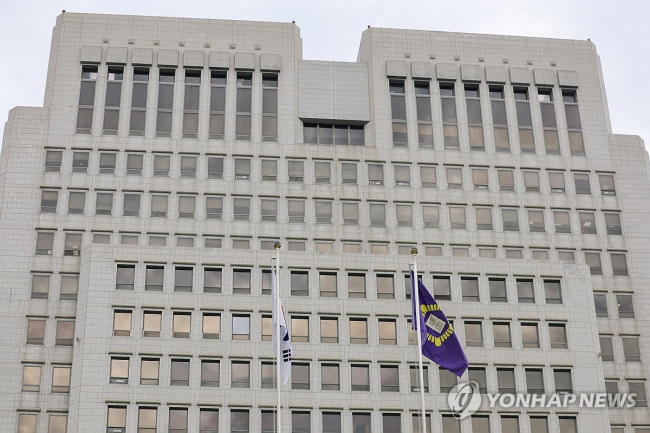 27 legal professionals from the Seoul National University Law School class of '76: "The Blue House’s demand for the reappointment of Supreme Court Justices is unjust."
The Supreme Court of Korea [Seoul=Yonhap News] Twenty-seven legal professionals from the Seoul National University College of Law's class of '76 issued a joint statement on the 3rd, criticizing P
27 legal professionals from the Seoul National University Law School class of '76: "The Blue House’s demand for the reappointment of Supreme Court Justices is unjust."
The Supreme Court of Korea [Seoul=Yonhap News] Twenty-seven legal professionals from the Seoul National University College of Law's class of '76 issued a joint statement on the 3rd, criticizing P
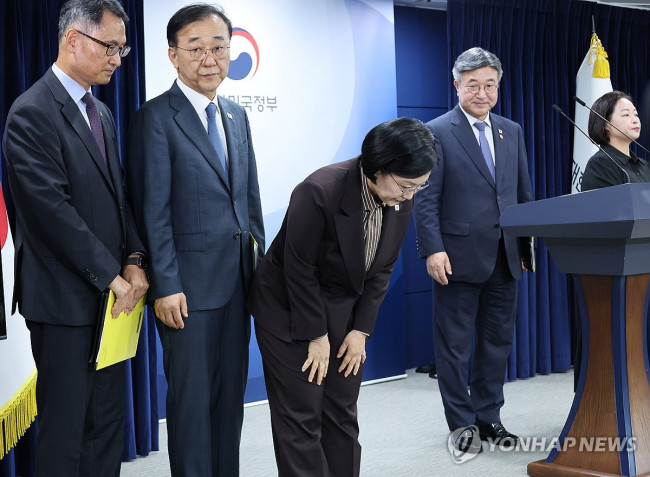 Relocation of Public Institutions to Begin Next Year… "Minimize Retention in Capital Region, Reduce 109 Institutions"
The government will begin the full-scale relocation of administrative and public institutions starting in the first half of next year.It is also launching reforms to reduce the number of public instit
Relocation of Public Institutions to Begin Next Year… "Minimize Retention in Capital Region, Reduce 109 Institutions"
The government will begin the full-scale relocation of administrative and public institutions starting in the first half of next year.It is also launching reforms to reduce the number of public instit
 [New Book] The True Face of the Ivory Tower Hidden in the Shadow of Power… Park Sun-kyung’s ‘Misaki’
The university campus, often called a sanctuary of intellect. A new novel has been published that sharply dissects the hypocrisy and absurdity committed within those solid walls of power. &
[New Book] The True Face of the Ivory Tower Hidden in the Shadow of Power… Park Sun-kyung’s ‘Misaki’
The university campus, often called a sanctuary of intellect. A new novel has been published that sharply dissects the hypocrisy and absurdity committed within those solid walls of power. &
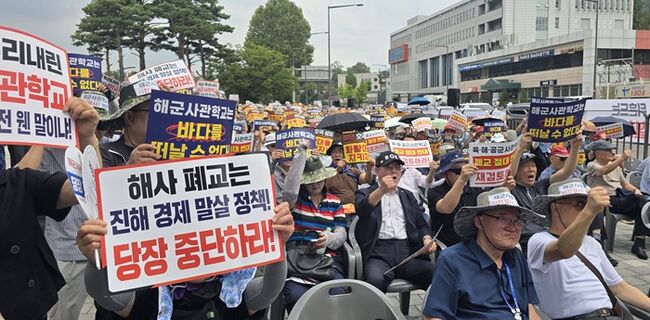 [Photo] “We Oppose the Closing of the Military Academy”… Large-Scale Protest Held in Front of the War Memorial on the 26th
The "National Solidarity for Preventing the Closure of Military Academies" held a rally to protest the closure of military academies at the plaza in front of the War Memorial of Korea in Samgakji, Seo
[Photo] “We Oppose the Closing of the Military Academy”… Large-Scale Protest Held in Front of the War Memorial on the 26th
The "National Solidarity for Preventing the Closure of Military Academies" held a rally to protest the closure of military academies at the plaza in front of the War Memorial of Korea in Samgakji, Seo
 [Trending Destinations] The Leisure of Seoul's Hangang Bus and the Romance of Hong Kong's Star Ferry
Hannam Bridge viewed from the Hangang Bus. [Video = Reporter Lim Yo-hee]With the introduction of the Hangang Bus, Seoul—which previously lacked sufficient water-based public transport—has gained a
[Trending Destinations] The Leisure of Seoul's Hangang Bus and the Romance of Hong Kong's Star Ferry
Hannam Bridge viewed from the Hangang Bus. [Video = Reporter Lim Yo-hee]With the introduction of the Hangang Bus, Seoul—which previously lacked sufficient water-based public transport—has gained a
 [Jung Jae-hak’s From Jeolla-do] Listening to Patti Kim’s ‘Song of September’
Today, as it has been all day long, the heat wave has been sculpting clouds, and the wind has been gathering them. Thus, from the early evening through the night, the sound of rain persists.&nbs
[Jung Jae-hak’s From Jeolla-do] Listening to Patti Kim’s ‘Song of September’
Today, as it has been all day long, the heat wave has been sculpting clouds, and the wind has been gathering them. Thus, from the early evening through the night, the sound of rain persists.&nbs
 [Issue Commentary] 3 Reasons Why the Lee Jae-myung Trial Must Proceed
 [Editorial Cartoon] A Draconian Law That Undermines Freedom of Expression

 List
List