
What is a devil?
If we set aside the language of religion for a moment and consider the question through the lens of philosophy, we arrive at an intriguing answer. A devil may not necessarily be a being that constantly urges obvious evil upon humans. Rather, it is more akin to a force that inverts the natural order of human desires.
Pleasure, in itself, is not evil. Without pleasure, human life would be desolate. Money, too, is not evil; it is a useful instrument that facilitates the exchange necessary for human life. The same applies to power: power is essential for leading a community and realizing the common good.
The problem begins the moment these things overstep their bounds.
Borrowing from the philosophy of Thomas Aquinas, humans must arrange their desires in an orderly fashion, directed toward a higher good. There is a distinction between enjoying pleasure and making pleasure the ultimate purpose of life. In the former, the human governs the pleasure; in the latter, the pleasure governs the human.
The same holds true for power.
Political power should be a means to achieve the common good—a power temporarily delegated by the people to protect their liberty and safety and to establish a just order.
But what happens when, at some point, the maintenance of power itself becomes the goal of politics? Everything is turned upside down.
Power is no longer used for the people; instead, the people are mobilized for power. Power is no longer used to realize justice; instead, justice is invoked to justify power. Power is no longer exercised to defend democracy; instead, the name of democracy is privatized to protect power. It is a perfect inversion of ends and means.
The Perfect Inversion of Means and Ends: The Birth of 'Demonic' Power
At this juncture, the essence of totalitarianism and the corruption of power are revealed.
The tragedy of 20th-century communist totalitarianism must be viewed through this lens. The communist revolution promised human liberation and equality. However, in the actual historical reality of various single-party communist regimes, the party and state power, which claimed to be merely means for the revolution, became a vast, self-serving end. Power, which was supposed to exist for the sake of human liberation, eventually demanded human obedience, resulting in a reversal where individuals were sacrificed for the party.
In theological terms, this can be called a "demonic inversion": a phenomenon where a lower-order good, intended as a means, usurps the place of the ultimate purpose.
This question must be thrust like a blade into our current political reality—especially regarding the power structure and dysfunctional conduct exhibited by the Lee Jae-myung administration and its ruling faction.
Looking at the current administration's exercise of power, it is clear that its goal is by no means the "pursuit of the common good" or the "safety and justice of the entire nation." For them, power has devolved into "the preservation of power itself" and a defensive shield to escape the judicial consequences and convictions facing the core of the regime.
Destruction of the Separation of Powers and Instrumentalization of State Systems
The recent push to "completely abolish the prosecution’s supplementary investigation rights" is a prime example. What common good is served by attempting to neutralize the power of investigative agencies, thereby shaking the foundations of the criminal justice system and ignoring the resulting void in investigations that the public will have to suffer?
The act of tying the hands of the nation’s highest law enforcement agency—the very body capable of investigating and adjudicating election irregularities, corruption, and the regime’s own failings—is a classic case of the "self-purposiveness of power," which has completely abandoned the public goal of judicial justice in favor of private and political survival.
As maintaining power becomes the ultimate goal, even the separation of powers, the bulwark of democracy, is trampled upon without hesitation. This was clearly proven by the unprecedented constitutional crisis in which the government demanded a renomination for Supreme Court justice candidates—challenging the nomination rights of Chief Justice Cho Hee-dae, who had made the nominations in accordance with his constitutional authority.
Rather than respecting the independence of the judiciary, the intention has become explicit: to turn the courts into a shield for the regime, tailored to its own interests. The democratic procedure of checks and balances stipulated by the Constitution is being destroyed, and the entire state apparatus is being mobilized for the single purpose of "defending power."
Living in fear that losing power would lead to political and judicial collapse, those in control view power not as a tool for the common good, but as an absolute, indispensable weapon. When power becomes an end in itself, laws, institutions, parliament, and the judiciary are reduced to mere accessories that support the regime's survival, shaking the very foundations of democracy.
It is also a problem that the ruling forces remain trapped in the worldview of the 80s and 90s student activist movement, which sees the world through a binary lens of good versus evil, "us" versus "the enemy."
Like frogs in a well, they are oblivious to the rapidly changing international landscape, blinded by a biased ideology born of victimhood, insisting that only their way is correct.
They preach change and reform with their lips, but their body has become a stagnant pool, rotting from within.
The Barbarism and Ruin Invited by Uncontrolled Desire
Just as a person who possesses money can become a slave to money, a person who possesses power can become a slave to power. The most dangerous person in politics is not simply someone who holds power.
It is someone who has forgotten that power is a means, someone who has gone further to make the preservation of that power their ultimate goal, thereby destabilizing the entire state system.
Here, we witness the point where power and pleasure converge—the extreme tragedy reached by unbridled human desire.
The shock delivered to us by the "Jeffrey Epstein" case, a real-life horror that shook the world, is not limited to one individual’s sexual depravity or crimes. Behind the network of sadistic pleasure and hideous crimes on Epstein’s private island, there was always the absolute power and wealth that enabled and concealed it.
The Epstein tragedy clearly demonstrated how cruel humans can become and how thoroughly they can instrumentalize the dignity and lives of others when individual greed, lacking self-control, is combined with unchecked power.
Whether it is power, pleasure, or money, the moment it loses its controlling mechanisms and moral boundaries and becomes an end in itself, it inevitably destroys humanity and plunges society into hell. Just as uncontrolled pleasure tramples upon a human soul and the lives of others, uncontrolled power slaughters the justice, the separation of powers, and the entire democratic system of a nation.
The cleverest way for the devil to tempt humanity is not by calling evil "good," but by making people believe that private interests or the greed of self-survival is the highest good.
Constantly limiting and rotating power so that it does not become an end in itself; monitoring it so that it is not used as a personal shield or an instrument for private desire—
That is the most powerful boundary line protecting liberal democracy from totalitarianism and barbarism. We must not forget that when we remain passive spectators to the corruption of power and its demonic inversion, we place ourselves under the dominion of the devil.
 Min Byung-gon, Political Documentary Writer

 [Analysis] Is a ‘Win-Win’ Possible for the U.S. and Venezuela?
U.S. President Donald Trump and Venezuelan Interim President Delcy Rodríguez. The U.S. government has secured a 35% stake in the parent company of the private oil firm NABEP and the rights to acquire
[Analysis] Is a ‘Win-Win’ Possible for the U.S. and Venezuela?
U.S. President Donald Trump and Venezuelan Interim President Delcy Rodríguez. The U.S. government has secured a 35% stake in the parent company of the private oil firm NABEP and the rights to acquire
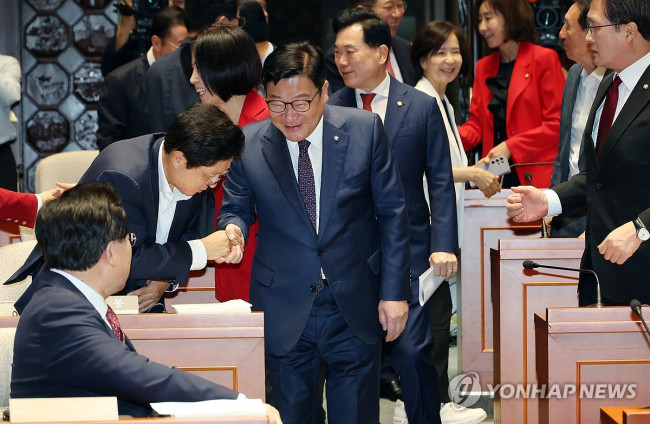 PPP's general meeting fails to adopt 'People's Voting Rights Protection Act' as party platform; agrees to further discussions
Floor Leader Jeong Jeom-sik attending the policy general meeting of lawmakers [Seoul=Yonhap News]On the 3rd, the People Power Party planned to adopt as a party platform a bill to reform the National E
PPP's general meeting fails to adopt 'People's Voting Rights Protection Act' as party platform; agrees to further discussions
Floor Leader Jeong Jeom-sik attending the policy general meeting of lawmakers [Seoul=Yonhap News]On the 3rd, the People Power Party planned to adopt as a party platform a bill to reform the National E
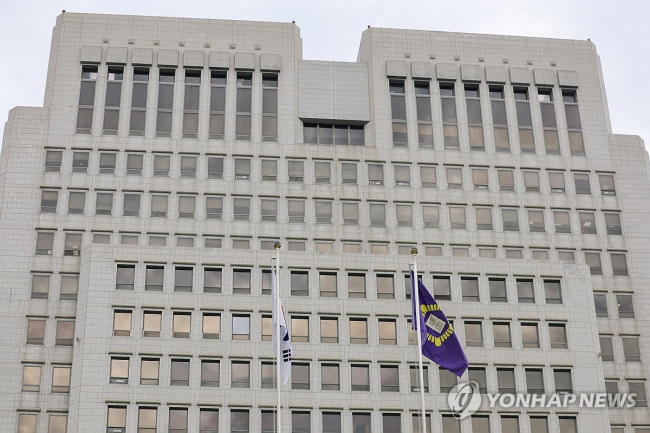 27 legal professionals from the Seoul National University Law School class of '76: "The Blue House’s demand for the reappointment of Supreme Court Justices is unjust."
The Supreme Court of Korea [Seoul=Yonhap News] Twenty-seven legal professionals from the Seoul National University College of Law's class of '76 issued a joint statement on the 3rd, criticizing P
27 legal professionals from the Seoul National University Law School class of '76: "The Blue House’s demand for the reappointment of Supreme Court Justices is unjust."
The Supreme Court of Korea [Seoul=Yonhap News] Twenty-seven legal professionals from the Seoul National University College of Law's class of '76 issued a joint statement on the 3rd, criticizing P
 Relocation of Public Institutions to Begin Next Year… "Minimize Retention in Capital Region, Reduce 109 Institutions"
The government will begin the full-scale relocation of administrative and public institutions starting in the first half of next year.It is also launching reforms to reduce the number of public instit
Relocation of Public Institutions to Begin Next Year… "Minimize Retention in Capital Region, Reduce 109 Institutions"
The government will begin the full-scale relocation of administrative and public institutions starting in the first half of next year.It is also launching reforms to reduce the number of public instit
 [New Book] The True Face of the Ivory Tower Hidden in the Shadow of Power… Park Sun-kyung’s ‘Misaki’
The university campus, often called a sanctuary of intellect. A new novel has been published that sharply dissects the hypocrisy and absurdity committed within those solid walls of power. &
[New Book] The True Face of the Ivory Tower Hidden in the Shadow of Power… Park Sun-kyung’s ‘Misaki’
The university campus, often called a sanctuary of intellect. A new novel has been published that sharply dissects the hypocrisy and absurdity committed within those solid walls of power. &
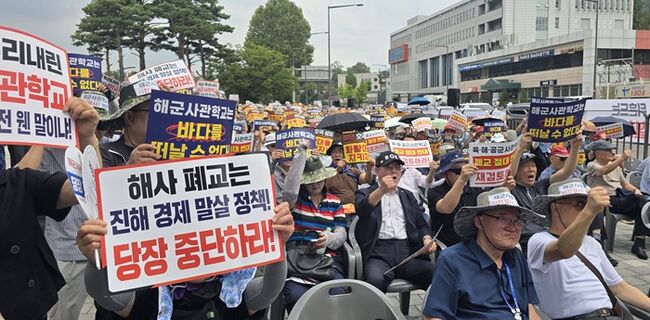 [Photo] “We Oppose the Closing of the Military Academy”… Large-Scale Protest Held in Front of the War Memorial on the 26th
The "National Solidarity for Preventing the Closure of Military Academies" held a rally to protest the closure of military academies at the plaza in front of the War Memorial of Korea in Samgakji, Seo
[Photo] “We Oppose the Closing of the Military Academy”… Large-Scale Protest Held in Front of the War Memorial on the 26th
The "National Solidarity for Preventing the Closure of Military Academies" held a rally to protest the closure of military academies at the plaza in front of the War Memorial of Korea in Samgakji, Seo
 [Trending Destinations] The Leisure of Seoul's Hangang Bus and the Romance of Hong Kong's Star Ferry
Hannam Bridge viewed from the Hangang Bus. [Video = Reporter Lim Yo-hee]With the introduction of the Hangang Bus, Seoul—which previously lacked sufficient water-based public transport—has gained a
[Trending Destinations] The Leisure of Seoul's Hangang Bus and the Romance of Hong Kong's Star Ferry
Hannam Bridge viewed from the Hangang Bus. [Video = Reporter Lim Yo-hee]With the introduction of the Hangang Bus, Seoul—which previously lacked sufficient water-based public transport—has gained a
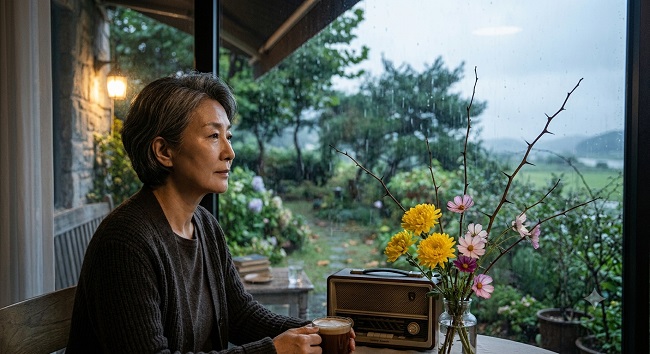 [Jung Jae-hak’s From Jeolla-do] Listening to Patti Kim’s ‘Song of September’
Today, as it has been all day long, the heat wave has been sculpting clouds, and the wind has been gathering them. Thus, from the early evening through the night, the sound of rain persists.&nbs
[Jung Jae-hak’s From Jeolla-do] Listening to Patti Kim’s ‘Song of September’
Today, as it has been all day long, the heat wave has been sculpting clouds, and the wind has been gathering them. Thus, from the early evening through the night, the sound of rain persists.&nbs
 [Issue Commentary] 3 Reasons Why the Lee Jae-myung Trial Must Proceed
 [Editorial Cartoon] A Draconian Law That Undermines Freedom of Expression

 List
List