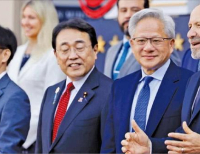
Kim Jung-kwan, Minister of Trade, Industry and Energy of South Korea, Japanese Minister of Economy, Trade and Industry Ryosei Akazawa, NVIDIA CEO Jensen Huang, and U.S. Secretary of Commerce Howard Lutnick pose for a commemorative photo at the G20 Innovation Ministerial meeting held in Chapel Hill, North Carolina, on the 2nd (local time). During the meeting, G20 member nations reached a consensus on the "Carolina Principles on Emerging Technologies" proposed by the United States. [Photo: Reuters/Yonhap News]
The G20 Innovation Ministerial meeting, held in Chapel Hill, North Carolina, concluded on the 2nd (U.S. local time). At the meeting, led by the U.S. Department of Commerce and the White House Office of Science and Technology Policy, member nations agreed on the "Innovation Ministerial Statement" and the "Carolina Principles on Emerging Technologies."
The statement declared that "emerging technologies have the potential to unlock prosperity, boost productivity, and expand opportunities for all citizens." To this end, nations pledged to invest in basic research, strengthen pathways for technology commercialization, and promote the adoption and dissemination of trustworthy technologies.
On the surface, this appears to be a familiar declaration of technological cooperation. However, when viewed in the context of the policies concurrently pursued by the Trump administration, it reads as an entirely different document.
Trump is not merely fostering the AI industry; he is designing the very framework through which AI is developed, traded, paid for, powered, and cross-borderly deployed. It is a structure where U.S. firms create the technological foundation, dollar-denominated stablecoins handle the transactions, and energy and raw materials support the entire system.
This is the new international order of the AI era that Trump envisions. The Carolina Principles can only be fully understood within this context.
Removing Barriers in the Name of Deregulation
The Innovation Ministerial Statement is built on six pillars: a pro-innovation policy framework, opportunity and prosperity through technology, workforce development, AI and intellectual property, AI for standards and standards for AI, and industrial innovation and supply chain investment.
Among these, the "pro-innovation policy framework" warrants the most attention. The statement suggests prioritizing the application of existing industrial regulations and only considering new rules when novel issues arise that cannot be addressed by current laws. It also identifies unnecessary barriers that hinder market entry, excessive licensing procedures, and unfair technology transfer demands as targets for removal.
Domestically in the U.S., this is seen as deregulation. However, the meaning shifts the moment it crosses borders. If another country’s laws, licensing systems, data regulations, or internet barriers obstruct U.S. firms, they can be classified as "market access barriers" that must be dismantled.
AI is not an industry where goods are loaded into shipping containers and passed through customs. Data, algorithms, cloud services, and payment networks traverse borders via the internet. In the AI era, market opening becomes less about lowering tariffs and more about opening pathways for data and internet connectivity.
Capital markets can be controlled to some extent through licenses and foreign exchange regulations. However, once the digital market—where intelligence and information move in real-time—is opened, the boundaries of industry, consumption, finance, public opinion, and even national security may become fluid. This is why state sovereignty in the AI era is difficult to define solely by existing territorial sovereignty.
Although the Carolina Principles speak of deregulation, if those regulations are digital barriers erected at borders, they ultimately function as principles for the removal of such barriers.
Will China Open Its Doors, or Forgo Global Markets?
At this point, it is striking that China participated in the consensus on the Carolina Principles.
China blocks major U.S. platforms and internet services while controlling the cross-border transfer of data. It maintains high barriers regarding algorithms, cloud computing, security audits, and business permits, all while attempting to export its own AI models and digital products to overseas markets.
Such asymmetry is difficult to sustain in the long run.
The Carolina Principles contain no clauses stating that "China must dismantle its internet barriers" or "apply reciprocity." It is a non-binding declaration, and it should not be interpreted as China agreeing to open its internet.
However, the U.S. has established a foundation of rhetoric that can be used to invoke reciprocity in the next stage. The demand is clear: if China wishes to sell its AI and digital products in the U.S. market, it must allow a corresponding level of access for U.S. AI, cloud, and digital services.
If China opens its doors, U.S. AI firms will enter the massive Chinese market. If it keeps them closed, Chinese AI could face restricted market access in the global arena based on reciprocity.
Trump is not simply trying to block China. He is using semiconductors and market access as leverage to force China's doors open and gain entry. Containment is not the end goal; it is the pressure intended to extract openness.
China’s vast domestic market and state support may serve as a short-term buffer. However, amidst population decline and cooling domestic demand, it is difficult to sustain the massive investments required for a cutting-edge AI ecosystem solely within its own borders. AI models evolve faster as they secure more users, data, capital, and access to international markets.
China must either open its internet and data markets to compete head-to-head with U.S. firms, or accept the risk of being isolated from the global market as the cost of maintaining its closure. This is why, while the Carolina Principles may not be a compulsory regulation that forces immediate change in China, they serve as international language that narrows China's options.
More remarkably, China has joined the consensus on the "innovation and barrier-removal" rhetoric put forth by the U.S.
Adding Dollars and Energy to AI Technology
If the Carolina Principles represent the rules of the market through which AI crosses borders, dollar-based stablecoins could become the primary payment method used in that market.
Connecting the AI export policy and the stablecoin policy released by the Trump administration reveals a broader master plan. While the U.S. government has not formally labeled these two policies as a single official strategy, the logic holds: if U.S. AI technology spreads globally and transactions are settled via dollar-based digital payment networks, the dominance of the dollar can be maintained even in the AI era.
In July 2025, Trump signed the GENIUS Act to establish a federal regulatory framework for payment-based stablecoins. The "U.S. AI Action Plan," released that same month, announced the export of a "full-stack AI"—integrating hardware, models, software, applications, and standards—to allies and partner nations.
Though they are distinct policies, they point in the same direction: a structure where U.S. AI becomes the world's technological bedrock, and dollar stablecoins settle the transactions occurring on top of it.
Historically, American hegemony functioned around the dollar, oil, and maritime trade routes. In the AI era, dollar stablecoins, AI platforms, semiconductors, and cloud computing may replace or supplement those pillars.
However, an AI-driven order cannot be completed by technology and currency alone. It requires the power and raw materials to physically operate it.
To run data centers and semiconductor plants 24/7, nuclear power, Small Modular Reactors (SMRs), hydrogen power, Energy Storage Systems (ESS), transmission networks, and cooling systems must all be integrated into a single, cohesive system.
This is why the low instantaneous cost of solar power cannot explain the competition for AI electricity. What AI data centers demand is not electricity that fluctuates with the weather, but high-density, high-quality power that never stops for 24 hours. Costs must be calculated based on the complete supply chain, including storage, backup generation, transmission grids, and power conversion facilities.
SMRs are not a distant future concept. They are already operating in China and Russia, and site selection, procurement, and permitting are already underway in the U.S. and the UK.
However, being the first to operate a reactor does not guarantee global market dominance. A reactor running and the world trusting that reactor are two different issues. One must be able to trust safety certifications, component standards, nuclear fuel supply, cybersecurity, operating software, finance, insurance, and decommissioning for decades.
Ultimately, the victory lies not in the initial development, but in who captures the technology standards. The standard-setting logic of the Carolina Principles may lead to future discussions on the interoperability of the semiconductors, data centers, and power infrastructure that drive AI. Companies that create technologies first may change, but the nation that controls the standards sets the terms of market entry and dominates the supply and maintenance markets for a long time.
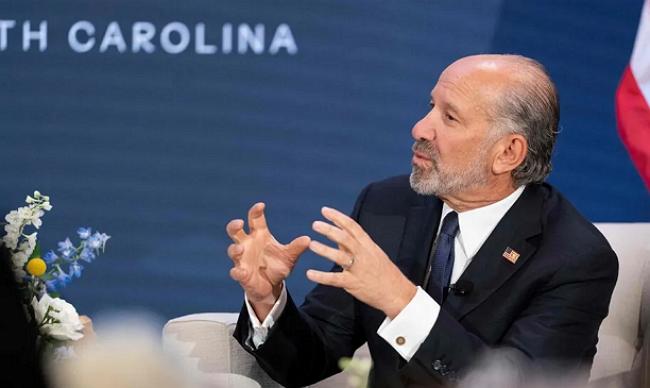 U.S. Secretary of Commerce Howard Lutnick talks with OpenAI founder Sam Altman at the G20 Innovation Ministerial meeting held in Chapel Hill, North Carolina, on the 2nd (local time). In an interview with CNBC during the meeting, he stated that future semiconductor tariffs would be a "targeted and thoughtful" policy. [Photo: AFP/Yonhap News]
From Value Alliance to Technology Alliance
If Korea is contemplating whether to choose between the U.S. and China, the answer lies in determining which nation will capture the technology standards of the AI era.
China possesses a massive domestic market and production capacity. However, under a closed internet and state-led data control, it is difficult to create global standards that other nations will voluntarily adopt. Standards are not established by technical prowess and price alone; the world must trust those technologies and systems.
This is why a "value alliance" is so important.
A value alliance is not an abstract diplomatic slogan. Because partners share democracy, the rule of law, market economy, private property rights, intellectual property, and freedom of information, they can entrust one another with core technologies and data. It is the foundation of trust that allows for the sharing of semiconductor blueprints, the construction of reactors, and the connection of cloud and payment networks.
A value alliance builds trust, and trust enables a technology alliance. A technology alliance creates common standards, and common standards create common markets.
The reason for strengthening the U.S.-Korea technology alliance is not just that the U.S. is powerful. It is because the most realistic path to making Korea's semiconductors, displays, batteries, robots, nuclear power, SMRs, hydrogen power, and precision manufacturing technologies into global standards lies in utilizing the software, market, certification, and financial systems of the United States.
The question Korea should ask is not whether it can make it into the "Top 3 AI powers." While the U.S. is busy designing a new international order by bundling technology, markets, currency, and energy, is Korea helping to define the rules of that order, or is it merely supplying semiconductor plants and data centers to a system designed by others?
If Korea fails to evolve its value alliance into a technology alliance and common standards, it may remain nothing more than an AI hardware supply base rather than an AI powerhouse.
The Carolina Principles are not a document that guarantees opportunities for Korea. They are a document that asks in what capacity Korea will participate in the order first proposed by the United States.
The Carolina Principles are not the final version of the new international order of the AI era. However, they can be viewed as the first international blueprint for American-style rules that will apply to how AI is developed, traded, and crossed across borders. Even China has joined the consensus on that blueprint.
The U.S. is already designing the order of the AI era. What makes the Carolina Principles unsettling is that what is narrowing is not just the potential of technology, but the room each nation has to choose its own position.

 [Analysis] Is a ‘Win-Win’ Possible for the U.S. and Venezuela?
U.S. President Donald Trump and Venezuelan Interim President Delcy Rodríguez. The U.S. government has secured a 35% stake in the parent company of the private oil firm NABEP and the rights to acquire
[Analysis] Is a ‘Win-Win’ Possible for the U.S. and Venezuela?
U.S. President Donald Trump and Venezuelan Interim President Delcy Rodríguez. The U.S. government has secured a 35% stake in the parent company of the private oil firm NABEP and the rights to acquire
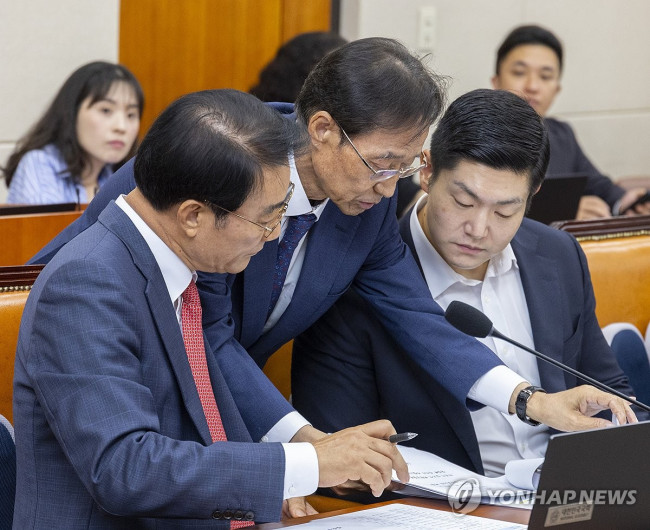 PPP estimates 54 trillion won in losses... to push for parliamentary investigation into leveraged ETFs
Opposition party members and National Policy Committee Chairman Yoo Dong-soo consulting on the processing of proposed bills [Seoul=Yonhap News]On the 3rd, the People Power Party announced, "We will pu
PPP estimates 54 trillion won in losses... to push for parliamentary investigation into leveraged ETFs
Opposition party members and National Policy Committee Chairman Yoo Dong-soo consulting on the processing of proposed bills [Seoul=Yonhap News]On the 3rd, the People Power Party announced, "We will pu
 27 legal professionals from the Seoul National University Law School class of '76: "The Blue House’s demand for the reappointment of Supreme Court Justices is unjust."
The Supreme Court of Korea [Seoul=Yonhap News] Twenty-seven legal professionals from the Seoul National University College of Law's class of '76 issued a joint statement on the 3rd, criticizing P
27 legal professionals from the Seoul National University Law School class of '76: "The Blue House’s demand for the reappointment of Supreme Court Justices is unjust."
The Supreme Court of Korea [Seoul=Yonhap News] Twenty-seven legal professionals from the Seoul National University College of Law's class of '76 issued a joint statement on the 3rd, criticizing P
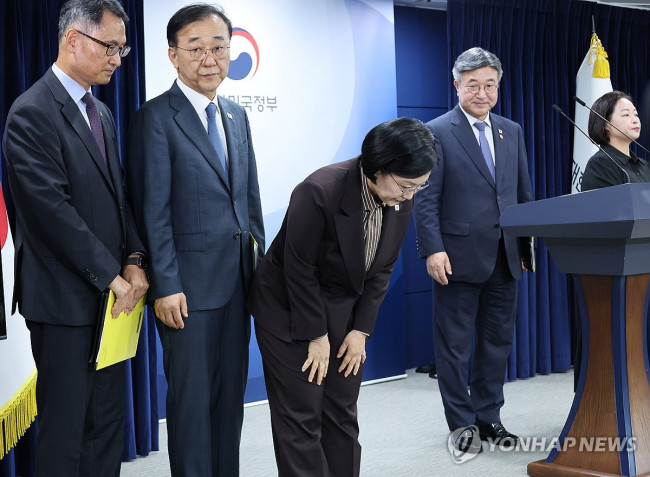 Relocation of Public Institutions to Begin Next Year… "Minimize Retention in Capital Region, Reduce 109 Institutions"
The government will begin the full-scale relocation of administrative and public institutions starting in the first half of next year.It is also launching reforms to reduce the number of public instit
Relocation of Public Institutions to Begin Next Year… "Minimize Retention in Capital Region, Reduce 109 Institutions"
The government will begin the full-scale relocation of administrative and public institutions starting in the first half of next year.It is also launching reforms to reduce the number of public instit
 [New Book] The True Face of the Ivory Tower Hidden in the Shadow of Power… Park Sun-kyung’s ‘Misaki’
The university campus, often called a sanctuary of intellect. A new novel has been published that sharply dissects the hypocrisy and absurdity committed within those solid walls of power. &
[New Book] The True Face of the Ivory Tower Hidden in the Shadow of Power… Park Sun-kyung’s ‘Misaki’
The university campus, often called a sanctuary of intellect. A new novel has been published that sharply dissects the hypocrisy and absurdity committed within those solid walls of power. &
 [Photo] “We Oppose the Closing of the Military Academy”… Large-Scale Protest Held in Front of the War Memorial on the 26th
The "National Solidarity for Preventing the Closure of Military Academies" held a rally to protest the closure of military academies at the plaza in front of the War Memorial of Korea in Samgakji, Seo
[Photo] “We Oppose the Closing of the Military Academy”… Large-Scale Protest Held in Front of the War Memorial on the 26th
The "National Solidarity for Preventing the Closure of Military Academies" held a rally to protest the closure of military academies at the plaza in front of the War Memorial of Korea in Samgakji, Seo
 [Trending Destinations] The Leisure of Seoul's Hangang Bus and the Romance of Hong Kong's Star Ferry
Hannam Bridge viewed from the Hangang Bus. [Video = Reporter Lim Yo-hee]With the introduction of the Hangang Bus, Seoul—which previously lacked sufficient water-based public transport—has gained a
[Trending Destinations] The Leisure of Seoul's Hangang Bus and the Romance of Hong Kong's Star Ferry
Hannam Bridge viewed from the Hangang Bus. [Video = Reporter Lim Yo-hee]With the introduction of the Hangang Bus, Seoul—which previously lacked sufficient water-based public transport—has gained a
 [Issue Commentary] 3 Reasons Why the Lee Jae-myung Trial Must Proceed
 [Editorial Cartoon] A Draconian Law That Undermines Freedom of Expression

 List
List